George Soros gave Ivanka's husband's business a $250 million credit line in 2015 per WSJ. Soros is also an investor in Jared's business.

Thursday, August 5, 2021

FDA ignored 2400+ clinical trials that broke its reporting “rules,” never levied a fine or other enforcement action. “That the US Government cannot comply with its own laws is particularly concerning”-Lancet, Jan. 2020

Our study has identified over 2,400 trials breaching the rules, but to our knowledge the FDA has never levied a single fine or other enforcement action.”…Lancet study, Jan. 2020

“January 2020 is the third anniversary of the implementation of the new US regulations that require clinical trials to report results within one year of completion (Final Rule of the FDA Amendments Act)—but compliance remains poor, and is not improving, with US Government sponsored trials most likely to breach.

Less than half (41%) of clinical trial results are reported promptly onto the US trial registry, and 1 in 3 trials remain unreported, according to the first comprehensive study of compliance since new US regulations came into effect in January 2017.

The findings, published in The Lancet, indicate that trials with non-industry sponsors (such as universities, hospitals, and governments) are far more likely to breach the rules than trials sponsored by industry—with US Government sponsored trials least likely to post results on time at the world’s largest clinical trial registry, ClinicalTrials.gov.

It has been known for several decades that the results of are often not fully reported. To improve , and limit selective publishing of results, the US Food and Drug Administration Amendment Act (FDAAA) of 2007 requires sponsors of most US-regulated clinical trials to register and report results on ClinicalTrials.gov within 12 months of primary completion, irrespective of whether the results are positive or negative.

A subsequent ‘Final Rule’ to the Act took effect in January, 2017. This introduced clearer reporting requirements including fines of up to US$10,000 a day for non-compliance (now US$12,103 inflation adjusted). National Institute of Health (NIH) leaders said that the Final Rule would result in “rapid increases” in the percentage of trials registered and shared on the US registry.

The authors say that the high rates of non-compliance found in the new study likely reflect the lack of enforcement by regulators, and they call for trial sponsors to be held to account by the FDA.

“Patients and clinicians cannot make informed choices about which treatments work best when trial results are routinely withheld. Clinical trials are not abstract research projects: they are large, expensive, practical evaluations that directly impact on patient care by informing treatment guidelines and evidence reviews.” says Dr. Ben Goldacre from Oxford University, UK, who led the research.

He continues: Sponsors are breaching their legal obligations, but also their ethical obligations to the patients who generously participate in clinical trials. Our study has identified over 2,400 trials breaching the rules, but to our knowledge the FDA has never levied a single fine or other enforcement action, despite all the levers available to them. Compliance will only improve when action is taken.”

Non-reporting of clinical trial results has been well documented since the 1980s, especially those trials finding no evidence of effectiveness for the treatment being tested. However, failing to disclose trial results threatens the integrity of the evidence base of all clinical medicine, breaches participants’ trust, and wastes valuable research resources.

The first trials covered by the Final Rule were due to report in January 2018. To investigate the extent of compliance with these new reporting requirements, the researchers examined all 4,209 trials registered on ClinicalTrials.gov that were legally required to report results between March 2018 and September 2019. They also assessed trends in compliance, factors associated with compliance, and ranked individual sponsors according to their level of compliance.

Of the completed trials included in the study, around half (52%; 2,178) had non-industry sponsors, most involved a drug intervention (71%; 2,968), and most were solely conducted in the USA (71%; 3,000).

Analyses found that only 41% (1,722/4,209) of completed clinical trials reported results within the one year legal deadline, whilst 36% (1,523/4,209) still had not been reported by September 16, 2019. Moreover, progress has stalledthe proportion of compliant trials has remained stable since July 2018. The median delay from completion to submitting results was 424 days–59 days higher than the legal reporting requirement of one year (figure 1).

Trials with an industry sponsor were much more likely to comply with the law than those with a non-industry or US Government sponsor (50% vs 34% vs 31% trials submitted in time). Better performance was also seen among sponsors with more experience of running large numbers of trials, when compared with those who have only ever run a very small number of projects (66% vs 21% trials submitted in time). Encouragingly, the authors say, this suggests that “research experience and robust internal governance processes can contribute to improved performance.”

Further analyses estimate that had the law been strictly enforced, over US$4 billion in fines could have been collected up to the end of September 2019.

“Over four decades since non-reporting of clinical trials was first reported, it is disappointing to see that we have only progressed to legislation being passed, and then largely ignored, says co-author Nicholas DeVito from the University of Oxford, UK.

The fact that the US Government cannot comply with its own laws is particularly concerning.”

He continues:Until effective enforcement action is taken, public audit may help. We have established an openly accessible public website at fdaaa.trialstracker.net where fresh data on compliance with FDAAA will be posted every day, identifying each individual overdue trial, and compliance statistics for each individual sponsor. We hope this will help to incentivise sponsors, and provide useful targeted information for all those who aim to comply with the law.”

The authors note that they only examine the availability of results on ClinicalTrials.gov as required by the law, and not the quality of the results or their availability elsewhere.

Writing in a linked Comment, lead author Dr. Erik von Elm (who was not involved in the study) from the University of Lausanne in Switzerland points out that, “any law is only as good as its enforcement”, adding that, “if this rule were to be enforced, academic sponsors would probably make substantial efforts to reduce the number of non- or late-reported and to improve data quality. Training, auditing and incentive mechanisms could be overseen by dedicated staff. A senior “transparency officer” versed in trial conduct and reporting could take a proactive mentoring role and help investigators overcome barriers that currently prevent them from timely reporting of trial results in registries. If completeness of reporting was a criterion in individual academic evaluations, this could have a considerable “signalling effect” within the local research community.””

……………………………..

Added: Lancet article on lax clinical trial reporting cited above:

2/1/2020, Compliance with legal requirement to report clinical trial results on ClinicalTrials.gov: a cohort study,thelancet.com

………
Published:January 17, 2020, DOI:https://doi.org/10.1016/S0140-6736(19)33220-9
…….
Summary
……
Background
……..
Failure to report the results of a clinical trial can distort the evidence base for clinical practice, breaches researchers’ ethical obligations to participants, and represents an important source of research waste. The Food and Drug Administration Amendments Act (FDAAA) of 2007 now requires sponsors of applicable trials to report their results directly onto ClinicalTrials.gov within 1 year of completion. The first trials covered by the Final Rule of this act became due to report results in January, 2018. In this cohort study, we set out to assess compliance.
……..
Methods
……..
We downloaded data for all registered trials on ClinicalTrials.gov each month from March, 2018, to September, 2019. All cross-sectional analyses in this manuscript were performed on data extracted from ClinicalTrials.gov on Sept 16, 2019; monthly trends analysis used archived data closest to the 15th day of each month from March, 2018, to September, 2019. Our study cohort included all applicable trials due to report results under FDAAA. We excluded all non-applicable trials, those not yet due to report, and those given a certificate allowing for delayed reporting. A trial was considered reported if results had been submitted and were either publicly available, or undergoing quality control review at ClinicalTrials.gov. A trial was considered compliant if these results were submitted within 1 year of the primary completion date, as required by the legislation. We described compliance with the FDAAA 2007 Final Rule, assessed trial characteristics associated with results reporting using logistic regression models, described sponsor-level reporting, examined trends in reporting, and described time-to-report using the Kaplan-Meier method.
……..
Findings
……..
4209 trials were due to report results; 1722 (40·9%; 95% CI 39·4–42·2) did so within the 1-year deadline. 2686 (63·8%; 62·4–65·3) trials had results submitted at any time. Compliance has not improved since July, 2018….
……….
Interpretation
……
Compliance with the FDAAA 2007 is poor, and not improving. To our knowledge, this is the first study to fully assess compliance with the Final Rule of the FDAAA 2007. Poor compliance is likely to reflect lack of enforcement by regulators. Effective enforcement and action from sponsors is needed; until then, open public audit of compliance for each individual sponsor may help. We will maintain updated compliance data for each individual sponsor and trial at fdaaa.trialstracker.net.
……
Funding
……
Laura and John Arnold Foundation.”
………


............

Wednesday, August 4, 2021

Soviet style law allowed Calif. Gov. Newsom to forbid hospitals from performing heart valve replacements, tumor removals and colonoscopies. Hospitals were empty so Stanford Health Care cut wages by 20%-4/24/2020

Hospitals such as Stanford shut down elective surgeries “under a state [of California] mandate to prepare for a surge of COVID-19 patients, but on Wednesday [4/22/20] Gov. Gavin Newsom relaxed some of those restrictions, allowing for procedures such as heart-valve replacements, tumor removals and colonoscopies.”

4/24/2020, Stanford Health Care to cut workers’ wages by 20%,” Palo Alto Weekly, Sue Dremann

“Hospital claims cuts are necessary due to COVID-19 economic impact,”

Stanford Health Care is reducing its employees’ pay by 20% starting April 27, [2020] leaving many workers stunned by the announcement.

Employees of Stanford Health Care, including doctors, nurses and technicians who are caring for COVID-19 patients, will have their pay reduced by up to 20% starting Monday, April 27, for 10 weeks, according to a tip sheet the organization sent to workers on April 21.

The medical center briefly stated it was making the cuts due to the economic impacts of COVID-19 on the organization instead of laying off employees. The “temporary workforce adjustment” program was created as part of the hospital’s “cost-saving measure and initiatives,” hospital administrators stated. The pay reductions will apply to all employees at Stanford Hospital, Lucile Packard Children’s Hospital Stanford and, in the East Bay, Stanford-ValleyCare. Asked if the cuts included to doctors’ salaries, hospital spokeswoman Lisa Kim reiterated the cuts are “across the board.”

The employees can choose to lose pay but continue to work full-time, or work fewer hours while taking paid time off in full-day increments, or work fewer hours but take up to 96 hours of flex time as time off. If they are not eligible, they can take unpaid time off. The hospital will offer tips on how to file for unemployment insurance.

Employees were stunned by the announcement. The pay cuts will be an economic burden for many employees, said Linda Cornell, a 40-year employee and unit secretary who works at a nursing station as a sort of “air traffic controller” for the unit. There’s also concern it could affect patient care, she added.

It’s just crazy. The governor was saying that we had the highest death rate (of COVID-19 patients) yesterday, and here they want to cut staff. I’ve never seen anything like this,” she said.

CEO David Entwistle has indicated in earlier news reports that emergency room visits at Stanford Hospital is down 40%, hospital spokeswoman Lisa Kim said.

In a statement, Stanford said in part: “Stanford Health Care is navigating the unprecedented economic impact of COVID-19 and, as part of this effort, is implementing a temporary reduction in hours across the organization. The current pandemic has affected many organizations globally, and we are no exception. This is a difficult but necessary decision to sustain the long-term health of the organization so we can continue to provide critical services to the community.”

In another statement issued Monday, April 27, the medical center said the workforce adjustment is limited to the 10-week time period.

“Current reduced volumes (of patients) make it possible to implement this program at present. We anticipate that when the current shelter-in-place order is lifted, our patient volumes will return.

Hospitals such as Stanford shut down elective surgeries, a large source of revenue, under a state [of California] mandate to prepare for a surge of COVID-19 patients, but on Wednesday Gov. Gavin Newsom relaxed some of those restrictions,

allowing for procedures such as heart-valve replacements, tumor removals and colonoscopies.

In the meantime, many employees will face economic hardship.

Many have already taken or used up paid time off to care for their children because schools and day care centers have closed.

Although workers can use up to 120 hours of additional paid time off, they would have to pay that money back or take time off without pay, she said.

“Some families will never be able to accrue enough money to pay that back,” she said, with many employees earning $50,000 or less….

The hospital still has to keep things running, she said. She fears that patients will receive a lower quality of care with fewer staff on duty because they can’t get to a lot of things….

In its statement, Stanford Health Care refuted the notion that the cuts would impact care.

“This measure will not impact any of our operations. We continue to provide the safest, highest quality care for our patients and remain dedicated to pioneering research and effective clinical therapies to address this evolving situation…” the hospital administration stated.

Steve Trossman, a spokesman for the Service Employees International Union-United Healthcare Workers, which represents many Stanford employees, said hospital administrators notified the union of the plan less than a week before the announcement but refused to negotiate.

Addressing Stanford’s employee-labor relations executives in an open letter, 16 employees — including unit secretaries, nursing assistants, technicians and others — said that they are dismayed by the hospital’s actions.

“Stanford Health Care is now turning its back on front-line health care workers and refusing to acknowledge our input when it comes to furloughs. Your refusal to work collaboratively and negotiate is extremely disrespectful to all of us who have been coming to work every day, often without proper protection, putting our lives at risk to care for patients,” they wrote.

“You’ve presented your furlough plan as a ‘shared sacrifice as if this extreme measure has the same impact on the CEO who makes over $3 million/year and a housekeeper or a nursing assistant who struggle to pay rent and feed our family in the Silicon Valley on $60,000 or $70,000 a year. This shows a stark lack of empathy and understanding for the reality of our lives.”

The letter asks the hospital to reconsider. The employees propose the hospital tier its approach to cutting costs by exempting the lowest paid workers and reducing the burden on employees earning less than $100,000 a year.

Among other requests, they also ask the hospital to ensure that no workers lose or pay more for health benefits. They also ask the hospital to explain the reasoning behind the furloughs, including how much money the hospitals are actually losing as a result of COVID-19 and how much Stanford Health Care will receive in federal stimulus funds included in the CARES Act and its recent supplement.

In its April 27 statement, Stanford said union-represented employees will also participate in the temporary workforce adjustment in accordance with the terms and conditions of their collective-bargaining agreements.

“At present, over 99% of all our employees have chosen to use the paid time off option,” Stanford said.”

……………………………………..

14 among comments

……………………………………..

Gwen
Greene Middle School
on Apr 25, 2020 at 12:22 pm

While I am not surprised at the typical corporate knee jerk reaction of cutting off your nose to spite your face at the first sign of decline in profits, I cannot help but call out the root of the problem here.

This is happening because the only people who are getting healthcare are the small fraction of population who have Corona. And even most of them are being sent home.

Everybody else who is not dying is not getting the healthcare they need. We’ve got a slew of “ experts” whose models have consistently been incorrect and government who continues to behave as though they were right.

Since when does a Government know better how to manage an outbreak than the healthcare system that is managing it? Most people are not aware that the data is also being controlled.

Test kits are being allocated in small batches, forcing hospitals to ration testing. This causes a complete distortion of the prevalence and risk of this virus.

We prevent spread of blood borne pathogens by preventing exposure to blood. We prevent spread of droplet pathogens by preventing exposure to droplets. If we could learn from the past we would set up quarantine and isolation units for people affected by this virus and allow healthcare to continue caring for people that don’t have it.”

………………………………………..

“Also local
Downtown North
on Apr 25, 2020 at 2:41 pm

People in Palo Alto need to wake up to what is going on in the rest of the country!! Hospitals everywhere are laying off staff and cutting salaries dramatically! From full layoffs to cutting hours and salaries for ALL EESincluding doctors – by 30-50%. Other employers are cutting staff and for the EES who are still working, but at home, are taking 20-30% cuts in pay.”

……………………………………………

“Your doctor
Old Palo Alto
on Apr 25, 2020 at 4:09 pm

…………………………………………..

Dan
Professorville
on Apr 25, 2020 at 9:57 am

I think the anger here against Stanford hospital is misplaced. They are at the end of the day running a business.

Our [state] government mandated that they shut down perhaps 75 percent of their revenue by making it illegal for Stanford to perform non emergency procedures. I don’t know the exact number, but it’s in this magnitude.

So why do you blame Stanford that when revenue drops massively they have to trim costs. How about blaming Newsom et al that mandated Stanford to shut down. And it turns out unnecessarily so, based on flawed models.

Oh and the government mandate to shut down elective procedures has also cost lives. Deferred cancer treatments heart surgeries etc will also have killed people.

The net is it’s easy to blame Stanford. But it’s not their fault, they don’t have a choice, they are following orders from the Governor and local public health department and dealing with the consequences of those orders.”

…………………………………………

JR

Palo Verde
on Apr 25, 2020 at 8:02 am

As of last report, Stanford was sitting on a $27.7 billion endowment (maybe this has dropped a bit recently due to stock market declines). So here we have a “non-profit educational organization” with a $27.7 billion endowment that is nickle and diming healthcare workers.”

………………………………………

Something is not right
another community
on Apr 24, 2020 at 11:16 pm

This is wrong. I think we overdid it with closing too many things down as a result of covid-19, including health care procedures and appointments. This does not make sense. How did this happen? And why are they cutting pay? Isn’t there some other possible solution? This is going to be a huge cost to everyone, including patients.”

………………………………………….

Local Healthcare Worker
Another Palo Alto neighborhood
on Apr 24, 2020 at 11:13 pm

Employees at Stanford Children’s Hospital are being instructed to reduce their hours by 40%. Some departments, like mine, were not significantly impacted by the virus and are still caring for the same number of patients. I don’t understand how these measures would “not impact any of our operations”. How can we “continue to provide the safest, highest quality care for our patients” when some departments are now understaffed due to these across-the-board cuts?”

………………………………………….

“Stanford Patient
Menlo Park
on Apr 25, 2020 at 10:42 pm

I am a regular Stanford patient in several different departments (some of which are not seeing patients right now). No staff should be furloughed or have pay cut. This is so crappy! Many of these people live pay check to pay check.”

………………………………………..

Thomas, pediatrics
Mountain View
on Apr 27, 2020 at 9:01 am

The governor should not get to say what procedures can and can’t be done. If we’re safe and have no issues with service, stay out of it.”

……………………………………….

Concerned

Midtown
on Apr 26, 2020 at 3:28 pm

The article posted here has some correct information but there are departments in the hospital that have been working on a 20% reduction for the last six weeks already and now are going to a 40% reduction with forced PTO to be taken. With no chance of making up hours any other way. These are workers on the front lines caring for our patients and their families.”

………………………………………………

chris
University South
on Apr 25, 2020 at 11:40 pm

Let’s see how much money from the Feds sticks with Stanford Health Care.

Trump twisted Stanford’s arm to not accept the money that was in the CARES Act for them. He may force Stanford Health Care to not accept Fed money either.”

……………………………………..

Witheld
Midtown
on Apr 26, 2020 at 1:37 pm

I went to the ER twice in the last month for an acute non-C19 problem that ended up needing an overnight stay and a surgical procedure to correct….

They are fully staffed, fully equipped and have well thought out and effective C19 controls in place. (dedicated hot zone for C19 patients, everyone gets a mask even outsize. Everyone admitted gets a C19 test — with results in 45 minutes for screening, etc. etc.)...It is night and day difference from the scenes of horror we are getting from the east coast….

But they are, in fact, lacking in patients. All elective/non-urgent procedures are getting postponed. Even a lot of urgent situations are being (sometimes tragically) postponed by patients due to fear of C19. I know because I was one of them….

I had laproscopic surgery at 9am and was discharged at 2pm the same day. But if I had waited much longer, it could have very easily become life or death serious….If you have a small problem and really aren’t sure if you should wait or go in, call or text your GP and ask!”…

…………………………………………………..

Iron Man 2
Midtown
on Apr 26, 2020 at 8:46 am

Everyone should take their comments to twitter in response to this article. This is an echo chamber and has very little impact.

It is unacceptable that Stanford Healthcare would be applauding healthcare workers and at the same time cutting salaries by 20% and likely that cuts will get worse. Weblink to the report on Twitter is below Web Link.”

………………………………………

Not the University
Another Palo Alto neighborhood
on Apr 27, 2020 at 12:43 pm

Some comments reference the University’s endowment, but Stanford Health Care and Stanford Children’s (Packard) are NOT part of the University and don’t have access to those funds.”…

…………………………..

………………………….

Added: California Gov. Newsom eases ban, says hospitals can now do “heart-valve replacements, angioplasty, tumor removal and colonoscopies”:

4/22/21, In hopeful sign, state rolls back ban on some elective surgeries,” Palo Alto Weekly, Sue Dremann

“Newsom announces that hundreds of thousands of swabs are on their way, to aid in [PCR] coronavirus testing.”

“Gov. Gavin Newsom took the first step in rolling back some restrictions on his stay-at-home order on Wednesday by announcing that hospitals could now start doing some elective surgeries. He cautioned, though, that the small step is just that: one piece in a series that will unfold only as health authorities feel they have made progress on controlling the spread of the COVID-19 disease.

Elective surgeries such as heart-valve replacements, angioplasty, removing tumors and performing colonoscopies, which were deferred as the state’s health care delivery systems prepared for a surge of COVID-19 patients, may proceed. The restrictions are being eased based on progress the state has made toward preparing hospitals to handle COVID-19 patients, he said.

As painful as continuing the shutdown is socially, economically and emotionally, state leaders warned they will not push the boundaries before the number of COVID-19 patients shrinks. The state will also need adequate safeguards in place: higher levels of testing, tracking of patients, and personal protective equipment such as masks. All currently remain in short supply, Newsom said.

“Normalcy needs to be guided on slowing the spread. We’ve tried to make that clear. There is no light switch, no date….We are not prepared to reopen large sectors of the community,” he said.

Testing is the most important factor in getting the state to reopen, he said. The state can’t consider lifting its stay-at-home order until it has completed much more testing and contact tracing. The latter follows up with whoever has been in contact with a COVID-19 patient and those people are tested, he said. 

After weeks of lagging testing, the state received some good news. It will now receive hundreds of thousands of swabs, which will allow testing for the coronavirus on a much larger scale, a prerequisite to any normalizing of the economy and society, he said.

Newsom said he spoke with President Donald Trump at around 11 a.m. Wednesday. Trump said the state will receive 100,000 swabs this week, 250,000 by next week and a “substantial increase” by the third week. Each swab represents another person who can be tested, Newsom added. With an abundance of swabs, the state could test up to 400,000 to 500,000 people weekly…. 

Ultimately, the state hopes to test 80,000 people each day using the polymerase chain reaction (PCR) test, which detects the presence of the virus in nasal and throat sputum. 

The testing has been mired in shortages of components for taking and preserving the samples, the latest being the swabs. At each step, public health staff have had to resolve missing or deficient quantities of reagent, viral transport media for fixing the samples in test tubes and other supplies, he said. While those bottlenecks continue, in some areas it is improving, he said. A dearth of swabs has been the latest hiccup, however. 

The governor could not say if the troublesome supply chain would be permanently fixed. The state can only conduct more tests if the availability of the supplies doesn’t slip backward….

Newsom said public health leaders are therefore looking at building “an army of tracers,” as many as 10,000 people [to be paid for by US taxpayers], who will help with tracing and tracking people who have had the disease [does this include people who’ve merely “tested positive” by PCR test?] and the people with whom they have been in contact. The state also is working with Google and Apple to develop smartphone apps for symptom tracking to aid in contact-tracing efforts.

Public health administrators will develop protocols for how to isolate and quarantine those who are still actively infectious.

In addition to the swab tests, the state has the capacity to perform 1.5 million serological, or blood, tests, which identify antibodies for the virus. These tests help health officers to understand the prevalence of the disease across California and where they might focus efforts to corral the disease. It’s still not clear whether the antibodies neutralize the disease and give a person immunity or if patients could become reinfected and pass on the disease to others, Ghaly said.

He reiterated Newsom’s call for a phased-in approach to reopening the state based on data and the availability of protective gear.

“It’s not a switch; it’s a dimmer,” he said.We need significant amounts (of protective equipment and testing) before we can move forward on any plans.”

The state also is focusing on creating “hubs” for testing, such as in skilled-nursing facilities and communities of color. The state is advancing an egalitarian response to the virus by opening 86 testing sites in rural areas and communities of colorso-called “testing deserts,” Newsom said.

Cody, said that testing has been “like a crazy quilt,” with a shifting pattern of multiple factors contributing to the problem. On the local level, besides the dearth of kits, she’s been bombarded by everyone offering the next test and the next new test.

The county also is dependent on state and federal resources, with many moving parts.

“The challenge as of today is that some labs have excess capacity (to do testing) and there are places where there’s an unmet need,” she said, echoing a goal Newsom also outlined in his briefing.

“We have to figure out how to match those two things up,” she said.”

………………………………

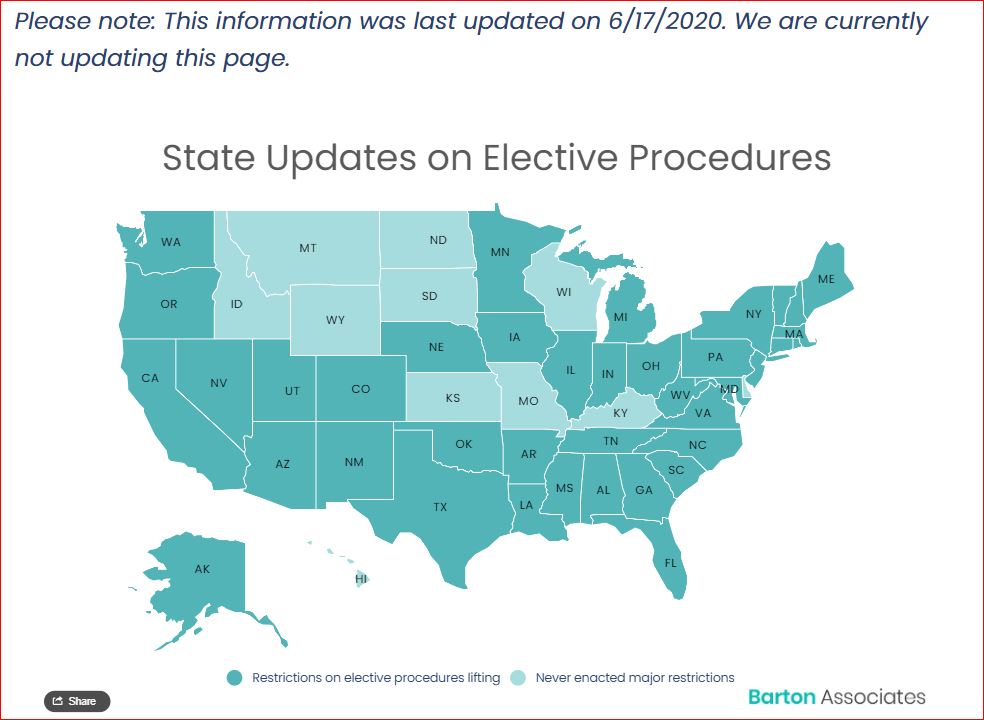
Added: States Lifting Bans on Elective Procedures [COVID-19],as of 6/17/2020

While the COVID-19 pandemic has caused certain states to ban hospitals and other medical facilities from performing elective procedures, we are now seeing some of these bans starting to lift.  Originally intended to help dedicate resources to fighting the virus, the bans will no longer be in effect in the following states. Read on for details:”…Barton Associates


....................

Two vaccinated NY Yankee starting pitchers test positive for Covid, will be out of Yankee lineup for at least ten days-Aug. 3, 2021

Both pitchers, who are vaccinated, are expected to be out at least 10 days — unless they test negative twice before then — plus however much time they might need to get their arms back in game condition….We kind of thought when we got the vaccines we wouldn’t have to deal with this quite as much and here we are,said [pitcher Jameson] Taillon, who tested negative Monday night. “The breakthrough cases are real. At least these guys are feeling all right.”

August 3, 2021, Jordan Montgomery tests positive for COVID-19 after Gerrit Cole," NY Post, Greg Joyce

A day after Gerrit Cole tested positive for the virus, Jordan Montgomery also tested positive, manager Aaron Boone revealed Tuesday before the Yankees hosted the Orioles in The Bronx.

Boone said no other players would be unavailable because of contact tracing, as of Tuesday afternoon, and “the hope” was that the spread would be contained to Cole and Montgomery, unlike the two other outbreaks the Yankees have experienced this season.

Both pitchers, who are vaccinated, are expected to be out at least 10 days — unless they test negative twice before then — plus however much time they might need to get their arms back in game condition….

Now down three starters — including Domingo German, who hit the injured list Sunday with shoulder inflammation — the only healthy Yankees starters left are Jameson Taillon (who is scheduled to start Wednesday), Andrew Heaney (who was acquired on Friday and made his Yankees debut Monday), Nelson Cortes (who will start Thursday for German) and Gil….

“We kind of thought when we got the vaccines we wouldn’t have to deal with this quite as much and here we are,” said [pitcher Jameson] Taillon, who tested negative Monday night. “The breakthrough cases are real. At least these guys are feeling all right. But we still have to keep showing up and doing our work.”…

“I think everyone can understand, that’s certainly a challenge and difficult,” Boone said. “Certainly feel for Gerrit and Monty in this situation, guys that are obviously in the midst of great seasons for us and integral parts of this team. So feel for them having to go sit out when, generally speaking, they’re feeling pretty well.”…

Cole was experiencing symptoms of a cold on Monday, which is what led to him getting tested, Boone said. The Yankees are not tested regularly because they have at least 85 percent of their Tier 1 personnel vaccinated. But Cole and Montgomery’s close contacts have been tested since their diagnoses.

The Yankees also had six players test positive for COVID-19 coming out of the All-Star break — including Aaron Judge, Gio Urshela and Kyle Higashioka — and Gleyber Torres and seven members of the coaching and support staff tested positive in May. They have since said Torres’ case was a false positive…

Cole, who was scheduled to start Tuesday’s game against the Orioles, was replaced by 23-year-old Luis Gil, who was called up to make his MLB debut.

Boone said he did not know who would take Montgomery’s start on Friday against the Mariners, but said a bullpen game is an option. Deivi Garcia, who has struggled this season at Triple-A Scranton/Wilkes-Barre, would also be on normal rest to start Friday….

The Yankees also have Corey Kluber (shoulder strain), Luis Severino (Tommy John surgery, groin strain), Clarke Schmidt (elbow strain) and Michael King (finger contusion) on the 60-day IL. Severino began another rehab assignment Tuesday with Double-A Somerset, but Boone said he was not an option to make his next start with the Yankees — even an abbreviated one — needing “at least” one more after Tuesday before he returns.

During their most recent outbreak, the Yankees went 5-4 before getting the last of their starting position players back. After getting a brief boost from their trade deadline additions in Anthony Rizzo and Joey Gallo over the weekend, the Yankees will now be shorthanded again as they continue to chase a playoff spot — entering Tuesday three games out of the final AL wild card.”…


 ..........

Sunday, August 1, 2021

When Trump bragged that statues of Jefferson and Washington wouldn’t be harmed on his watch, they had already been torn down. A wimp himself, he flailed that Republicans should “get tougher with mobs”-Carol Brown, American Thinker, 6/26/2020

We expect the government to do its job–and not just any job, but its primary job. Many have commented that Trump is in a difficult position. If he continues down the road of inaction, he looks weak and ineffective (because he is). On the other hand, if he takes bold action and upholds the rule of law, he will be vilified, to which I say: so what? He’s vilified anyway. And if he’s intimidated by this, then he has no business being President of the United States.”

June 26, 2020, Trump promises things won’t happen on his watch that have already happened, American Thinker, Carol Brown

“Increasing numbers of us are frustrated with the lack of action from the President in the face of madness sweeping across the country. Here’s a 48-hour snapshot of words with no results.

On Wednesday [6/24/20], the President promised Americans that statues of Jesus Christ and the Founding Fathers would be protected from destruction. He noted that the mob had set its sights on statues of George Washington and Thomas Jefferson, among others, and that it was “not going to happen as long as I’m here.”

Let’s get a couple of simple facts out of the way first.

Marxists, anarchists, sociopaths, criminals, foreign actors, and braindead brainwashed college-educated lemmings had already desecrated and toppled statues of Washington and Jefferson by the time the President made his statement. Someone might want to bring that to his attention. (here, here, and here)

(6/14/2020, Thomas Jefferson statue in Portland, OR torn down)

In light of his statement, he looked clueless and weak as he continued to make tough talk threats via Twitter (a ridiculous medium for the President to use to address matters of great import) with no follow through. None.

Well, perhaps there’s one exception. When the mob shows up in Washington DC, the (unarmed) National Guard is called in. As it should be. But what about the rest of us dealing with this insanity?

We’re being attacked, and in some cases killed, by evil mobs who roam the streets with impunity, working toward a common goal: the destruction of America.

The madness isn’t just happening in cities. The mob crops up everywhere. (for a couple of examples see here and here; 7:15 mark)

And consistent with communist states, our history is being erased and/or re-written as censorship destroys books, movies, and all manner of communication. Truth-tellers are silenced. Some are punished harshly. An alarming number of people are being fired from their jobs for speaking their minds.

But destruction of one’s career and livelihood is not enough for the insatiable appetite of the mob, as it targets people and threatens to kill their families.

The punishment for living as free-thinking Americans will become even more severe with time–something we’re running out of.

We watch in horror, fear, and confusion as the police do nothing while barbarians loot, vandalize, desecrate, and burn businesses and public property. They tear down statues, block roads, assault people, attack the police, weaponize fireworks, and commit murder. All the while, they scream obscenities as they rattle off a litany of threats and outrageous demands. (This comes on the heels of watching the police arrest people for the crime of going to work or playing in a park with their children during coronavirus lockdowns. And more recently, as the FBI assigned fifteen agents to investigate the Bubba Wallace non-incident.)

We are shocked, stunned, scared, and disgusted. We expect the government to do its job–and not just any job, but its primary job.

Many have commented that Trump is in a difficult position. If he continues down the road of inaction, he looks weak and ineffective (because he is).

On the other hand, if he takes bold action and upholds the rule of law, he will be vilified, to which I say: so what? He’s vilified anyway. And if he’s intimidated by this, then he has no business being President of the United States.

We need strength, conviction, resolve, and bravery, not someone who seems to be clueless or cowering in fear. Acting out of fear is weak, emboldens evil, and hands the left victories.

We must stand up to evil because it is the right thing to do, the American thing to do, and the only thing that affords us a fighting chance. And we must stand up with real action, and not just words.

Speaking of which, the following day, on Thursday [6/25], a leader in the Black Lives Matter movement (aka human shield for Marxists) announced that if their demands aren’t met, they will “burn down this system.”

Using Twitter as him means of communication (ugh),

Trump accused this person of treason, sedition, and insurrection.

Good. But only if action follows.

If the Attorney General doesn’t pursue this immediately and with all the legal force possible that can be brought to bear, then we’ll be left with another heap of meaningless words.

Later the same day [6/25], Trump called on Republicans to “get tougher with the mobs.”

Sure. That would be a good thing.

But Trump is the president. It looked absurd for him to be acting as if he’s done everything possible, and then some, to put an end to this madness and, oh, as an aside, would appreciate it if others in the party would also step up.

But he’s not being tough. He’s spewing a lot of words that, thus far, appear to have no teeth behind them.

To his credit, he did suggest that those perpetrating violence are “terrorists, in a sense.”

Yes, they are! Not “in a sense.” Can we please stop this sluggish attitude toward this rapid-fire pace reign of terror? We need to treat lawless behavior accordingly Immediately. And with force.

Every day that strong action on the part of this administration is withheld, evil grows, gains momentum, and takes root in what may be one of the most defining moments in our nation’s history.

We are in a dire situation, and yet, for whatever reason, Trump seems unwilling to do what needs to be done. The clock is running out as America literally, and figuratively, burns.”


...............

No pregnant or breastfeeding women are included in Pfizer's ongoing Covid trials. How can Pfizer vaccine be approved in fall 2021 when its trials won’t be finished until May 2023?-ClinicalTrials.gov

“Estimated [Pfizer] Study Completion Date: May 2, 2023.”..Excluded from ongoing Pfizer study: Women who are pregnant or breastfeeding."… “FDA officials familiar with the process predict that full approval of at least Pfizer’s vaccine could come in September or October [2021]."…8/1/21, FDA Under Pressure to Grant Full Approval to Covid-19 Vaccines," Wall St. Journal

As of 7/22/21, Study to Describe the Safety, Tolerability, Immunogenicity, and Efficacy of RNA Vaccine Candidates Against COVID-19 in Healthy Individuals, clinicaltrials.gov

“Sponsor: BioNTech SE

Collaborator: Pfizer

Information provided by (Responsible Party): BioNTech SE…
…..
Study Design…
…………
Actual Study Start Date: April 29, 2020
Estimated Primary Completion Date: Nov. 2, 2021
…………
Eligibility Criteria…

Inclusion Criteria:…

Note that participants <18 years of age cannot be enrolled in the EU….

  • Participants who are willing and able to comply with all scheduled visits, vaccination plan, laboratory tests, lifestyle considerations, and other study procedures….
  • Capable of giving personal signed informed consent

Exclusion Criteria:

  • Women who are pregnant or breastfeeding.
  • Previous vaccination with any coronavirus vaccine.
  • Individuals who receive treatment with immunosuppressive therapy, including cytotoxic agents or systemic corticosteroids, eg, for cancer or an autoimmune disease, or planned receipt throughout the study….
  • Phases 1 and 2 only: Known infection with human immunodeficiency virus (HIV), hepatitis C virus (HCV), or hepatitis B virus (HBV).
  • History of severe adverse reaction associated with a vaccine and/or severe allergic reaction (eg, anaphylaxis) to any component of the study intervention(s).
  • Receipt of medications intended to prevent COVID 19.
  • Previous clinical (based on COVID-19 symptoms/signs alone, if a SARS-CoV-2 NAAT result was not available) or microbiological (based on COVID-19 symptoms/signs and a positive SARS-CoV-2 NAAT result) diagnosis of COVID 19
  • Phase 1 only: Individuals at high risk for severe COVID-19, including those with any of the following risk factors:
    • Hypertension
    • Diabetes mellitus
    • Chronic pulmonary disease
    • Asthma
    • Current vaping or smoking
    • History of chronic smoking within the prior year
    • BMI >30 kg/m2
    • Anticipating the need for immunosuppressive treatment within the next 6 months
  • Phase 1 only: Individuals currently working in occupations with high risk of exposure to SARS-CoV-2 (eg, healthcare worker, emergency response personnel)."...

……………………………………….


Followers

Blog Archive

About Me

My photo
I'm the daughter of an Eagle Scout and World War II Air Force pilot born in Brooklyn, finally settling in New Jersey.