George Soros gave Ivanka's husband's business a $250 million credit line in 2015 per WSJ. Soros is also an investor in Jared's business.

Saturday, July 10, 2021

The trouble with Trump insider, “staple a green card” Charlie Kirk-Pedro Gonzalez, American Thinker, 3/13/20….”We should staple a green card” to foreigners’ diplomas: Charlie Kirk, Hillary, Biden, Mitt Romney, Nancy Pelosi

6/29/2016, “Hillary would “staple” a green card to STEM masters and PhDs from accredited institutions-–enabling international students who complete degrees in these fields to move to green card status.”…

2019, “If you graduate from a United States University with a skill, upon graduation we should staple a green card behind your diploma.” Charlie Kirk

More “Staple a Green Card:” Joe Biden, Mitt Romney, Nancy Pelosi: “As we said in 2005 and 2006, “Staple a green card.“

10/30/2019, “I was flabbergasted to hear Turning Point USA founder Charlie Kirk telling students at a university campus lecture last week that “We should staple a green card behind your diploma.” He repeated this nonsense at Ohio State University during a “Culture War” tour stop this week, asserting that any foreign national who graduates from any “four-year college” should get a green card if any “American employer” needs to fill a job.”

…………………………..

Kirk and his associates “have co-opted [with full support of Jared/Trump, Inc.] a movement they, in fact, had no part building.”
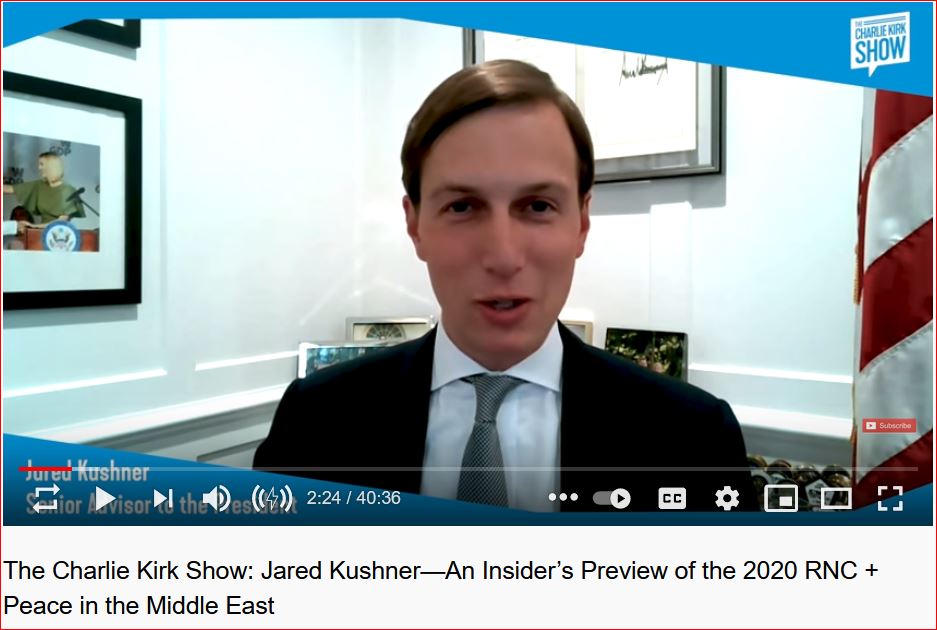
[Image: 8/25/2020, Jared Kushner praises Charlie Kirk while appearing as a guest on Kirk’s radio show (after ads)]

3/13/2020, “The Trouble with Charlie Kirk," Pedro Gonzalez, American Thinker

“Few faces have become so identifiable with support for President Trump as Charlie Kirk’s. Frequently found grinning like a Cheshire cat beneath the gilded wing of this or that member of the Trump family, Kirk brags in his new book that he was “MAGA before it was cool.” Trump has even given Kirk’s book the presidential seal of approval on Twitter [now dead]. There is, however, a small problem with Kirk’s latest claim to fame: it’s a lie.

In an interview with Newsweek last April [2019], Kirk asserted that “he’s been a supporter of Trump’s presidential ambitions since at least 2011.” A few months later, he contradicted himself in an op-ed: “Yes, it’s true, a year before the 2016 election,” he wrote last November [2019], “I was still skeptical that a billionaire from New York City with no real political record was going to be as conservative as some of the other candidates.” The diehard pro-Trump Kirk of 2011 would like a word with the snarky anti-Trump Kirk of 2016.

His go-to response, when called on his contradictions, is some variation of complaining he has been misunderstood, misinterpreted, or “falsely accused.” But can he blame his critics? Even as he beats his chest in the president’s name now, it seems like only yesterday that Kirk was on Fox News, calling Trump “laughable,” mocking him for standing his ground on pro-life issues when pressed during a town hall meeting. Kirk scoffed at a representative of Student’s for Trump who defended Trump on that and other points.

Most importantly, however, is that Kirk’s dishonesty goes beyond fabricating a “MAGA before it was cool” origin story. He is the political used car salesmen of the hour, selling a broken-down neoconservative ride with a new paint job as America First nationalism.

Consider what he wants to sell as “traditional American values.” 

During a speaking event on his “Culture War” tour, Kirk was asked, “how long do we have to wait until child drag shows are pushed as American traditional conservatism?“ Indeed, amid the proliferation of LGBTQ ideology, Kirk doesn’t seem to have a problem with warming up to Lady Maga, “America’s conservative drag superstar.” He deferred on that note to his cohost, Rob Smith, a gay man who recently came out as conservative….

Later, Smith accused another man of being closeted for asking how the promotion of heteronormative sexuality helps win the culture war. “You seem to be really interested in gay sex,” said Smith, “I’m pretty sure if you’re into that you can go find somebody to do it with.” Smith reminded America First nationalists that their values — which some might even call traditional America values — are “behind the times” and, as such, “doesn’t really have any place in the conservative movement.”

Kirk sat smiling beside Smith in apparent agreement.

It is on immigration, however, that the paint on Kirk’s heap wears thinnest.

On another tour stop, Kirk smugly condemned a bronze-skinned, black-haired, brown-eyed student wearing an America First hat of harboring a “racist idea” for asking how we can maintain our conservative ideals when immigrants, and the attendant demographic changes, overwhelmingly favor the Democratic Party. It is a hallmark of the Left, which Kirk is ostensibly at “war” with, to accuse people of racism for asking tough questions.

Elsewhere, Kirk speculated that there are anywhere between 30 and 40 million people worldwide who “should be given a chance to come to America.“ The idea of importing enough people to populate a second California doesn’t faze Kirk. “Fly from Chicago to Reno and tell me that we’re full,” he said, chastising those of us reluctant to surrender our spacious skies and amber waves of grain for smog and urban sprawl. But just in case he didn’t sound inclusive enough, Kirk also declared his support for “unlimited merit visas.”

America, he insisted, ought to hand out an “unlimited amount of ‘genius’ visas,” and there “should be no limitations on EB-5 visas.” 
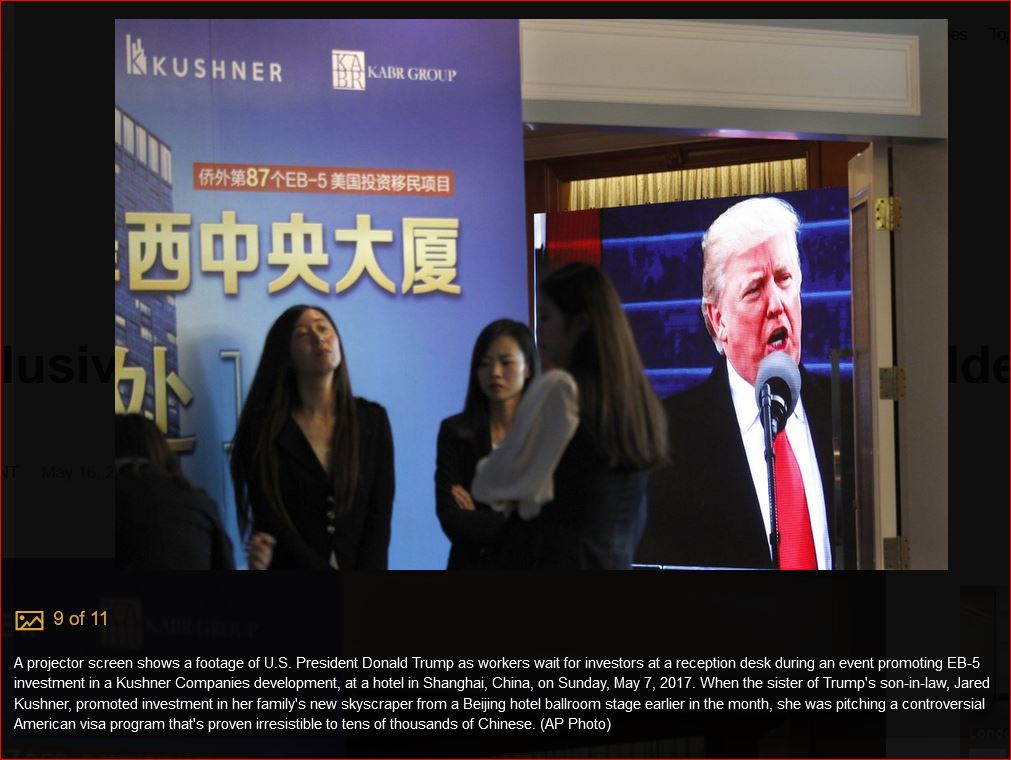
[Image, 5/7/2017, “A projector screen shows a footage of U.S. President Donald Trump as workers wait for investors at a reception desk during an event promoting EB-5 investment in a Kushner Companies development, at a hotel in Shanghai, China, on Sunday, May 7, 2017. When the sister of Trump’s son-in-law, Jared Kushner, promoted investment in her family’s new skyscraper from a Beijing hotel ballroom stage earlier in the month, she was pitching a controversial American visa program that’s proven irresistible to tens of thousands of Chinese. (AP Photo)”]

The EB-5 Investor Program is a legalized bribe-for-green-card scam that is rife with fraud, with the added negative of importing a wealthy Chinese elite to America –– people who Kirk called “adversarial” at a recent Florida State University talk. From 2012-2018, around 80 percent of these visas went to people from China, according to the Center for Immigration Studies (CIS). “America can benefit from genuine ‘Einstein immigration,'” writes Mark Krikorian, Executive Director of CIS, “the arrival of world-class talents who are at the top of their fields. But there’s not that many people like that, and we currently pretend that many ordinary workers are best-and-brightest immigrants.” An analysis of data from the Program for International Assessment of Adult Competencies by CIS found that “immigrants with foreign degrees perform substantially worse than U.S. degree holders on tests of literacy, numeracy, and computer operations.”

It’s not uncommon for immigrants with foreign college degrees to have skills that are in reality on par with those of Americans holding a high-school diploma. Nevertheless, this is [Charlie] Kirk’s idea of “merit-based” immigration. To limit or eliminate fundamentally flawed programs like the EB-5 visa, said Kirk, is “one of the most backwards, stupid things we could possibly do.” The Chinese couldn’t agree more.

The pushback against unlimited visas for the “best and brightest,” and millions of more immigrants in general, has since come like a mighty river — from Kirk himself. “I believe in less legal and illegal immigration,” he told Ben Shapiro in an interview recently. But how to square that with his other recent declaration: “I don’t believe that the conservative movement, and some people believe this,” he said, “should become an anti-legal immigration posture.” Evidently, “some people” includes the most recent, anti-legal immigration iteration of Charlie Kirk, for however long that lasts. My guess is not very long.

In his new book, reviewed in Spectator USA, Kirk yearns for the “day when the entire apparatus of the modern welfare state has been turned into private and voluntary services, the United States can afford to let in everyone –– everyone who abides by the rules of the marketplace and pays their own way.” Kirk does not envision a real place that is home to a real people with real culture, but an open-air multicultural bazaar in a territory formerly known as the United States of America.

The idea that America is or ought to be “an economy with a country, not a country with an economy,” is a Cato Institute talking point that would put a smile on the face of the Koch organization, which pays to keep their lights on. Unfortunately for Kirk, America is, as Teddy Roosevelt said, “a nation — not a polyglot boarding house” or a mere marketplace. 

Dishonesty and inconsistency wouldn’t be a problem for anyone but Kirk, were it not for the fact that he is a self-declared fixture of the “intellectual foundation” of the America First movement. The real trouble, then, is that Kirk and his associates effectively function as gatekeepers.

They have co-opted [with full support of Jared/Trump, Inc.] a movement they, in fact, had no part building.

Now they’re restraining the America First anti-establishment direction by accommodating what is essentially the status quo on important issues such as immigration, while denouncing dissidents as racists and bigots —the same slurs hurled by the Left.

The policies favored by Kirk are fundamentally flawed, hurt American workers most of all, and fuel support for candidates like Bernie Sanders. It was, after all, the disaffected Middle American, working-class demographic feeling left behind by big business GOP policies that carried Trump to the White House [in 2016].

What Kirk is offering is the same bad deal against which they revolted in 2016.

If America First nationalists intend to put some real miles on this movement, it ought to send the junker Charlie Kirk is trying to sell them back to the scrapyard where it belongs.”

…………………………………….

“If you would like to comment on this or any other American Thinker article or post, we invite you to visit the American Thinker Forum at MeWe. There, you can converse with other American Thinker readers and comment freely (subject to MeWe’s terms of use). The Forum will be fully populated and ready for comments by midday (Eastern time) each day.”

……………………………………….

Added: “Liberals know which politics threatens their hegemony. They don’t care about standard-issue, old-school conservatives: Mitch McConnell or Mitt Romney. They can beat those in their sleep. They’re petrified of GOP adopting working-class, anti-imperialism, anti-corporatist politics:” Glenn Greenwald:
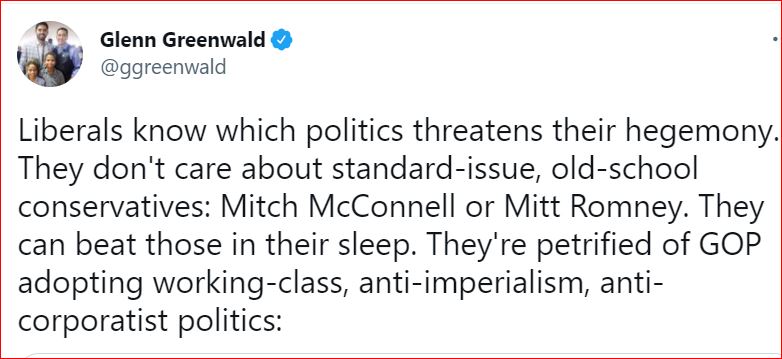
Above, July 9, 2021, Glenn Greenwald twitter

…………………………………………..

Added:

Above, 5/7/2017, “A projector screen shows a footage of U.S. President Donald Trump as workers wait for investors at a reception desk during an event promoting EB-5 investment in a Kushner Companies development, at a hotel in Shanghai, China, on Sunday, May 7, 2017. When the sister of Trump’s son-in-law, Jared Kushner, promoted investment in her family’s new skyscraper from a Beijing hotel ballroom stage earlier in the month, she was pitching a controversial American visa program that’s proven irresistible to tens of thousands of Chinese. (AP Photo)”

May 16, 2017, “AP Exclusive: Kushners tap China’s $24B ‘golden visa’ market," AP, Nomaan Merchant, Beijing

When the sister of President Donald Trump’s son-in-law Jared Kushner promoted investment in her family’s new skyscraper from a Beijing hotel ballroom stage earlier this month, she was pitching a controversial American visa program that’s proven irresistible to tens of thousands of Chinese.

More than 100,000 Chinese have poured at least $24 billion in the last decade into “golden visa” programs across the world that offer residence in exchange for investment, an Associated Press analysis has found. Nowhere is Chinese demand greater than in the United States, which has taken in at least $7.7 billion and issued more than 40,000 visas to Chinese investors and their families in the past decade, the AP found.

The Chinese investors flocking to these programs are people like Jenny Liu, a doctoral student in the eastern city of Nanjing, who sold her apartment two years ago and moved in with her parents. She used the money from the sale to invest $500,000 in a hotel project in the United States. If the project creates enough jobs in two years, she’ll get a prized “green card” and a pathway for a less stressful education for her 9-year-old son.

“My son has a lot of homework to do every day, but I don’t think he has learned a lot from school,” Liu said. “I hope he can actually pick up some useful knowledge or skills rather than only learn how to pass tests.”

The flood of investors reflects how China’s rise has catapulted tens of millions of families into the middle class. But at the same time, it shows how these families are increasingly becoming restless as cities remain choked by smog, home prices multiply and schools impose ever-greater pressure on children. They also feel insecure about being able to protect their property and savings.

Their money goes toward government bonds, businesses, mountain ski resorts, new schools and real estate projects, including a Trump-branded tower in New Jersey built by the Kushner Companies, once run by Jared Kushner, now a White House senior adviser. But the industry is murky, loosely regulated and sometimes fraud-ridden — in the U.S., federal regulators have linked the EB-5 visa program to fraud cases involving more than $1 billion in investment in the last four years.

Despite criticism from Congress, Trump signed a spending bill that included a renewal of the program through September,

although federal authorities have proposed more than doubling the minimum investment. Just one day later, Kushner’s sister, Nicole Meyer, was in Beijing courting Chinese for a new project funded by EB-5. That’s raised complaints about conflicts of interest and new calls to revise or even end the program.

“It is a growing industry and we do need more oversight,” said Stephen Yale-Loehr, an expert on the program and a professor at Cornell Law School. “EB-5, when it is done properly, can and does benefit the economy.”

THE LURE OF A GOLDEN VISA

The number of Chinese using investment migration programs worldwide tripled between 2010 and 2015, the AP found among the countries in its survey . In the last decade, Chinese have taken 75 percent of the investor visas issued by the United States, 70 percent for Portugal and 85 percent for Australia. China also remains the top recipient of investor visas in Canada, the United Kingdom, New Zealand, Spain, Hungary and Malta.

To be sure, those migrating make up only a small fraction of the around 18 million households that could be considered upper-middle-class or wealthier in China, but they echo the laments of many better-educated, urban Chinese.

“Middle-class investors’ choosing to leave shows that their confidence in their future, their dreams and the regime in China is fading,” said Zhang Lifan, an independent political scholar in Beijing.

China’s “golden visa” investors are part of a wave characterized not by poverty, persecution or war, but by people with steady jobs and homes who are pursuing happiness that’s eluded them in their homeland.

After decades of economic mismanagement and political upheaval, the ruling Communist Party reversed some of its most destructive policies and unleashed a four-decade-long economic boom in the 1970s. That growth lifted 500 million people out of poverty and vaulted generations of Chinese from peasantry into relatively well-paying manufacturing or service jobs. More than 3 million households in China now have an income of more than $34,000 a year, according to the consultancy McKinsey & Company.

Key to their spending power is China’s real estate boom. Real estate prices in China’s largest cities have more than tripled in the last decade, with prices in Beijing rising by an average of 25 percent a year during that time. Since late 2015 alone, Beijing’s home prices have jumped 63 percent, making a 1,300 square-foot (120 square-meter) apartment worth more than $1 million.

A family that gained ownership of an ordinary apartment more than a decade ago can now sell it for the price of a “golden visa.” And as their dissatisfaction with China’s problems grows, more families are choosing to do so.

Like Liu, many of about a dozen investors or prospective investors interviewed by the AP say they don’t want their children to struggle in China’s rigid and intensely competitive education system, which emphasizes rote learning and can stifle creativity.

Cherry Deng, the mother of a 10-year-old boy in Sichuan province, invested in a port construction project in North Carolina through the U.S. EB-5 program. Deng, who used funds from her car dealership business, said she wants her son to learn from the American emphasis on self-reliance. Deng said she sees Chinese parents supporting their children even after they’ve graduated from college — securing for them homes, jobs and, sometimes, even spouses….

Urban Chinese have also been disgusted by scandals ranging from tainted baby formula to toxic running tracks, and alarmed that even the most prosperous cities are not safe from deadly factory explosions and other man-made disasters.

Despite her success running an online clothing business in the southwestern Chinese city of Chengdu, Peng Jie isn’t confident in her future in China. She sees the prices of property and schools rising and the value of the yuan falling, and fears that success could be taken away.

“In China, we have family and friends, and daily life is convenient,” Peng said. But, she added, “someone in the middle class can become poor in one second.”

WOOING CHINESE INVESTORS

China is central to the success of almost every major investment migration program in the world, so many countries are going out of their way to court Chinese investors….

Agents selling U.S. projects to Chinese take great pains to prove their expertise on the states, the EB-5 program and perceived ties to American leaders. Some marketing materials include photos of Chinese posing with former President Barack Obama.

Now, they’re competing directly against the current president’s relatives.

Meyer, Kushner’s sister, appeared this month at events in Beijing and Shanghai to promote One Journal Square, a New Jersey tower project planned by the Kushner family that would be partially funded through EB-5 investment. The presentation included a photo of Trump and vague promises that the project had “government support” and was “founded by celebrity developers.” The company later apologized for any implication that her brother was supporting the project, and Meyer pulled out of a presentation to Chinese investors scheduled for this past weekend.

Trump’s name already appears on another New Jersey residential tower, Trump Bay Street, built with the help of EB-5 funding. And one month before the November [2016] election, an ad appeared on a Chinese website catering to foreigners seeking a “white American to join our team” for a new project: “A 200 million dollar hotel developed by The Trump Organization in Austin.” A brochure posted online described Trump as the “king of real estate” and included a photo of him giving a speech.

White House press secretary Sean Spicer this month said Kushner would follow government policies on potential conflicts of interest, and that Trump and Congress would review “all the various visa programs and whether or not they are serving the purpose that they were intended to.”

The AP obtained data from officials in 13 countries on how many Chinese have used their investor programs since 2007. To estimate money spent, the AP multiplied the numbers of Chinese investors in each country by the minimum investment required, making the figures an undercount.

The market leader is the United States’ EB-5 program, which gives green cards to anyone who invests $500,000 in a business that creates or saves at least 10 jobs. Several others market themselves as cheaper or quicker alternatives.

Portugal has drawn at least $1.7 billion over four years from Chinese investors willing to buy property to support its faltering real estate market. Spain and Greece offer similar programs. Chinese have bought the most visas in all three countries.

Five Caribbean nations offer passports for as little as $100,000. Chinese are the top buyers in Antigua and Barbuda, according to government statistics.

Australia goes the more expensive route, requiring an investment of 5 million Australian dollars (nearly $3.7 million). Despite a price nearly eight times as high as the EB-5 program, Australia is estimated to have attracted more than $6 billion in Chinese investment in just four years.

But problems in the industry worldwide are rife.

FRAUGHT WITH RISK

The U.S.’s EB-5 program has been heavily criticized by government watchdogs and targeted by lawmakers of both parties in Congress, who say it promotes fraud and helps developers building megaprojects more than struggling communities. Sen. Dianne Feinstein, a California Democrat who has introduced legislation to end the program, has called EB-5 a “Ponzi scheme.” Her Republican counterpart, Sen. Charles Grassley of Iowa, has said EB-5 “poses significant national security risks” and “may be facilitating terrorist travel, economic espionage, money laundering and investment fraud.”

Federal investigators said in April [2017] they found that at least three Chinese investors who obtained green cards through the program were fugitives wanted by Beijing. And the U.S. Securities and Exchange Commission has opened more than a dozen civil cases since 2013 alleging fraud in projects involving around 2,000 investors and more than $1 billion in funds.

Defenders of the EB-5 program say it creates jobs and provides vital funding for projects across the United States, from massive developments in New York to hotels, restaurants and small businesses in the Midwest and on the West Coast….

Canada’s program drew an estimated $2.4 billion through Chinese investors over the past decade, but the national government ended it in 2014, saying that it “significantly undervalued” Canadian residency and created little economic benefit. The province of Quebec has kept in place its separate program, which has drawn at least $1.9 billion from Chinese investment.

And a former Portuguese interior minister and other senior government officials have been on trial since February for corruption, influence-peddling and misconduct in handling “golden visa” applications of investors linked to three Chinese businessmen. Hungary suspended its program selling visas for government bonds earlier this year after opposition parties and watchdogs accused it of corruption.

Ironically, calls to end investment migration programs often end up as marketing tools for the hundreds of agents selling them in China. One agent made note of proposals to change the EB-5 program by saying, “Do not hesitate, and act quickly!”…

If China, which doesn’t recognize dual nationality, can’t keep entrepreneurs and middle-class families from leaving, it risks endangering its economic future. That includes people like Joey, a 30-year-old Beijing resident who works for a major Chinese state-owned conglomerate. He shared his story on the condition that his last name not be used because he hadn’t told his employer of his plans.

Joey and his fiancee have a two-bedroom apartment and plan to get married and have a child in China. Despite their seemingly bright future, they want to raise that child elsewhere. His friends and relatives helped him move enough money offshore to invest in the American EB-5 program.

Joey says he’s seen parents and children struggling to breathe outside in China’s smoggy air, and signs that China’s economy is headed for deeper trouble.

“In China, you have to plan ahead,” Joey said. “You cannot just leave today, whenever you want. You never know what happens next.””

……………………

“Associated Press researchers Liu Zheng and Yu Bing in Beijing and Fu Ting in Shanghai, and reporters Pablo Gorondi in Budapest, Hungary, and Barry Hatton in Lisbon, Portugal, and data journalist Larry Fenn in New York contributed to this report.”

__

...........

Thursday, July 8, 2021

Letters of Lord Jeffery Amherst discuss using smallpox as a weapon against American Indians. Amherst was North American Commander of British forces, acquired Canada from France for England-Peter d’Arrico, UMass

Lord Jeffery Amherst [1717-1797] served the King of England as “commanding general of British forces in North America during the final battles of the so-called French & Indian war (1754-1763). He won victories against the French to acquire Canada for England and helped make England the world’s chief colonizer at the conclusion of the Seven Years War among the colonial powers (1756-1763). Amherst was de facto military Governor-General of Canada, also served as Governor of Quebec and Crown Governor of Virginia.

…………………….

“Jeffery1 Amherst and Smallpox Blankets:Lord Jeffery Amherst’s letters discussing germ warfare against American Indians,” people.umass.edu, Author of this site is Peter d’Errico © 2001, 2020

“Lord Jeff”

“Lord Jeffery1 Amherst [1717-1797] was commanding general of British forces in North America during the final battles of the so-called French & Indian war (1754-1763). He won victories against the French to acquire Canada for England and helped make England the world’s chief colonizer at the conclusion of the Seven Years War among the colonial powers (1756-1763). [Image, getty]

The town of Amherst, Massachusetts, was named for Lord Jeff even before he became a Lord. Amherst College was later named after the town. It is said the local inhabitants who formed the town preferred another name, Norwottuck, after the Indians whose land it had been; the colonial governor substituted his choice for theirs. Frank Prentice Rand, in his book, The Village of Amherst: A Landmark of Light [Amherst, MA: Amherst Historical Society, 1958], says that at the time of the naming, Amherst was “the most glamorous military hero in the New World....the name was so obvious in 1759 as to be almost inevitable.” [p. 15]

“Amherst College china plates depicting mounted Englishman with sword chasing Indians on foot were in use until the 1970’s.”

Amherst College Trustees voted January 26, 2016, to allow the college administration to decide whether to abandon Lord Jeff as a symbol: “The College, when its own resources are involved, can decide not to employ this reference in its official communications, its messaging, and its symbolism…” The trustees further stated that the college inn—the only place where Lord Jeff’s name officially appears on a building—will be renamed in a way to “reflect its deep connections with Amherst College and the town of Amherst.” As to the unofficial presence of Lord Jeff as a college mascot—at sports games and elsewhere in student and alumni life—the trustees stepped behind the principle of “free expression,” saying the college has no official mascot and “the College has no business interfering” with unofficial mascots.

Significantly, the trustee statement made no pretense of doubt about the root of the controversy, saying, “a central reason [to dislike the symbolism of Lord Jeff] has always been his suggestion, in wartime correspondence, that smallpox be used against Native Americans.”

[Image, smallpox, NY State Dept. of Health]

In contrast, as recently as January 14, 2016, commentators in major sources like the New York Times and the New York Review of Books described the smallpox letters as having “no conclusive proof” and “allegations” rather than fact.

See d’Errico, “Amherst’s Lord Jeff Out: Lessons Learned,” [originally published Indian Country Today Media Network, January 27, 2016.]

See also “Go Amherst Hamsters? Mass. college mulls new mascots after nixing ‘bioterrorist’ Lord Jeff. – The Washington Post” [11 January 2017]

On May 4, 2020, the Amherst College Alumni Class of 1970 presented “FROM MURDEROUS PLATES TO CENTER FOR NATIVE AMERICAN STUDIES: NATIVE AMERICANS AND AMHERST COLLEGE,” a “truth and reconciliation” project for their 50th reunion. The presentation was organized and hosted by Tito Craige, Program Chair. Craige’s remarks focused on the question “If not now, when" shall we account for the past? He quoted a 1941 letter from College President Stanley King, describing the “fun” he had creating the design for the College china: “We were delighted with the result. Our china made a conversation piece, and we knew that the students would frequently have their dates as guests for lunch and dinner.” The plates were removed from the dining hall in 1973 by President John William Ward.

The history of the naming of the town of Amherst, New York, shows a similar idolizing of the general:

“On April 10, 1818, the Town of Amherst [New York] was officially created by an Act of the Senate of the State of New York. This new town was named for Sir Jeffrey Amherst, an English lord who was Commander-in-Chief of the British troops in America in 1758-1763, before the American Revolution. King George III rewarded Lord Amherst by giving him 20,000 acres in New York, but Lord Amherst never visited his new lands. [From: A Brief History of the Town of Amherst, (Amherst Museum, 1997) [archived]”

Smallpox blankets

Despite his fame, Jeffery Amherst’s name became tarnished by stories of smallpox-infected blankets used as germ warfare against American Indians. These stories are reported, for example, in Carl Waldman’s Atlas of the North American Indian [NY: Facts on File, 1985]. Waldman writes, in reference to a siege of Fort Pitt (Pittsburgh) by Chief Pontiac’s forces during the summer of 1763:

“…Captain Simeon Ecuyer had bought time by sending smallpox-infected blankets and handkerchiefs to the Indians surrounding the fort — an early example of biological warfare — which started an epidemic among them. Amherst himself had encouraged this tactic in a letter to Ecuyer. [p. 108]”

Some people have doubted these stories; other people, believing the stories, nevertheless assert that the infected blankets were not intentionally distributed to the Indians, or that Lord Jeff himself is not to blame for the germ warfare tactic.

“Drawing by Terry R. Peters, Medical Illustrator, Topeka (Kansas) Veterans Administration Medical Center. Used with permission.”

Lord Jeff’s letters during Pontiac’s Rebellion

The documents provided here are made available to set the record straight. These are images of microfilmed original letters written between General Amherst and his officers and others in his command during the summer of 1763, when the British were fighting what became known as Pontiac’s Rebellion.

Pontiac, an Ottawa chief who had sided with the French, led an uprising against the British after the French surrender in Canada. Indians were angered by Amherst’s refusal to continue the French practice of providing supplies in exchange for Indian friendship and assistance, and by a generally imperious British attitude toward Indians and Indian land. As Waldman puts it:

“…Lord Jeffrey Amherst, the British commander-in-chief for [then British owned] America, believed…that the best way to control Indians was through a system of strict regulations and punishment when necessary, not “bribery,” as he called the granting of provisions. [p. 106]”

The British Manuscript Project

The documents provided here are among Amherst’s letters and other papers microfilmed as part of the British Manuscript Project, 1941-1945, undertaken by the American Council of Learned Societies and the United States Library of Congress during World War II. The project was designed to preserve British historical documents from possible war damage. There are almost three hundred reels of microfilm on Amherst alone. [See British Manuscripts Project]

The microfilm is difficult to read, and paper copies even harder. Nonetheless, the images obtained by scanning the copies are sufficiently clear for online viewing. The images are of key excerpts from the letters. An index is provided to show by microfilm document number the location of the imaged documents in the microfilm set. Text files of the excerpts are also provided.

The documents

These are the pivotal letters:

*Colonel Henry Bouquet to General Amherst, dated 13 July 1763, suggests in a postscript the distribution of blankets to “inocculate the Indians”;

*Amherst to Bouquet, dated 16 July 1763, approves this plan in a postscript and suggests as well as “to try Every other method that can serve to Extirpate this Execrable Race.” (This postcript spans two pages.)

[Above, *Colonel Henry Bouquet to General Amherst, dated 13 July 1763,

Above, Amherst to Bouquet, dated 16 July 1763]

These letters also discuss the use of dogs to hunt the Indians, the so-called “Spaniard’s Method,” which Amherst approves in principle, but says he cannot implement because there are not enough dogs. In a letter dated 26 July 1763, Bouquet acknowledges Amherst’s approval and writes, “all your Directions will be observed.”

Historian Francis Parkman, in his book The Conspiracy of Pontiac and the Indian War after the Conquest of Canada [Boston: Little, Brown, 1886] refers to a postscript in an earlier letter from Amherst to Bouquet wondering whether smallpox could not be spread among the Indians:

“Could it not be contrived to send the Small Pox among those disaffected tribes of Indians? We must on this occasion use every stratagem in our power to reduce them. [Vol. II, p. 39 (6th edition)]”

I have not found this letter, but there is a letter from Bouquet to Amherst, dated 23 June 1763, three weeks before the discussion of blankets to the Indians, stating that Captain Ecuyer at Fort Pitt (to which Bouquet would be heading with reinforcements) has reported smallpox in the Fort. This indicates at least that the writers knew the plan could be carried out.

It is curious that the specific plans to spread smallpox were relegated to postscripts. I leave it to the reader to ponder the significance of this.

Several other letters from the summer of 1763 show the smallpox idea was not an anomaly. The letters are filled with comments that indicate a genocidal intent, with phrases such as:

*"…that Vermine…have forfeited all claim to the rights of humanity" (Bouquet to Amherst, 25 June)

*"I would rather chuse the liberty to kill any Savage….” (Bouquet to Amherst, 25 June)

*"…Measures to be taken as would Bring about the Total Extirpation of those Indian Nations” (Amherst to Sir William Johnson, Superintendent of the Northern Indian Department, 9 July)

*"…their Total Extirpation is scarce sufficient Attonement….” (Amherst to George Croghan, Deputy Agent for Indian Affairs, 7 August)

*"…put a most Effectual Stop to their very Being" (Amherst to Johnson, 27 August; emphasis in original).

Amherst’s correspondence during this time includes many letters on routine matters, such as officers who are sick or want to be relieved of duty; accounts of provisions on hand, costs for supplies, number of people garrisoned; negotiations with provincial governors (the army is upset with the Pennsylvania assembly, for example, for refusing to draft men for service); and so on. None of these other letters show a deranged mind or an obsession with cruelty. Amherst’s venom was strictly reserved for Indians.

The French and the Indians

The sharpest contrast with letters about Indians is provided by letters regarding the other enemy, the French. Amherst has been at war with the French as much as with the Indians; but he showed no obsessive desire to extirpate them from the earth. They were apparently his “worthy” enemy. It was the Indians who drove him mad. It was they against whom he was looking for “an occasion, to extirpate them root and branch." [J. C. Long, Lord Jeffery Amherst: A Soldier of the King (NY: Macmillan, 1933), p. 187]

Long describes Amherst’s “kindliness to the French" and refers to Amherst’s “intensity of feeling on these issues”:

“Amherst’s kindliness to the French civilians was more than a military gesture. He had a warm sympathy for the countryside, an interest in people and the way they lived. “The Inhabitants live comfortably,” he observed in his journal, “most have stone houses…. ….

This humane attitude was reflected in his rules for the governing of Canada. As its de facto military Governor-General he established a temporary code...a program of tolerance and regard for colonial sensibilities….***

Perhaps most statesmanlike of all was Amherst’s recognition of the French law,… a recognition which permitted change of national loyalty without social upheaval. [p. 137]”

“Drawing by R. Smirke, engraved by P. Audinet & published by J. Stratford 112 Holborn Hill, May 18, 1811, entitled “The Humanity of General Amherst." Courtesy of William Plowden, London, England, who writes: “The image appears to refer to the end of a siege or battle in which some Caucasians have surrendered to General Amherst who is, presumably, treating them more humanely than may have been expected.” Note the curious figure, right background, who appears to be West Indian. Click on image to view full engraving in new window.”

In contrast to these kindly feelings, Long says that Pontiac’s attacks on British forts at Detroit and Presqu’Isle “aroused Amherst to a frenzy, a frenzy almost hysterical in its impotence.” Long then quotes from Amherst’s letter to Sir William Johnson:

“…it would be happy for the Provinces there was not an Indian settlement within a thousand Miles of them, and when they are properly punished, I care not how soon they move their Habitations, for the Inhabitants of the Woods are the fittest Companions for them, they being more nearly allied to the Brute than to the Human Creation. [p.186]”

Colonel Bouquet’s poetic line, “… every Tree is become an Indian,” [63k] quoted above, was his description of a contagion of fear among “the terrified Inhabitants,” for whom the Indians were a part of the wildness they perceived around themselves. Indian warriors would not stand in ordered ranks; they fell back into the forests only to emerge again in renewed attack; their leaders defied British logic and proved effective against a string of British forts; these were the enemy that nearly succeeded in driving the British out, and became the target for British genocide.2

Conclusion

All in all, the letters provided here remove all doubt about the validity of the stories about Lord Jeff and germ warfare. The General’s own letters sustain the stories.

As to whether the plans actually were carried out, Parkman has this to say:

“…in the following spring, Gershom Hicks, who had been among the Indians, reported at Fort Pitt that the small-pox had been raging for some time among them….”

An additional source of information on the matter is the Journal of William Trent, commander of the local militia of the townspeople of Pittsburgh during Pontiac’s seige of the fort. This Journal has been described as “…the most detailed contemporary account of the anxious days and nights in the beleaguered stronghold.” [Pen Pictures of Early Western Pennsylvania, John W. Harpster, ed. (University of Pittsburgh Press, 1938).]

Trent’s entry for May 24, 1763, includes the following statement:

“…we gave them two Blankets and an Handkerchief out of the Small Pox Hospital. I hope it will have the desired effect.”

Trent’s Journal confirms that smallpox had broken out in Fort Pitt prior to the correspondence between Bouquet and Amherst, thus making their plans feasible. It also indicates that intentional infection of the Indians with smallpox had been already approved by at least Captain Ecuyer at the fort, who some commentators have suggested was in direct correspondence with General Amherst on this tactic (though I have not yet found such letters).”

………………………

“Notes

1. There is some dispute about the spelling of Amherst’s first name. As Lion G. Miles points out, “Amherst always signed as ‘Jeff:’ so there has been a long-standing controversy as to the correct spelling of his first name. I am reasonably certain that it should be ‘Jeffery.’ Those officers closest to him, his aides etc., always spelled the name that way and transcribed his orders as from ‘Jeffery.’ Official letters addressed to him from England and the British Army List have it as ‘Sir Jeffery Amherst’ (never mind that Bouquet solved the problem by addressing him as ‘Jeffry’). Even the biography by Long … has the title of ‘Lord Jeffery Amherst,’ not ‘Jeffrey.'”” [Lion G. Miles, member of the board, Native American Institute at Hudson, NY, in a personal email communication, 15 November 1998] ⤒

2. The depiction of Indians as wild beasts was quite common among early American leaders, including George Washington and Thomas Jefferson. David E. Stannard writes: “As is so often the case, it was New England’s religious elite who made the point more graphically than anyone. Referring to some Indians who had given offense to the colonists, the Reverend Cotton Mather wrote: ‘Once you have but got the Track of those Ravenous howling Wolves, then pursue them vigourously; Turn not back till they are consumed… Beat them small as the Dust before the Wind.’ Lest this be regarded as mere rhetoric, empty of literal intent, consider that another of New England’s most esteemed religious leaders, the Reverend Solomon Stoddard, as late as 1703 formally proposed to the Massachusetts Governor that the colonists be given the financial wherewithal to purchase and train large packs of dogs ‘to hunt Indians as they do bears.'” [American Holocaust: Columbus and the Conquest of the New World (New York & Oxford: Oxford University Press (1992)), p. 241] ⤒”

*Go to index of microfilm images and text files of excerpts.

*Go to a discussion of smallpox and Indians archived from the H-WEST discussion list. Or go to H-NET Online (Humanities and Social Sciences Net) Logs Search. Select the “h-west” list and search for “indians and smallpox”.

*Go to selections from Journal of William Trent, 1763

Additional Sources of Information

1. Medical information

A mild form of smallpox virus, Variola minor (also called alastrim), is transmitted by inhalation and is communicable for 3-7 days. The more serious smallpox virus, Variola major, is transmitted both by inhalation and by contamination; it is communicable by inhalation for 9-14 days and by contamination for several years in a dried state. For further medical information, see Donald A. Henderson, et al., “Smallpox as a Biological Weapon: Medical and Public Health Management,” Journal of the American Medical Association Vol. 281 No. 22 (June 9, 1999).

Ann F. Ramenofsky, Vectors of Death: The Archaeology of European Contact (Albuquerque, NM: University of New Mexico Press, 1987), also discusses the question of communicability:

“Among Class I agents, Variola major holds a unique position. Although the virus is most frequently transmitted through droplet infection, it can survive for a number of years outside human hosts in a dried state (Downie 1967; Upham 1986). As a consequence, Variola major can be transmitted through contaminated articles such as clothing or blankets (Dixon 1962). In the nineteenth century, the U.S. Army sent contaminated blankets to Native Americans, especially Plains groups, to control the Indian problem (Stearn and Stearn 1945). [p. 148]”

Abraham B. Bergman, et al., “A Political History of the Indian Health Service,” comments on the birth of the Indian Health Service:

“Federal health services for Indians began under War Department auspices in the early 1800’s. At that time the Federal Indian policy was primarily one of military containment. As early as 1802 Army physicians took emergency measures to curb contagious diseases among Indian tribes in the vicinity of military posts. The first large scale smallpox vaccination of Indians was authorized by Congress in 1832, probably launched more to protect US soldiers than to benefit Indians. [unpaginated draft, quoted with permission from the author and the Seattle Indian Health Board; publication data: Bergman, Abraham B., et al. “A Political History of the Indian Health Service.” The Milbank Quarterly 77, no. 4 (1999):571-604]”

2. Social and Political Effects of Disease

E. Wagner Stearn & Allen E. Stearn, The Effect of Smallpox on the Destiny of the Amerindian (Boston: Bruce Humphries (1945)), point out the social-political effects of smallpox:

“Smallpox, which was introduced into the mainland of the Americas in the early part of the sixteenth century, not only decimated the native population for four centuries, but so demoralized the tribes through the terror it spread among them that it has been considered by many authorities to have been an important factor in their comparatively easy subjugation by the whites. Before the advent of the white man tribal warfare and, at times, famine made the chief inroads on the native population, but during the period of exploration and settlement the diseases of the white man, new to the native, caused terrific havoc. It is claimed that Haiti (Espanola) alone lost two-thirds of its population in the three years of Columbus’s conquest, during the years 1492-1495. The two to three hundred inhabitants had quickly fallen prey not only to ruthless conquest but to a variety of infectious diseases. [p. 13]”

Harold Napoleon, Yuuyaraq: the Way of the Human Being, with commentary, edited by Eric Madsen (Fairbanks, Alaska: University of Alaska, College of Rural Alaska, Center for Cross-Cultural Studies (1991)), states that epidemics caused a form of post-traumatic stress disorder and social collapse:

“Compared to the span of life of a culture, the Great Death was instantaneous. The Yup’ik world was turned upside down, literally overnight. Out of the suffering, confusion, desperation, heartbreak, and trauma was born a new generation of Yup’ik people. They were born into shock. They woke to a world in shambles, many of their people and their beliefs strewn around them, dead. In their minds they had been overcome by evil. Their medicines and their medicine men and women had proven useless. Everything they had believed in had failed. Their ancient world had collapsed.

From their innocence and from their inability to understand and dispel the disease, guilt was born into them. They had witnessed mass death—evil—in unimaginable and unacceptable terms. These were the men and women orphaned by the sudden and traumatic death of the culture that had given them birth. They would become the first generation of modern-day Yup’ik. [p. 11]…

The survivors taught almost nothing about the old culture to their children. It was as if they were ashamed of it, and this shame they passed on to their children by their silence and by allowing cultural atrocities to be committed against their children. The survivors also gave up all governing power of the villages to the missionaries and school teachers, whoever was most aggressive. There was no one to contest them. In some villages the priest had displaced the angalkuq. In some villages there was theocracy under the benevolent dictatorship of a missionary. The old guardians of Yuuyaraq on the other hand, the angalkuq, if they were still alive, had fallen into disgrace. They had become a source of shame to the village, not only because their medicine and Yuuyaraq had failed, but also because the missionaries now openly accused them of being agents of the devil himself and of having led their people into disaster. [pp. 13-14]”

3. Other writers on Amherst and smallpox

A.1. Elizabeth A. Fenn, “Biological Warfare in Eighteenth-Century North America: Beyond Jeffrey Amherst,” Journal of American History vol. 86, no. 4 (March, 2000), pp. 1552-1580:

“Our preoccupation with Amherst has kept us from recognizing that accusations of what we now call biological warfare—the military use of smallpox in particular—arose frequently in eighteenth-century America. Native Americans, moreover, were not the only accusers. By the second half of the century, many of the combatants in America’s wars of empire [meaning “wars of empire” by various European such as France, Spain, and UK on beginnings of US soil. America’s 13 colonies weren’t even set free from UK until 1783] had the knowledge and technology to attempt biological warfare with the smallpox virus. Many also adhered to a code of ethics that did not constrain them from doing so. Seen in this light, the Amherst affair becomes not so much an aberration as part of a larger continuum in which accusations and discussions of biological warfare were common, and actual incidents may have occurred more frequently than scholars have previously acknowledged. [p. 1553]” …[This is “whataboutism,” which can be good or bad, depending on what side you’re on. In this example, we’re told Amherst just reflected the times, others were doing it, so he shouldn’t be singled out.]

A.2. Elizabeth A. Fenn expands on this theme in her book, Pox Americana: The Great Smallpox Epidemic of 1775-82 (NY: Hill and Wang, 2001), discussing widespread accusations and examples of biological warfare on the American continent during this period. Selected excerpts from the book are presented on a separate page.

B. Helen Jaskoski, “‘A Terrible Sickness Among Them’: Smallpox Stories of the Frontier," in Helen Jaskoski, ed., Early Native American Writing: New Critical Essays (Cambridge: Cambridge University Press, 1996), 136-157:

“Three nineteenth-century historians who wrote about the colonial Great Lakes area recorded accounts of smallpox epidemics and their origins. The most widely known smallpox story comes from Francis Parkman’s The Conspiracy of Pontiac (1870). Ottawa political leader Andrew J. Blackbird relates a similar story from the same period of the French and Indian War in his History of the Ottawa and Chippewa Indians of Michigan (1887). William Whipple Warren, a Minnesota Ojibwa historian and legislator, offers two very different accounts of an epidemic that took place in Minnesota in the 1780s in his History of the Ojibway People (1885). Comparison of these historians’ smallpox stories enlarges our understanding of the history and epidemiology of the disease in the particular period. The smallpox stories also offer insight into alternative conceptualizations of the experience that historians a century later envisioned as the “frontier.” One other Ojibwa historian, George Copway, who does not tell a smallpox story, offers in his Indian Life and Indian History (1860) such a paradigm for understanding events of the time – including smallpox epidemics – as they were experienced by the native communities. [pp. 137-138]”

An excerpt from Blackbird’s History, with Jaskoski’s introduction and commentary, are presented on a separate page.

C. Adrienne Mayor, “The Nessus Shirt in the New World: Smallpox Blankets in History and Legend,” Journal of American Folklore 108(427):54-77 (1995):

“One name is repeatedly linked to the story of the smallpox blanket: Jeffrey Amherst. In 1851, Francis Parkman was the first historian to document Lord Amherst’s “shameful plan” to exterminate Indians by giving them smallpox-infected blankets taken from the corpses of British soldiers at Fort Pitt in 1763 (Parkman 1991:646-651). The feasibility of the documented plan, whether or not it was successfully carried out, has given credibility and moral impact to the fears expressed in all poison-garment tales. The Amherst incident itself has taken on legendary overtones as believers and nonbelievers continue to argue over the facts and their interpretation. [p. 57]”

D. Robert L. O’Connell, Of Arms and Men: A History of War, Weapons, and Aggression (NY and Oxford: Oxford University Press, 1989):

“Marking a milestone of sorts, certain colonists during the French and Indian Wars resorted to trading smallpox-contaminated blankets to local tribes with immediate and devastating results. While infected carcasses had long been catapulted into besieged cities, this seems to be the first time a known weakness in the immunity structure of an adversary population was deliberately exploited with a weapons response. [p. 171]”

E. R. G. Robertson, Rotting Face: Smallpox and the American Indian (Caldwell, Idaho: Caxton Press, 2001):

“With the surrender of New France to Great Britain, command of the English North American military forces fell to Lord Jeffrey Amherst. An arrogant aristocrat who despised all Indians, Amherst withheld gunpowder and lead from France’s former native allies, stating that England’s enemies ought to be punished, not rewarded. When informed that the tribes depended on their muskets for taking game and would starve without ammunition, he remained unswayed, callously informing his aides that they should seed the complaining bands with smallpox so as to lend starvation a speedy hand. [p. 119; with footnote to Herman J. Viola, After Columbus (Washington: Smithsonian Books, 1990), 98]…

In the spring of 1763, during the Indian uprising led by Ottawa Chief Pontiac, a party of Delawares ringed British owned Fort Pitt (now Pittsburgh, Pennsylvania), calling for its surrender. Captain Simeon Ecuyer, a Swiss mercenary and the fort’s senior officer, saved the garrison by giving the Delawares a gift—two blankets and a handkerchief. The Indians readily accepted the offering, but still demanded that Ecuyer vacate the stockade. They had no inkling that the blankets and kerchief were more deadly than a platoon of English sharpshooters. Ecuyer had ordered the presents deliberately infected with smallpox spores at the post hospital. By mid July, the Delawares were dying as though they had been raked by a grape cannonade. Fort Pitt remained firmly in English hands. [with footnote to Robert M. Utley and Wilcomb E. Washburn, Indian Wars (New York: American Heritage, 1977; Boston: Houghton Mifflin, 1987)]

The same year, British General Sir Jeffrey Amherst urged Colonel Henry Bouquet to figure some way of infecting France’s Indian allies with smallpox. On July 13, the colonel wrote that he would attempt seeding some blankets with Variola, then send them to the warring tribes. Recognizing the risk of such a tactic, Bouquet expressed the hope that he would not catch the sickness himself. Whether the plan was ever carried out is unknown. [p. 124; with footnote to John Duffy, “Smallpox and the Indians in the [European owned] American Colonies,” Bulletin of the History of Medicine 25 (1951): 324-341]”

F. Mark Wheelis, “Biological warfare before 1914,” in E. Geissler and J. Moon, Biological and Toxin Weapons: Research, Development and Use from the Middle Ages to 1945 (Oxford: Oxford University Press, 1999), pp. 8-34:

“[Historical events and records] suggest that the use of smallpox as a weapon may have been widely entertained by British military commanders, and may have been employed without scruple when opportunity offered, possibly on a number of occasions. [p. 29]”


Other Links

“Author of this site is Peter d’Errico © 2001, 2020. Copyright permission is granted for educational use, provided that credit is given to the site author and the URL is included.”


AUTHOR’S STATEMENT:

“My motivation in undertaking this project was to make good on a promise I made to Floyd Red Crow Westerman (Dakota), who asked me to “find the proof” about the smallpox plans to counter the many commentators who denied anything like that had ever happened. Floyd told me he wanted to make a movie that would “put a knife into America’s heart and pull it out to heal America.” I think what he meant was that facing historical truths would heal America, though this would kill its illusions. Floyd passed on before he could complete this film project, but his inspiration lives in the material available to educate those who will learn.”

Floyd Red Crow Westerman, circa 2008

“Floyd Red Crow Westerman, circa 2008”


“Fedor of FlyClipart provided a Russian translation of an earlier version of this site. Thank you, Fedor!”


myreportlinks.com seal of approval


…………………………………………………


Added: Between 1966 and 1978, smallpox escaped from UK labs three times:

3/31/2014, “Threatened pandemics and laboratory escapes: Self-fulfilling prophecies,” Martin Furmanski, Bulletin of the Atomic Scientists…

“Smallpox releases in Great Britain”…

“The first recognized laboratory escape, in March 1972, occurred with the infection of a laboratory assistant at the London School of Hygiene and Tropical Medicine. She had observed the harvesting of live smallpox virus from eggs used as a growing medium; the process was performed on an uncontained lab table, as was then routine. Hospitalized, but before she was placed in isolation, she infected two visitors to a patient in an adjacent bed, both of whom died. They in turn infected a nurse, who survived, as did the laboratory assistant.In August of 1978, a medical photographer at Birmingham Medical School developed smallpox and died. She infected her mother, who survived. Her workplace was immediately above the smallpox laboratory at Birmingham Medical School. Faulty ventilation and shortcomings in technique were ultimately implicated.

Investigators then re-examined a 1966 smallpox outbreak, which was strikingly similar. The initial 1966 infection was also a medical photographer who worked at the same Birmingham Medical School facility. The earlier outbreak was caused by a low-virulence strain of smallpox (variola minor), and it caused at least 72 subsequent cases. There were no deaths. Laboratory logs revealed variola minor [low virulence strain] had been manipulated in the smallpox laboratory at a time appropriate to cause the infection in the photographer working a floor above.”…


................

Wednesday, July 7, 2021

In 1746 British economist Postlethwaite (1707-1767) wrote, “If we have no Negroes, we can have no sugar, tobacco, rum etc….Public revenue…will be wiped out. And hundreds of thousands of Britons will lose their jobs”-BBC

“In 1746, [British] economist Malachi Postlethwaite [1707-1767] wrote, “If we have no Negroes, we can have no sugar, tobacco, rum etc. Consequently the public revenue, arising from the importation of plantation produce, will be wiped out. And hundreds of thousands of Britons making goods for the triangular [slave] trade will lose their jobs and go a begging.” Many agreed with him, believing that the slave-based plantation system was vital to British wealth, industry and jobs.”…

“Britain and the Caribbean,” BBC.co.uk, page 2

“In the 17th and 18th centuries slaves were moved from Africa to the West Indies to work on sugar plantations. This industry and the slave trade made British ports and merchants involved very wealthy.”…

“The increased availability and popularity of sugar was due to a gradual increase in the standard of living (whereas before only the very rich could afford such luxuries as sugar)….

The need for slaves

Sugar production was labour intensive. The increased demand led Europeans to forcibly transport Africans as slaves.

In 1746, [British] economist Malachi Postlethwaite [1707-1767] wrote, “If we have no Negroes, we can have no sugar, tobacco, rum etc. Consequently the public revenue, arising from the importation of plantation produce, will be wiped out. And hundreds of thousands of Britons making goods for the triangular [slave] trade will lose their jobs and go a begging”.

Many agreed with him, believing that the slave-based plantation system was vital to British wealth, industry and jobs.”…

Above, map of West Indies, Jamaica below Cuba

Above, West Indies highlighted

…………………………………

Added: British citizens owned 300,000 African slaves in Jamaica in 1831-32.

“In 1672 the Royal Africa Company was formed by [UK King] Charles II and London merchants to provide African slaves for the West Indies.”

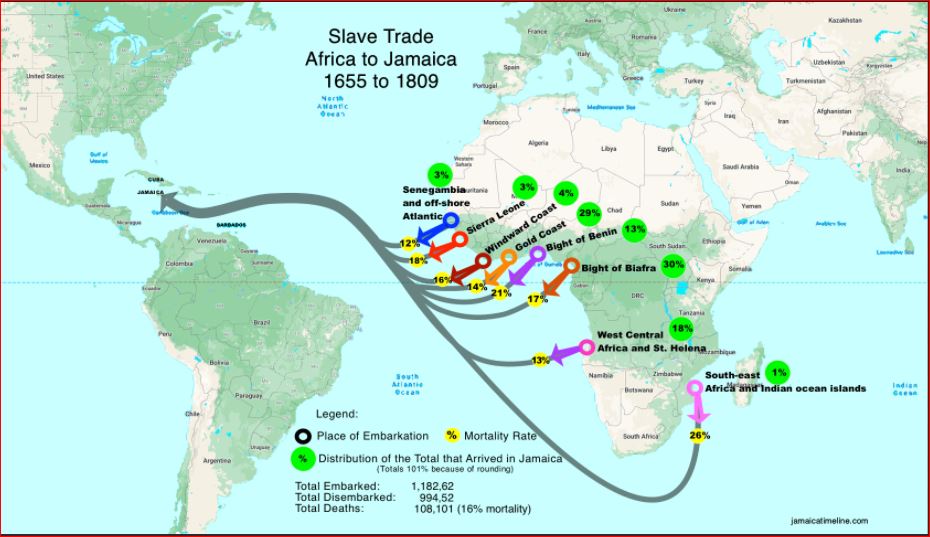
Map: 154 years of UK slave voyages from Africa to Jamaica, 1655-1809. Source: Slave Voyages Database-Trans-Atlantic Slave Trade-Estimates, via JamaicaGreatHouses.com…UK “merchants” needed 10,000 new African slaves every year for Jamaica sugar death camps. The work was so hard that a third of each new shipment of slaves died within 3 years. creating a constant demand for new slaves. “Every slave was expected to work–even women, children and the elderly.…Between 1766 and 1791, the British West Indies produced over a million tons of sugar.” (BBC)


……………………………

Freedom for 300,000 African slaves in Jamaica was delayed by House of Commons and House of Lords’ vested interests, even after massive Christmas 1831 Jamaica slave rebellion made it clear it was all over

British citizens owned 300,000 African slaves in Jamaica in 1831-32. The Christmas 1831 slave rebellion in Jamaica against British slave masters made it clear Emancipation was inevitable. Yet, “negotiations toward that end were protracted, in part, because of the vested interest of those in the House of Commons and the House of Lords.”…

“Slavery” and “Slave Trade” are two separate issues:

“The slave trade between Africa and the [Caribbean] West Indies was made illegal in 1807 and the traffic in slaves between the islands became illegal in 1811. However, it took another 26 years to effect the emancipation of the enslaved [from the British], when in 1833 Parliament passed the Slavery Abolition Act that finally abolished slavery in Jamaica and the other West Indian colonies on August 1, 1834.

There were many factors that influenced the legislation of 1833. There were doubts about the economic feasibility and the sustainability of slavery given the sustained resistance of the enslaved people that culminated in the major rebellion of Christmas 1831.

There was growing popular support for abolition but the negotiations toward that end were protracted, in part, because of the vested interest of those in the House of Commons and the House of Lords.

In the end, the final terms resulted in the grant of £20 million in compensation payable by the British taxpayers, 40% of Britain’s budget, to slave owners (equivalent to £2.6bn today [$3.5 billion US]).

Nothing went to the freed slaves to redress the injustices. The money went exclusively to the owners of slaves as compensation for the loss of “their property”, the slaves. The Emancipation act also introduced a system of apprenticeship that tied the newly freed people into working for low wages under their old masters or a fixed term. The intent was to “help and train” the freed slaves to be free men and women. The quotation marks are inserted because the program was not to the exclusive benefit of the slaves….

The Emancipation Act of 1st August 1834 declared all children born into slavery under the age of six, and any born after that date, free. All other enslaved persons became apprenticed to their former masters up to 1st August 1838 –– praedials (field workers) for six years and non-praedials for four years –– after which, they were to be made free. Apprentices were obliged to work on the estates for 40.5 hours per week in exchange for food, clothing, and shelter, but not wages.

The wealth created [for British owners] in Jamaica by the labor of black slaves has been estimated at £18 million (£2.3bn today [$3.1 billion US), more than half of the estimated total of £30 million for the entire British West Indies.”…

Map: 154 years of UK slave voyages from Africa to Jamaica, 1655-1809. Source: Slave Voyages Database-Trans-Atlantic Slave Trade-Estimates, via JamaicaGreatHouses.com…UK “merchants” needed 10,000 new African slaves every year for Jamaica sugar death camps. The work was so hard that a third of each new shipment of slaves died within 3 years. creating a constant demand for new slaves. “Every slave was expected to work–even women, children and the elderly….Between 1766 and 1791, the British West Indies produced over a million tons of sugar.” (BBC)


...............

Followers

Blog Archive

About Me

My photo
I'm the daughter of an Eagle Scout and World War II Air Force pilot born in Brooklyn, finally settling in New Jersey.