George Soros gave Ivanka's husband's business a $250 million credit line in 2015 per WSJ. Soros is also an investor in Jared's business.

Thursday, August 2, 2018

Fake Facebook group the Resisters promoted anti-Trump protests in NY City and Springfield, Missouri in 2017. Hundreds showed up at Aug. 2017 Springfield, Missouri anti-Trump protest-The Hill, 8/1/18...(Putin must be cracking up if he’s running anti-Trump protests, right?)

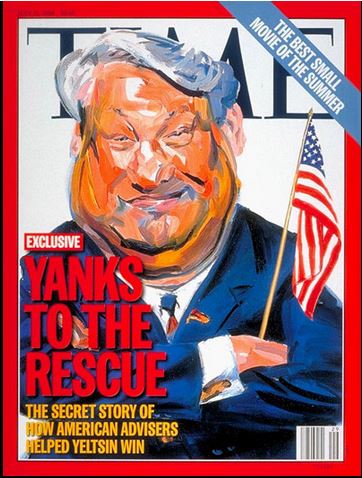
The Hill article below says Facebook doesn’t blame Russia or Russian trolls for inauthentically promoting three 2017 anti-Trump protests which people attended thinking they were real, but says the behavior matched that of others they’ve perceived to be Russian trolls. Russia and its people have cause to do much worse to the US than putting some trolls on the internet since for Russia’s entire 26 year existence, US elites have treated the country as if it were their personal property: “In the years following the end of the Soviet Union, the idea that Russia was “ours to lose” gained wide currency in American foreign policy circles.”...May 2018, The Cold War Culture War,” James Carden. A group of Americans even stationed themselves in Moscow and ran President Yeltsin’s 1996 presidential re-election campaign. Yanks to the Rescue, Time, cover, 7/15/1996…US elite view of Russia: The Western agenda for Russia is that of “superpower-turned economic and military weakling, a subservient client state,“ 3/20/2008, Why the West loved Yeltsin and hates Putin,“ thehindu.com, Vladimir Radyuhin 

7/15/1996 cover

As to Ukraine, it took two decades of US interfering in Ukraine affairs and $5 billion US taxpayer dollars but US elites finally won the the prize” by engineering violent “regime change” in Ukraine in 2014. (Murderous US neocon Gershman labeled Ukraine the prize,” 9/26/2013 Washington Post)
………………. 

8/1/18, “Shadowy Facebook account led to real-life Trump protests, The Hill, Ali Breland 

“At least three of the events co-organized on Facebook by a group the company now thinks was part of a coordinated disinformation network appear to have been held, and to have been attended by hundreds of people. 

The events, in New York City and Springfield, Mo., were all co-hosted on Facebook by a group called the Resisters. All three events were critical of President Trump. 

Archived versions of the event pages showed that 674 people responded on Facebook to say that they would attend the “We Stand with DREAMers! Support DACA!” event in New York on Sept. 9 last year. Another 3,000 said they were interested in attending. 

The New York Post reported that “thousands” of people gathered in Midtown on Sept. 9 to protest Trump’s decision to unwind the Deferred Action for Childhood Arrivals program, which allowed children brought to the U.S. illegally to live and work in the United States. 

It appears to be the same event co-hosted by Resisters on Facebook, as it took place on the same date and at the same location as the group’s “We Stand with DREAMers! Support DACA!” event. 

More than 2,000 people said they were interested in attending “The People’s Protest. Springfield against Trump” in the Missouri town on Aug. 30, [2017] and 726 said that they planned to attend the event. 

Springfield, Mo.’s NBC affiliate, KY3, and the Kansas City Star reported that hundreds of protesters showed up on that date to protest President Trump’s trip to Springfield at the time. 

The third event that appears to have taken place was titled “Protest Trump and ideology of hate at Trump Tower!” Around 4,700 said they were interested in attending the event and 1,400 said they were attending on the Facebook page. 

DNAInfo reported that thousands protested Trump at Trump Tower on Aug. 14, 2017, the same day and location of the event promoted on Facebook. 

Reports at the time from The Hill and The Washington Post also highlighted the protest. 

All three events were hosted by what appear to be legitimate groups in addition to the Resisters. 

Facebook on Tuesday said “inauthentic” groups, including Resisters, created roughly 30 events. Facebook in a call with reporters highlighted fake pages set up by the groups, but said it had no evidence on whether the events actually took place. 

There is some evidence that the events set up by Resisters were meant to piggy-back on existing, legitimate events by opponents of Trump. 

Indivisible St. Louis told The Hill that its Springfield event was already being organized when Resisters contacted them on Facebook. They also said that they did not encounter any representatives from Resisters at the protest.”… 

[Ed. note: If “representatives from Resisters” were Russian trolls and actually went to a US event, anyone they spoke with would know by their accent that they were from Russia. Not that there’s anything wrong with Russian accents, but if you’re leading a cheer at a US political rally in a foreign accent other than Spanish, someone will likely say to you afterward, “Hey! welcome, pal, where ya from?”]. 

(continuing):The [2017] Columbus Circle in New York protest similarly capitalized on [alleged] nationwide outrage over Trump’s DACA policy and may have been organized regardless.
Protests against the policy had already occurred early in September 2017. 

Roger Ray of the Emerging Church in Springfield, said that the protest he was involved in would have happened regardless. 

“I don’t doubt there were lots of fakes groups that might have tried to glom on, but they didn’t have any physical representation. They wouldn’t have had any influence,” he told The Hill in a phone interview. 

It’s not clear who was behind the Resisters work. 

Facebook executives did not blame Russia or the Russian troll group the Internet Research Agency (IRA), but said that the behavior matched past work by the IRA. 

The IRA during the 2016 presidential election created events that were highlighted on Facebook, including one [against Trump] in New York City attended by thousands. 

Multiple organizers told The Hill that they were frustrated by the possibility that the involvement of a fake account could undermine their actual cause and stressed that they were engaged in real organizing. 

“I certainly was not inspired by Russia or anything like that, Ray said.”
……………………. 

[Added: Online Russian trolls don’t promote Russia, they pretend to be Americans. They don’t even promote one US political candidate over another, instead add divisive social messages to existing internet clutter and hope some of it takes. US mass media already incites hatred and division 24/7 so Russian trolls are really wasting their time. Further on Russian trolls, “Facebook says 56% of the ads ran after the election,” and,Most of the ads did not solicit support for a candidate and carried messages on issues like racism, immigration and guns.”… 

10/15/17, You Can’t Buy the Presidency for $100,000, Wall St. Journal, Mark Penn, op-ed (Penn was chief strategist for Hillary’s 2008 pres. campaign, her 2000 Senate campaign, and for Bill Clinton’s 1996 pres. campaign) 

“Russia didn’t win Trump the White House any more than China re-elected Bill Clinton in 1996.” 

The fake news about fake news is practically endless. Americans worried about Russia’s influence in the 2016 election have seized on a handful of Facebook ads—as though there weren’t also three 90-minute debates, two televised party conventions, and $2.4 billion spent on last year’s campaign. The danger is that bending facts to fit the Russia story line may nudge Washington into needlessly and recklessly regulating the internet and curtailing basic freedoms. 

After an extensive review, Facebook has identified [that during a two year period, 7 months of which were AFTER the election] $100,000 of ads that came from accounts associated with Russia. Assume for the sake of argument that Vladimir Putin personally authorized this expenditure. Given its divisive nature, the campaign could be dubbed “From Russia, With Hate”—except it would make for a disappointing James Bond movie. 

Analyzing the pattern of expenditures, and doing some back-of-the-envelope math, it’s clear this was no devilishly effective plot. Facebook says 56% of the ads ran after the election, reducing the tally that could have influenced the result to about $44,000. It also turns out the ads were not confined to swing states but also shown in places like New York, California and Texas. 

Supposing half the ads went to swing states brings the total down to $22,000.”…


[Links for above paragraph: Facebook says only about 25% weregeographically targeted(no locations mentioned), and of those more ran in 2015 than 2016. They’ve already said that 56% of the total ran AFTER the election. Not stated is how many “targeted” ads ran after the election.]

(continuing): “Facebook also counted ads as early as June 2015.

Assuming they were evenly spread and we want only those that ran the year of the election, that knocks it down to $13,000.

Most of the ads did not solicit support for a candidate and carried messages on issues like racism, immigration and guns. The actual electioneering then amounts to about $6,500.

Now look at the bigger picture. Every day, Americans see hundreds of ads on TV and radio, in newspapers and magazines, on billboards and smartphones. North Americans post to Facebook something like a billion times a day, and during the election many of those messages were about politics. Facebook typically runs about $40 million worth of advertising a day in North America. 

Then consider the scale of American presidential elections. Hillary Clinton’s total campaign budget, including associated committees, was $1.4 billion. Mr. Trump and his allies had about $1 billion. Even a full $100,000 of Russian ads would have erased just 0.025% of Hillary’s financial advantage. In the last week of the campaign alone, Mrs. Clinton’s super PAC dumped $6 million in ads into Florida, Pennsylvania and Wisconsin. 

I have 40 years of experience in politics, and this Russian ad buy, mostly after the election anyway, simply does not add up to a carefully targeted campaign to move voters. It takes tens of millions of dollars to deliver meaningful messages to the contested portion of the electorate. Converting someone who voted for the other party last time is an enormously difficult task. 

Swing voters in states like Ohio or Florida are typically barraged with 50% or more of a campaign’s budget. Try watching TV in those states the week before an election and you will see how jammed the airwaves are. 

No one wants foreign governments meddling in American elections. In 1996, the Chinese government had the “China plan” and pumped hundreds of thousands of dollars into Bill Clinton’s re-election campaign. There were congressional investigations, and several fundraisers were prosecuted, but Attorney General Janet Reno rejected calls for an independent counsel. 

Campaigns tightened up their donor-validation procedures, and life moved on. The same is called for here. Internet companies should improve their screening of electioneering ads, impose clearer standards on all ads, and do a better job weeding out phony accounts. 

Millions of taxpayer dollars have probably been spent already poring over that $100,000 of Facebook ads. Better to keep it all in perspective, as everyone did in 1996. The only way Russia will get its money’s worth is if Washington overreacts and narrows the very freedoms that make America different in the first place.” [Facebook says roughly 25% of the ads were never shown to anyone.] 


.................

Wednesday, August 1, 2018

Trump didn't say this: "Media made themselves the enemy of the American people and a fundamental threat to democracy," said Pat Caddell, 9/27/2012. "Media have made the decision they will control the political process." They do have accomplices, adds Caddell, such as the supine GOP Establishment

Sept. 2012 article: 

9/27/2012, "Pat Caddell Says: Media Have Become “Enemy of the American People”," Roger Aronoff, AIM

"In remarks to the AIM conference...on September 21st, former Democratic pollster and analyst Pat Caddell said, “I think we’re at the most dangerous time in our political history in terms of the balance of power in the role that the media plays in whether or not we maintain a free democracy.” Caddell noted that while First Amendment protections were originally provided to the press so they would protect the liberty and freedom of the public from “organized governmental power,” they had clearly relinquished the role of impartial news providers.

Nowhere was this more evident than during the tragic death of a U.S. ambassador in Libya that was covered up for nine days because the press and the administration did not want to admit it was a terrorist attack. 


We’ve had nine day of lies over what happened because they can’t dare say it’s a terrorist attack, and the press won’t push this,” said Caddell. Yesterday there was not a single piece in The New York Times over the question of Libya. Twenty American embassies, yesterday, are under attack. None of that is on the national news. None of it is being pressed in the papers.”

Caddell added that it is one thing for the news to have a biased view, but It is another thing to specifically decide that you will not tell the American people information they have a right to know.”


He closed his talk with these words: "The press’s job is to stand in the ramparts and protect the liberty and freedom of all of us from a government and from organized governmental power. When they desert those ramparts and go to serve—to decide that they will now become an active participants—when they decide that their job is not simply to tell you who you may vote for, and who you may not, but, worse—and this is the danger of the last two weeks—what truth that you may know, as an American, and what truth you are not allowed to know, they have, then, made themselves a fundamental threat to the democracy and, in my opinion, made themselves the enemy of the American people. And it is a threat to the very future of this country if…we allow this stuff to go on, and…we’ve crossed a whole new and frightening slide on the slippery slope this last two weeks, and it needs to be talked about.”...

You can also watch the entire talk along with Q and A below, or watch along with a transcript here." "The Audacity of corruption."
...................

More Pat Caddell from 9/21/2012 transcript referenced above:

"These individual reporters—let me tell you something about the press: Reporters become reporters and don’t enter the political fray because, basically, they can’t stand the heat."...


9/21/2012, "“The Audacity of Corruption,” Transcript, Accuracy in Media Conference, Speaker: Pat Caddell

From Caddell transcript: "When I first started in politics – and for a long time before that – everyone on both sides, Democrats and Republicans, despised the press commonly, because they were SOBs to everybody. Which is exactly what they should be. They were unrelenting. Whatever the biases were, they were essentially equal-opportunity people. That changed in 1980.  There’s a lot of reasons for it.... 

Most recently, what I call the nepotism that exists, where people get jobs—they’re married to people who are in the administration, or in politics, whatever. But the overwhelming bias has become very real and very dangerous. 


We have a First Amendment for one reason. We have a First Amendment not because the Founding Fathers liked the press—they hated the press—but they believed, as [Thomas] Jefferson said, that in order to have a free country, in order to be a free people, we needed a free press. That was the job—so there was an implicit bargain in the First Amendment, the press being the only institution, at that time, which was in our process of which there was no checks and balances. We designed a constitutional system with many checks and balances.

The one that had no checks and balances was the press, and that was done under an implicit understanding that, somehow, the press would protect the people from the government and the power by telling—somehow allowing—people to have the truth. That is being abrogated as we speak, and has been for some time. It is now creating the danger that I spoke to.... 


The New York Times, The Washington Post, or the most important papers that influence the networks, ABC, NBC, and, to a lesser extent—because CBS has actually been on this story, partly because the President of Libya appeared on [Bob Schieffer’s Face the Nation] and said, on Sunday, while [U.S. Ambassador to the U.N.] Susan Rice was out—the U.N. Ambassador has no portfolio on this matter—lying, said of the Secretary—you know why, notice the Secretary of State wasn’t out there doing this—was on national television, lying and promoting the White House line while the Libyan President, the very same moment, is saying “This is a premeditated attack.” Nobody has asked that question. This morning—take a look at The New York Times this morning, it’s a minor reference.  Oh, now we’ve decided that it was a terrorist incident. But this is—that would have changed, that should change the politics.

This is not without accomplices, because the incompetence of the [Mitt] Romney campaign, which I said a week ago is the—my God!the worst campaign in my lifetime, and the Republican establishment in general’s inability to fight, has allowed these things to happen in part because they don’t do it....

There is no doubt that Romney is blowing an election he could not lose, and has done everything he can to lose it.... We have a political campaign where, to put the best metaphor I can on it, where the referees on the field are sacking the quarterback of one team, tripping up their runners, throwing their bodies in front of blockers, and nobody says anything. The Republicans don’t.... 


Too many political people in the Republican party in this town, want to maintain their relationships with the press. This is how Sarah Palin got handed over to Katie Couric and to ABC before she was ready—because Steve Schmidt and others want to preserve their view, their relationships with the press.  You know, people have their own agendas, and often it’s not winning."...  

From Q and A:

"CADDELL: The corruption in this town is so great.  Everybody in Washington seems to almost be on the take....When you have firms that have Ed Gillespie in business with Jack Quinn, who was the counsel for Bill Clinton, and responsible for the pardon of Marc Rich, among other things, is because everybody in this—those people on K Street, in both parties, are about arrangements and money. Everyone in the press is. We have stimulus money being given. We have people who, as I said, the relationships, when people are making contracts, and their husbands and wives are getting—Jay Carney’s wife works in the government! Now he works—he was the head of the Time Magazine! He was a liar then, and a liar now, apparently! You know—and nobody says there’s anything wrong with this. And you’re right: Everybody’s on the take here, and everybody’s cutting up their stock. That’s why, what used to be one of the best and most important things for the press, which was the investigative journalism of corruption and money, the stealing of the taxpayers, the looting of the Treasury isn't an issue, and why no one speaks of it in this town.... 

AUDIENCE MEMBER 4: Thank you....I am very concerned about Romney’s poor campaign, combined with the media bias the way it is. Is there anything that Romney can do at this point?


CADDELL: Well, he should’ve been out there already! He should’ve been out there pushing back—and so should the Republican establishment. The Republican establishment, as I said, in this town...to me, a lot of the establishment, is getting a lot of money to line their pockets, and not fighting or doing things that are effective. Why aren’t they out there challenging this? Why isn’t Romney himself getting up and saying, “I’m running against two organizations: I’m running against the Democrats and the President, and I’m running against the mainstream media, which will not tell you the truth”? 

Now let me tell you something: You want to liven up some of your rallies? That’ll do it. But they don’t do it because this man dares to be cautious. He’s going to dare-to-be-cautious himself right out of a race that was his to lose, and he’s losing it.... 

(Caddell): These individual reporters—let me tell you something about the press: Reporters become reporters and don’t enter the political fray because, basically, they can’t stand the heat. That’s my experience. You ever watch reporters under attack in a public venue and so forth? They wilt like—they melt like ice on the equator. The fact is that they need to be called out. Their organizations need to be called out. Ezra Klein still writes for The Washington Post? I mean, this is unbelievable! They had a secret operation group, “Journo” group, online, coordinating how they would promote Obama, and how they would attack Republicans—and he’s still there? But nobody calls out the publisher, or the editor, or whatever—there is no effort here—or calls him.... 


We have a different press now. They have now made the decision they will control the political process. They are serving—with the hundreds of millions of dollars that the networks and these newspapers are, in effect, contributing—in-kind contributions to candidates in the Democratic Party. 

That’s the legal issue that I would have been exploring.  I mean, I would begin to put the heat on.


.....................

"Pat Caddell is the founder of Cambridge Survey Research, a public opinion pollster, and an expert in analyzing public opinion.  Many will recognize him from his frequent appearances on Fox News, and some of us—the older ones in here—will remember him from all the way back to the McGovern campaign.  He also worked on the Carter campaign, for Gary Hart, for Joe Biden, and Jerry Brown. What some of you might not be aware of is that Pat Caddell also worked as a consultant to various movies, TV shows, and documentaries, most notably Apocalypse Now, The West Wing, on TV, and, most recently, to a documentary you may have seen the last couple weeks on Fox called The Hope and the Change.  And without further ado, I’m going to welcome Pat Caddell."


.................. 


Three Ukrainian citizens arrested for prolific hacking, credit card and bank fraud in US and other countries-BBC

8/1/18, “US names arrested Fin7 cyber-gang suspects,” BBC 

“Three Ukrainian citizens suspected of being part of a “prolific hacking group” have been arrested, the US Department of Justice has announced. 

The three men are accused of using malware to attack more than 120 US companies, including the restaurant chains Chipotle and Arby’s. 

Firms in the UK, France and Australia were also said to have been targeted.
 

The gang involved has been called several names including Fin7, Carbanak and JokerStash. 

Its activities had been widely tracked in the cyber-security press. In some cases it was suspected of being a Russia-based operation. 

The Department of Justice (DoJ) said that the group had hijacked more than 15 million payment card details from more than 6,500 payment check-out points in the US alone. 

It said the information was then sold via the “dark net” – a part of the internet that is not indexed by regular search engines such as Google. 

The resulting losses are believed to have run into the tens of millions of dollars. 

The group is understood to still be active. 

Each of the three accused faces allegations of conspiracy, wire fraud, computer hacking, access device fraud, and aggravated identity theft. 

However, only one of the men is currently in US custody. 

Fedir Hladyr is being held in Seattle pending trial after being handed over by the German authorities, who arrested the 33-year-old in January. 

Dmytro Fedorov was arrested the same month in Poland. The Spanish authorities are holding the third suspect, Andrii Kopakov. The US is seeking to have both extradited. 

It is not known whether the men deny the crimes they are accused of. 

“The naming of these Fin7 leaders marks a major step towards dismantling this sophisticated criminal enterprise,” said the FBI agent in charge, Jay Tabb. 

“The FBI will continue to work with its law enforcement partners worldwide to pursue the members of this devious group, and hold them accountable for stealing from American businesses and individuals.”...  

“The criminal organisation, to which the individuals arrested are alleged to belong, is one of the larger groups, which likely is the reason for it attracting sufficient attention from law-enforcement,” commented Dr Steven Murdoch from University College London. 

“The clever techniques it used to infiltrate companies demonstrates that it is impossible to guarantee that systems processing card numbers will be protected from all attacks. 

“For this reason, payment systems are gradually being changed to reduce the value of card numbers to criminals, such as by creating card numbers which can only be used once, or confirming transactions by sending a text message to the customer.””
…………………….. 

Added: linked above: “FOR IMMEDIATE RELEASE 

8/1/18, “Three Members of Notorious International Cybercrime Group “Fin7” In Custody for Role in Attacking Over 100 U.S. companies, justice.gov 

Victim Companies in 47 U.S. States; Used Front Company ‘Combi Security’ to Recruit Hackers to Criminal Enterprise” 

“Three high-ranking members of a sophisticated international cybercrime group operating out of Eastern Europe have been arrested and are currently in custody facing charges filed in U.S. District Court in Seattle, announced Assistant Attorney General Brian A. Benczkowski of the Justice Department’s Criminal Division, U.S. Attorney Annette L. Hayes for the Western District of Washington and Special Agent in Charge Jay S. Tabb Jr. of the FBI Seattle Field Office. 

According to three federal indictments unsealed today, Ukrainian nationals Dmytro Fedorov, 44, Fedir Hladyr, 33, and Andrii Kolpakov, 30, are members of a prolific hacking group widely known as FIN7 (also referred to as the Carbanak Group and the Navigator Group, among other names). Since at least 2015, FIN7 members engaged in a highly sophisticated malware campaign targeting more than 100 U.S. companies, predominantly in the restaurant, gaming, and hospitality industries.  As set forth in indictments, FIN7 hacked into thousands of computer systems and stole millions of customer credit and debit card numbers, which the group used or sold for profit.

Since at least 2015, FIN7 members engaged in a highly sophisticated malware campaign targeting more than 100 U.S. companies, predominantly in the restaurant, gaming, and hospitality industries. As set forth in indictments, FIN7 hacked into thousands of computer systems and stole millions of customer credit and debit card numbers, which the group used or sold for profit.

In the United States alone, FIN7 successfully breached the computer networks of companies in 47 states and the District of Columbia, stealing more than 15 million customer card records from over 6,500 individual point-of-sale terminals at more than 3,600 separate business locations.  Additional intrusions occurred abroad, including in the United Kingdom, Australia, and France. Companies that have publicly disclosed hacks attributable to FIN7 include such familiar chains as Chipotle Mexican Grill, Chili’s, Arby’s, Red Robin and Jason’s Deli.  Additionally in Western Washington, FIN7 targeted other local businesses. 

The three Ukrainian nationals indicted today allegedly were part of a prolific hacking group that targeted American companies and citizens by stealing valuable consumer data, including personal credit card information, that they then sold on the Darknet,” said Assistant Attorney General Benczkowski.

“Because hackers are committed to finding new ways to harm the American public and our economy, the Department of Justice remains steadfast in its commitment to working with our law enforcement partners to identify, interdict, and prosecute those responsible for these threats.”… 

Each of the three FIN7 conspirators is charged with 26 felony counts alleging conspiracy, wire fraud, computer hacking, access device fraud, and aggravated identity theft. 

In January 2018, at the request of U.S. officials, foreign authorities separately arrested Ukrainian Fedir Hladyr and a second FIN7 member, Dmytro Fedorov.  Hladyr was arrested in Dresden, Germany, and is currently detained in Seattle pending trial. Hladyr allegedly served as FIN7’s systems administrator who, among other things, maintained servers and communication channels used by the organization and held a managerial role by delegating tasks and by providing instruction to other members of the scheme.  Hladyr’s trial is currently scheduled for Oct. 22.

Fedorov, a high-level hacker and manager who allegedly supervised other hackers tasked with breaching the security of victims’ computer systems, was arrested in Bielsko-Biala, Poland. Fedorov remains detained in Poland pending his extradition to the United States. 

In late June 2018, foreign authorities arrested a third FIN7 member, Ukrainian Andrii Kolpakov in Lepe, Spain. Kolpakov, also alleged to be a supervisor of a group of hackers, remains detained in Spain pending the United States’ request for extradition. 

According to the indictments, FIN7, through its dozens of members, launched numerous waves of malicious cyberattacks on numerous businesses operating in the United States and abroad.  FIN7 carefully crafted email messages that would appear legitimate to a business’ employee, and accompanied emails with telephone calls intended to further legitimize the email. Once an attached file was opened and activated, FIN7 would use an adapted version of the notorious Carbanak malware in addition to an arsenal of other tools to ultimately access and steal payment card data for the business’ customers. Since 2015, FIN7 sold the data in online underground marketplaces

(Supplemental document “How FIN7 Attacked and Stole Data” explains the scheme in greater detail.) 

FIN7 used a front company, Combi Security, purportedly headquartered in Russia and Israel, to provide a guise of legitimacy and to recruit hackers to join the criminal enterprise.  Combi Security’s website indicated that it provided a number of security services such as penetration testing.  Ironically, the sham company’s website listed multiple U.S. victims among its purported clients.

The charges in the indictments are merely allegations, and the defendants are presumed innocent until proven guilty beyond a reasonable doubt in a court of law. 

The indictments are the result of an investigation conducted by the Seattle Cyber Task Force of the FBI and the U.S. Attorney’s Office for the Western District of Washington, with the assistance of the Justice Department’s Computer Crime and Intellectual Property Section and Office of International Affairs, the National Cyber-Forensics and Training Alliance, numerous computer security firms and financial institutions, FBI offices across the nation and globe, as well as numerous international agencies. Arrests overseas were executed in Poland by the “Shadow Hunters” from CBÅšP (Polish Central Bureau of Investigation); in Germany by the LKA Sachsen – Dezernat 33, (German State Criminal Police Office) and the Polizeidirektion Dresden (Dresden Police); and in Spain the Grupo de Seguridad Logica within the Unidad de Investigación Technologica of the Cuerpo Nacional de Policía (Spanish National Police).. 

This case is being prosecuted by Assistant U.S. Attorneys Francis Franze-Nakamura and Steven Masada of the Western District of Washington with assistance from Trial Attorney Anthony Teelucksingh of the Justice Department’s Computer Crime and Intellectual Property Section.”


.............

Remembering the Koch Brothers and their fellow fake Emperors with no clothes-NY Magazine, 3/20/2016

3/20/2016, "There Was no Republican Establishment After All," Frank Rich, NY Magazine

D. Koch, Ryan, C. Koch, McConnell, Murdoch


"In mid-July of 2015, a month after Donald Trump announced his presidential run, I joined a gaggle of political junkies in a clubby bar four blocks from the White House to hear a legendary campaign strategist expound on the race ahead. Our guest’s long résumé included service to Mitt Romney and two generations of Bushes. Not speaking for attribution, and not having signed on to any 2016 campaign, he could talk freely. The nomination was Jeb Bush’s to lose, he said. Scott Walker, the union-busting Wisconsin governor then considered something of a favorite, had no chance because he was just “too stupid.” And Trump? Please! Trump represented every ugly element that was dragging down the GOP in presidential elections. But our guy wasn’t fazed. The good thing about Trump, he said, is that he would finally “gather together all the people we want to lose” and march them off the Republican reservation — though to what location remained undisclosed.

That same week, I was at a similar gathering with John McCain, then in a mild fury that Trump had just appeared with the nativist Arizona sheriff Joe Arpaio at a weekend rally in Phoenix. McCain worried that by activating “the crazies” — the same crazies, it politely went unmentioned, that he helped legitimize by putting Sarah Palin on his ticket in 2008 — Trump could jeopardize both the GOP in general and McCain’s own incumbency if challenged in a primary. The senator soon said the same in public, and not long after that, Trump retaliated by mocking his wartime bravery with the memorable insult “I like people who weren’t captured.”

And that, you may recall, was the end of Trump.

His “surge in the polls has followed the classic pattern of a media-driven surge,” wrote the analyst Nate Cohn in the “Upshot” column of the Times, speaking for nearly every prognosticator.Now it will follow the classic pattern of a party-backed collapse. Since “Republican campaigns and elites had quickly moved to condemn” Trump’s slam of McCain, his candidacy had “probably” reached the moment when it would tilt “from boom to bust.” How could it be otherwise? As Cohn reiterated a few weeks later, “the eventual nominee will need wide support from party elites.

The Republican Elites. The Establishment. The Party Elders. The Donor Class. The Mainstream. The Moderates. Whatever you choose to call them, they, at least, could be counted on to toss the party-­crashing bully out.

To say it didn’t turn out that way would be one of the great understatements of American political history. Even now, many Republican elites, hedging their bets and putting any principles in escrow, have yet to meaningfully condemn Trump. McCain says he would support him if he gets his party’s nomination. The Establishment campaign guru who figured the Trump problem would solve itself moved on to anti-Trump advocacy and is now seeking to unify the party behind Trump, waving the same white flag of surrender as Chris Christie. Every major party leader — Paul Ryan, Mitch McConnell, Reince Priebus, Kevin McCarthy — has followed McCain’s example and vowed to line up behind whoever leads the ticket, Trump included. Even after the recurrent violence at Trump rallies boiled over into chaos in Chicago, none of his surviving presidential rivals would disown their own pledges to support him in November. Trump is not Hitler, but those who think he is, from Glenn Beck to Louis C.K., should note that his Vichy regime is already in place in Washington, D.C.

Since last summer, Trump, sometimes in unwitting tandem with Bernie Sanders, has embarrassed almost the entire American political ecosystem — pollsters, pundits, veteran political operatives and the talking heads who parrot their wisdom, focus-group entrepreneurs, super-pac strategists, number-crunching poll analysts at FiveThirtyEight and its imitators. But of all the emperors whom Trump has revealed to have few or no clothes, none have been more conspicuous or consequential than the GOP elites. He has smashed the illusion, one I harbored as much as anyone, that there’s still some center-right GOP Establishment that could restore old-school Republican order if the crazies took over the asylum.

The reverse has happened instead. The Establishment’s feckless effort to derail Trump has, if anything, sparked a pro-Trump backlash among the GOP’s base and, even more perversely, had the unintended consequence of boosting the far-right Ted Cruz, another authoritarian bomb-thrower who is hated by the Establishment as much as, if not more than, Trump is. (Not even Trump has called McConnell “a liar,” which Cruz did on the Senate floor.) The elites now find themselves trapped in a lose-lose cul-de-sac. Should they defeat Trump on a second or third ballot at a contested convention and install a regent more to their liking such as Ryan or John Kasich — or even try to do so — they will sow chaos, not reestablish order. In the Cleveland ’16 replay of Chicago ’68, enraged Trump and Cruz delegates, stoked by Rush Limbaugh, Laura Ingraham, Matt Drudge, et al., will go mano a mano with the party hierarchy inside the hall to the delectation of television viewers while Black Lives Matter demonstrators storm the gates outside.

Did the pillars of the Establishment fail to turn back the Trump insurgency because they have no balls? Because they have no credibility? Because they have too little support from voters in their own party? Because they don’t even know who those voters are or how to speak their language? To some degree, all these explanations are true. Though the Republican Establishment is routinely referenced as a potential firewall in almost every media consideration of Trump’s unexpected rise, it increasingly looks like a myth, a rhetorical device, or, at best, a Potemkin village. It has little power to do anything beyond tardily raising stop-Trump money that it spends neither wisely nor well and generating an endless torrent of anti-Trump sermons for publications that most Trump voters don’t read. The Establishment’s prize creation, Marco Rubio — a bot candidate programmed with patriotic Reaganisms, unreconstructed Bush-Cheney foreign-policy truculence, a slick television vibe, and a dash of ethnicity — was the biggest product flop to be marketed by America’s Fortune 500 stratum since New Coke.

While it’s become a commonplace to characterize Trump’s blitzkrieg of the GOP as either a takeover or a hijacking, it is in reality the Establishment that is trying to hijack the party from those who actually do hold power: its own voters. The anti-Establishment insurgencies of Trump, Cruz, and Ben Carson collectively won the votes of more than 60 percent of the Republican-primary electorate from sea to shining sea both before and after the opposition thinned. If you crunch the candidates’ vote percentages in the five states that voted on March 15, after Carson’s exit, you’ll find that Trump and Cruz walked away with an average aggregate total of 67 percent. The next morning, The Wall Street Journal’s editorial page, the leading Establishment voice of anti-Trump conservatism, saw hope in Kasich’s “impressive” victory in Ohio and Trump’s failure to break 50 percent in any state. It failed to note that Kasich also fell short of 50 percent in the state where he is the popular sitting governor, or that his continuing presence in the race perpetuates Trump’s ability to divide and conquer.

It’s debatable who or what can be called the Republican Establishment at this point. Presumably it includes the party’s leadership on the Hill and in the Republican National Committee; its former presidents, presidential nominees, top-tier officeholders, and their extended political networks; hedge-fund and corporate one-percenters typified by Paul Singer, Kenneth Langone, and the Koch brothers, mostly based in the Northeast, who write the biggest campaign checks; and the conservative commentators who hold forth on the op-ed pages of the country’s major newspapers, conservative media outlets like Fox News, and conservative journals like National Review, which devoted an entire issue to its contributors’ “Dump Trump” diatribes well after his runaway train of a campaign had already left the station.

Once you get past the hyperventilation that Trump will destroy democracy, wreck the GOP, and make America unsafe, you’ll see that the objections of Trump’s Establishment critics have several common threads. Trump is a vulgarian (true). He has no fixed ideology or coherent policy portfolio (true). He repeatedly and brazenly makes things up (true). He wantonly changes his views (true). He is not recognizable as “a real Republican” (false).

It’s the members of the Establishment who have a tenuous hold on the term “real Republican.” Their center-right presidential candidates of choice (Jeb Bush, Chris Christie) were soundly rejected, and their further-right candidates (Rubio and Kasich) fared little better. The Republican-primary voters embracing Trump and Cruz have every right to say that they are the real Republicans, and after Cleveland, they could even claim to be the de facto new Establishment, if they believe in such a thing. The old center-right has not held in the GOP. Last fall, some 73 percent of Republicans told Pew that they support building a border wall, Trump’s signature campaign issue. A Washington Post–ABC News poll, published March 9, showed that Hillary Clinton would whip Trump, 50 to 41 percent, but that 75 percent of Republicans would vote for Trump. While it is constantly and accurately said that “millions of Republicans will never vote for Trump,” those millions are unambiguously in the party’s minority.

The charges that Trump is a “con man” and an ersatz Republican were particularly rich coming from Romney, who in typical regal fashion elected himself leader of the Establishment’s anti-Trump brigade. (His intervention failed to have any effect, even in his native state of Michigan.) Romney is a man who made up so many things in 2012 that his own pollster was moved to declare that “we’re not going to let our campaign be dictated by fact-checkers.” Much has been said about Romney’s hypocrisy in attacking as “a phony” and “a fraud” the man whose endorsement he brandished four years ago in an obsequious Las Vegas summit and whose business acumen he lavishly praised at the time. But no less phony is his holier-than-thou assault on Trump as a despoiler of the pure Republican faith given his own long history of political flip-flops and xenophobic hostility to immigrants.

As an unsuccessful Senate candidate in Massachusetts in the 1990s, Romney took stands well to the left of those in Trump’s past: He was a steadfast advocate for not only Planned Parenthood (his wife, Ann, made a contribution during campaign season) but abortion rights, and he promised to “provide more effective leadership” than his opponent, Ted Kennedy, in support of “equality for gays and lesbians.” As Massachusetts’s governor, Romney didn’t just endorse certain elements of government health care as Trump has; he pioneered what is now Obamacare. And as his policy gyrations match Trump’s, so, too, does his xenophobia. In 2012, he chastised his rivals Rick Perry and Newt Gingrich for expressing a few scintillas of humanity toward immigrants, reviled Rudy Giuliani with the bogus and racially loaded charge of turning New York into a “sanctuary city,” and coined the now-notorious term self-deportation. Romney’s nativism was all the more egregious given that his own father was an immigrant from Mexico, where he was born to American parents in a Mormon colony. (The legality of George Romney’s claim to qualify for the presidency as a “natural-born citizen,” like Cruz’s, went unresolved during his 1968 campaign.) If Trump is a counterfeit Republican, then Mitt is nothing if not the template for his forgery.

Romney and his Establishment peers have also made a big show of branding Trump a traitor to GOP values because he feigned ignorance of his fan David Duke and took his sweet time before disavowing Duke’s alma mater, the Ku Klux Klan. But just over a year ago the Republican congressman Steve Scalise of Louisiana conceded that he had committed an even greater infraction than Trump’s by speaking before a Duke-affiliated white-supremacy group in 2002. Scalise had been invited to do so by two longtime Duke aides, at least one of whom was a friend, but he nonetheless maintained, just as Trump did, that he had no idea who these people were or what they stood for. Even hard-line conservatives doubted Scalise’s story — Charles Krauthammer called it “implausible,” and Erick Erickson asked, “How the hell does somebody show up at a David Duke–organized event in 2002 and claim ignorance?” — but the incident was hardly an impediment to Scalise’s advancement in the GOP. He was rewarded with the No. 3 post in the House leadership, majority whip, which he retains today. That Scalise’s boss, Paul Ryan, would glom onto Trump’s Duke brouhaha as a cue to grandstand about how Republicans must reject all groups that traffic in bigotry — “There can be no evasion and no games,” he lectured—is as laughable as it is shameless.

The fiction that Trump’s exploitation of racial resentments is a shocking breach of Republican values has been fiercely asserted by Romney, Ryan, and the rest of the GOP Establishment for the obvious reason: A nearly all-white party, staring down the barrel of a looming minority-white America, can’t compete in national elections unless it can claim to have retained its founding identity as the party of Lincoln. That’s why there have been so many recent revisionist histories in conservative publications (not to mention a book by Joe Scarborough) attempting to sanitize the racial animus of the Goldwater-Nixon “Southern strategy” of a half-century ago. As voters went to the polls on Super Tuesday, March 1, Bret Stephens, a conservative columnist at the Journal who loathes Trump, captured the Establishment’s panic that Trump might now be sabotaging that elaborate airbrushing effort. “It would be terrible to think the left was right about the right all these years,” he wrote, and to discover that its “tendentious” accusations of “racial prejudice” were validated by Trump’s success among the Republican electorate of 2016.

One doesn’t need tendentiousness to make the accusation that some modern Republican leaders-and not just notorious southern racists of the Strom Thurmond and Jesse Helms ilk but the Establishment’s very own centurions-have courted, and still court, bigots much as Trump does. The facts speak for themselves. It was no accident that Ronald Reagan traveled from the 1980 Republican convention to give a speech on states’ rights to a virtually all-white audience just outside the small town of Philadelphia, Mississippi, best known as the site where the Ku Klux Klan murdered three civil-rights workers in 1964. Reagan was no Klan sympathizer, but, like Trump, he knew how to pander to voters who might be.

Reagan’s ostensibly more genteel, old-school-Republican successor, George H. W. Bush, was scarcely different when it came to playing the race card, though you’d never know that from the way he has been canonized lately to serve as a paragon of the Establishment-GOP values Trump has defiled. Bush opposed the Civil Rights Act of 1964 in his first run for Senate in Texas because he thought it “trampled” the Constitution. When he first ran for president in 1980, he hired Charles Snider, the longtime campaign manager for George Wallace, the populist and racist demagogue who increasingly seems to be Trump’s role model. Eight years after that, Bush hired Thurmond’s protégé Lee Atwater to run his race-infected campaign against Michael Dukakis. (Atwater rhetorically linked Willie Horton, a black murderer and rapist featured in a pro-Bush pac’s ad campaign, to Jesse Jackson.)

The next generation of this archetypal Establishment Republican dynasty has done its best to uphold the family tradition in a new century. George W. Bush journeyed to Bob Jones University to deliver a campaign speech in 2000, when it still banned interracial dating; that same year, he refused to support taking down the Confederate flag at the South Carolina statehouse in Columbia, where it had been raised in 1961 in resistance to desegregation. In 2015, his brother Jeb was slightly ahead of the curve of his major GOP presidential competitors in suggesting (gently) that the same flag be removed after the Charleston church massacre, but he still waited three days and acted only after Romney had done so more unequivocally. What separates Trump from such stalwarts of the Republican Establishment as the Bushes is that instead of perfuming his nativist or racial pandering with disingenuous phraseology like compassionate conservatism and kinder, gentler and right to rise, he dispenses with the niceties, or, as he would put it, is brave enough to be politically incorrect. Trump is hardly an outlier in a party that questioned Barack Obama’s citizenship from day one and that, eight years later, still regards him as an illegitimate president whose Supreme Court nominee is unworthy of even pro forma consideration by the Republican Senate leadership.

In trying to understand why smart Establishment-conservative commentators like David Brooks and Ross Douthat (at the Times) and George Will and Michael Gerson (at the Washington Post) so uniformly underestimated Trump’s appeal among Republican voters for so long, you have to start by assuming that they were in denial, as Stephens was, about how his baser instincts might appeal to some in their party’s angry base. But insularity may have played as big a role as denial. Most Republicans are not racists, and race is hardly the whole Trump story, yet it’s not clear that the elites got any of the story. Thomas Frank, writing in The Guardian, has mocked the liberal pundit Nicholas Kristof for devoting a column to a dialogue with an “imaginary” Trump voter rather than speaking to an actual one, but Establishment-conservative pundits may not have dug much deeper into their own grassroots.

Just how out-of-touch they are was broadcast late last summer by the National Review writer Ramesh Ponnuru, who, like Douthat and Gerson, is part of the so-called reform-conservative coterie, eager to remake the GOP so it might speak not just to the needs of the business-ownership class but to middle-class Americans (rather like many of the voters Trump has been attracting, paradoxically enough). For Bloomberg View, Ponnuru compiled a list of bullet points to explain why Trump had no chance of winning the GOP nomination: “too many of his supporters are just registering discontent before they make a real decision several months from now”; “Republican elected officials would consolidate behind a consensus choice if Trump started winning delegates”; “the decisive Republican presidential primary voters are a pretty sober-minded bunch.” This sounds like the kind of thinking Marie Antoinette must have entertained before being marched to the guillotine.

It’s hard to believe now, when the bar has fallen so low that merely being “an adult” is enough to make Kasich the class act of the Republican debate stage, but back at the start of this election cycle, virtually the entire conservative-Establishment commentariat was touting the large Republican field as Olympian: “the most impressive since 1980, and perhaps the most talent-rich since the party first had a presidential nominee, in 1856” (George Will). None of these elites could believe that Trump would get anywhere, given all the fabulous alternatives bestowed on the benighted voters. And surely everyone would love Rubio — the oft-described “future of the party”whom the Establishment started hawking once its natural favorite, Jeb!, failed to launch. Rubio is “a genius at relating policy depth,” Brooks wrote in September, days after predicting that Trump and Carson “will implode.” In October, he declared Rubio “the most likely presidential nominee” and noted that while “disaffected voters” were turning to Trump, “there aren’t enough of those voters in the primary electorate to beat Rubio,” who “has no natural enemies anywhere in the party.” After the Iowa caucus in February, Brooks wrote that “the amazing surge for Marco Rubio shows that the Republican electorate has not gone collectively insane.” Rubio may have come in third in Iowa, but what did that matter, given his “growing Establishment base”?

By then the elite pundits were reduced to begging Republican voters to heed their gravitas. Brooks and Stephens wrote twin columns respectively pleading “Stay Sane America, Please!” and “Sober Up, America.” But it wasn’t America they were asking to sober up — it was the rank-and-file of their own party, whose impertinence and independence have blindsided and baffled them. Gerson, a former Bush 43 speechwriter who has taken to likening Trump to the end of civilization as we know it, wrote an early-March Post column proposing this antidote: “#DraftCondi.” Who was this Hail Mary pass being pitched to, exactly — fellows at the American Enterprise Institute? Why would Republican voters who had rejected Bush, Christie, and Rubio — all of whom embraced George W. Bush’s discredited national-security team for foreign-policy advice — do anything other than laugh at the Establishment fantasy of a Condoleezza Rice revival? If nothing else, Gerson verified a point that Jacob Heilbrunn, the editor of the National Interest, made in Politico: “In debunking the GOP’s hollow men and bringing the Bush-Cheney era to a close, Trump is essentially kicking in a rotten door.”

If Trump has one indisputable talent, it’s for spotting the weakness in others (though not himself). In the GOP Establishment, he saw a decadence that he has targeted as relentlessly as he did Jeb’s “low energy.” As far as I can tell, the only Establishment-conservative pundit who had a clue that Trump was taking root (and why) has been Peggy Noonan of the Journal, who made a point of talking to Trump voters. Noonan made a fool of herself on the eve of 2012’s Election Day when she saw intimations of “a Romney win” in a profusion of Romney lawn signs in Ohio, Florida, and “tony Northwest Washington, D.C.” She learned from her mistake. In December, she summed up what was happening this time as well as anyone: “The Establishment thinks they are saving the party from vandals, from Trumpian know-nothingism. But Republicans on the ground think those in the Establishment were the vandals, with their open borders, donor-class interests and social liberalism.” (Two of these three charges overlap with Bernie supporters’ discontent with the Clinton Establishment’s devotion to free trade and other donor-class interests.)

The elites’ ill-fated promotion of Rubio, who never got any serious traction beyond newspaper columns even before he self-immolated with urination and dick jokes, illustrates this. They gambled that Rubio would fly with the base because he’s an unalloyed conservative and anti-abortion extremist whose smooth façade of seeming moderation would make him more “electable” than the oily Cruz, whose political views (and high ratings from conservative interest groups) he almost entirely duplicates. Rubio’s brief showboating flirtation with Gang of Eight immigration reform damaged him more than Cruz’s similar but less public apostasy, not just because it put him briefly in league with Chuck Schumer but also because it linked him to the same tarp class of fat-cat contributors who tainted Bush and Christie.

Among Rubio’s prominent backers was Paul Singer, who has contributed heavily to groups backing causes Rubio decidedly does not—immigration reform and legal same-sex marriage.
To the GOP base, associating with what culturally might be called the Romney set is at least as big a sin as palling around with Schumer. In his devastating populist put-down of Romney in 2008, Mike Huckabee described himself as a prospective “president who reminds you of the guy you work with, not the guy who laid you off.” That caricature of Romney — which was hammered in by Gingrich, who tried to take him out in 2012 with a full-bore vilification of “vulture capitalism” at Bain — more or less applies to every Establishment figure or donor associated with Rubio, Christie, Bush, and Kasich. That Trump, who’s literally made a show of firing people on national television, escapes this stain is a testament to the power of his crude everyman shtick. Unlike such Republican billionaires as the Koch brothers and Stephen Schwarzman, Trump would never be caught embossing his name in fancy fonts on elite cultural palaces like the Lincoln Center home of the New York City Ballet or the New York Public Library. He earns proletarian cred by instead stamping his own name in gold caps on cheesy buildings that he claims to have built himself.

The Republican elites’ complaint that Trump’s politics, to the extent that his politics can be defined, would change those of their party is a red herring. The GOP is and will be mostly conservative; the percentage of Republican voters who call themselves “very conservative” has jumped from 19 percent to 33 percent since 1995. Even an ostensibly less-conservative Republican like Kasich is an abortion absolutist who defunded Planned Parenthood in Ohio and is a foe of both regulating carbon emissions and tightening gun laws.

Trump’s deviation from party orthodoxy on free trade, preserving entitlements, and, perhaps, social issues won’t change the party’s ideological profile (though it may bring in more Democrats, independents, and new voters than a Cruz or Rubio ever would). His outlandish positions on immigration, torture, barring Muslims, and fighting isis are just crasser iterations of his opponents’ calls for turning away Syrian refugees, building their own border walls, repealing the “birthright citizenship” bestowed by the 14th Amendment, carpet-bombing the Middle East, and expanding Guantánamo.

For all the Republican talk about “personal responsibility,” the party’s leaders have worked overtime to escape any responsibility for fanning the swamp fevers that produced Trump: They instead blame him on the same bogeymen they blame everything on — Obama and the news media. What GOP elites can’t escape is the sinking feeling that a majority of Republican voters are looking for a president who will repudiate them and, implicitly, their class. Trump refuses to kowtow to the Establishment—and it is precisely that defiance, as articulated in his ridicule of Romney and Jeb Bush and Megyn Kelly and Little Marco, that endears him to Republican voters and some Democrats as well. The so-called battle for the “soul” of the Republican Party is a battle over power, not ideology. Trump has convinced millions of Americans that he will take away the power from the pinheads on high and return it to people below who feel (not wrongly) that they’ve gotten a raw deal. It’s the classic populist pitch, and it will not end well for those who invest their faith in Trump. He cares about no one but himself and would reward his own class with extravagant tax cuts like any Republican president. But the elites, who represent the problem, have lost any standing that might allow them to pretend to be part of the solution.

So what is the embattled GOP Establishment to do? On Super Tuesday morning, Ross Douthat, who had long foreseen a Rubio victory and Trump collapse, offered this tweet: “The forces that Trump is pandering to/unleashing will prevent him from ever consolidating elite conservatives. Period.” But I suspect a more accurate prediction of what’s to come could be found in Rupert Murdoch’s tweet the next afternoon, following Trump’s latest multistate victory: “As predicted, Trump reaching out to make peace with Republican ‘establishment.’ If he becomes inevitable party would be mad not to unify.” Murdoch’s use of scare quotes around Establishment is appropriate: It barely functions now, and the pretense of its existence is unlikely to survive Election Day.

The conventional wisdom that Trump is “destroying” the GOP may prove as wrongheaded as the assumption in 1964 that Barry Goldwater had done the same. Win or lose, Trump, like Goldwater, may be further hastening the party’s steady consolidation rightward. For all their blustery threats of third-party campaigns, defections to Hillary, and other acts of rebellion, Republican elites in the political game are more likely to bend to Trump than the other way around, no matter how many conservative op-ed columnists beg them not to do so. They still want to preserve any shred of power they can, and to do that, they must pitch in and try to win. You’ll notice that just about the only Republican politicians or campaign operatives who are vocal in the #NeverTrump claque are either congressmen who are retiring this year, party potentates who have long been out of power (Christine Todd Whitman, Ken Mehlman, J. C. Watts, Mel Martinez), or, as Trump would say, losers (anyone who served in the campaign hierarchies of Romney or Jeb, any neocon who served as a Bush-Cheney architect of the Iraq War). Everyone else will keep on doing what senators and governors like Orrin Hatch and Jeff Sessions and Paul LePage have steadily been doing: They will appease Trump or surrender to him altogether on the most favorable terms they can, for “the good” of the party and the ticket in November. They will make their peace with the art of the deal."

"*This article appears in the March 21, 2016 issue of New York Magazine."

Image caption: "A few of the broken power brokers, from left: David Koch, Paul Ryan, Charles Koch, Mitch McConnell, and Rupert Murdoch." Image by Joe Darrow


...................

FBI still refuses to tell Congress the origin of its counterintelligence probe against Trump campaign. Possible reason for this reluctance is involvement of CIA-Wall St. Journal, Thomas J. Baker, opinion, 8/1/18

Related: 5/22/18, When Carter Page met Stefan Halper, Wall St. Journal Editorial Board:A timeline that contradicts claims by Justice and the FBI.” “Who asked Mr. Halper to keep tabs on the Trump officials, and when and why? The answers go to the credibility of the Federal Bureau of Investigation’s claim that it didn’t open an official counterintelligence probe into Trump-Russia collusion until July 31, 2016.”…Stefan Halper’s 5 payments from US Dept. of Defense, 2012-2017, total $1,058,160. The 5th contract was dated July 26, 2017. Source: fpds.gov.
………………

The FBI continues to stonewall Congress as to the inquiry’s origin.” 

7/31/18, “What Are the FBI and CIA Hiding? Wall St. Journal, Thomas J. Baker, opinion (8/1 print ed., “Mr. Baker is a retired FBI special agent and legal attaché.”) 

“The agency might have led the bureau down a rabbit hole in the 2016 Trump counterintelligence probe.” 

“Did the Central Intelligence Agency lead the Federal Bureau of Investigation down a rabbit hole in the counterintelligence investigation of Donald Trump’s 2016 presidential campaign? 

Although the FBI’s case officially began July 31, 2016, there had been investigative activity before that date. John Brennan’s CIA might have directed activity in Britain, which could be a problem because of longstanding agreements that the U.S. will not conduct intelligence operations there. It would explain why the FBI continues to stonewall Congress as to the inquiry’s origin. 

Further, what we know about the case's origin does not meet the threshold required by the attorney general guidelines for opening a counterintelligence case. That standard requires “predicate information,” or “articulable facts.” 

From what has been made public, all that passes for predicate information in this matter originated in Britain. Stefan Halper, an American who ran the Centre of International Studies at Cambridge [UK], had been a CIA source in the past. Recent press reports describe him as an FBI informant. Joseph Mifsud, another U.K.-based academic with ties to Western intelligence, met with Trump campaign aide George Papadopoulos on April 26, 2016. Mr. Mifsud reportedly mentioned “dirt” on Hillary Clinton. Then, on May 10, Mr. Papadopoulos met with Australian Ambassador Alexander Downer in London, to whom he [allegedly] relayed the claim about “dirt” on Mrs. Clinton."...

[Ed. note: Per 5/31/18 WSJ column, Mr. Downer said no such claim was made to him:According to the tipster [Downer] himself, Mr. Papadopoulos said nothing about emails.” 5/31/18, The Curious Case of Mr. Downer,Wall St. Journal, Kimberley A. Strassel]. 

(continuing): "Peter Strzok, the FBI’s deputy assistant director, went to London Aug. 2, 2016, two days after the case was opened, ostensibly to interview Mr. Downer about his conversation with Mr. Papadopoulos. But what about the earlier investigative activity? The FBI would not usually maintain an informant in England. It is far likelier that in the spring of 2016 Mr. Halper was providing information to British intelligence or directly to the CIA, where Mr. Brennan was already pushing the collusion narrative. 

James Clapper, the former director of national intelligence, has acknowledged that “intelligence agencies” were looking into the collusion allegations in spring 2016. The Guardian, a British newspaper, reported that British intelligence had been suspicious about contacts between associates of Mr. Trump’s campaign and possible Russian agents.”…

[Ed. note: This may be UK Guardian article the author cites: April 13, 2017: British spies were first to spot Trump team’s links with Russia,” UK Guardian, Luke Harding, Stephanie Kirchgaessner, Nick Hopkins] 

(continuing): “That prompted Robert Hannigan, then head of Britain’s Government Communications Headquarters, to pass information to Mr. Brennan. With only these suspicions, Mr. Brennan pressured the FBI into launching its counterintelligence probe. 

The FBI probe lacked any real predicate. But in the post-9/11 world, a referral from the CIA would cause some in the FBI to believe they had to act—particularly as the agency’s information originated with America’s closest ally. Shortly after the case opened that summer, Mr. Brennan gave a briefing to then-Senate Minority Leader Harry Reid, telling him that the CIA had referred the matter to the FBI—an obvious effort to pressure the bureau to get moving on the collusion case. 

As the FBI’s investigation progressed, it would use a surveillance warrant against Carter Page a former member of Mr. Trump’s campaign [who never met Trump], who had been in contact with Mr. Halper.”… 

[Ed. note: Carter Page has cooperated with CIA and FBI for decades per his Sept. 25, 2016 letter to Comey in which Mr. Page states that he (Page) hasinteracted with members of the US intelligence community including the FBI and CIA for many decades.”page 10 (page 13 pdf)https://intelligence.house.gov/uploadedfiles/carter_page_hpsci_hearing_transcript_nov_2_2017.pdf.Recently Mr. Page cooperated with FBI on a case that began in 2013, eventually became an FBI court case that successfully concluded in March 2016 with Carter Page as a secret FBI witness. The fact that Mr. Page was a secret FBI witness wasn’t public knowledge until 2017 when US government personnel illegally leaked that he had been “Male 1” in the Buryakov case. Mr. Page describes this on page 16 (p. 19 pdf) in his 11/2/2017 letter to congress. Added: Carter Page says he never succeeded in meeting Trump, page 12, his Nov. 2, 2017 letter to congress. 

11/2/2017, Page #19 House Intelligence Testimony pdf…]
.........


……………………………… 

(continuing):A dossier prepared for the Clinton campaign by Christopher Steele, formerly of Britain’s MI6″…

[Ed. note: “Steele left MI6 in 2009 to start up a commercial intelligence firm Orbis….Soon after its founding, Orbis began working with Fusion GPS, a Washington-based companywhich commissioned the investigation of Trump in 2016.” Added: [Victoria] Nuland was the State Department official who in late June 2016 signed off on a meeting between [British subject and British business owner] Steele and the FBI’s legal attache in Rome.Daily Caller, 6/20/18. Steele was simultaneously an FBI informant and a US presidential campaign political operative.]

(continuing): was used to obtain the warrant.

The existence of the investigation was withheld from the congressional “gang of eight” because of its “sensitivity,” former FBI Director James Comey later said. The FBI continues to withhold the full details of the origin story from Congress. Their rationale is the “protection of sources,” as the origin lies with our best international partner. 

Although Mr. Brennan has exposed himself as a biased actor, the CIA has escaped criticism for using only thinly sourced information from British intelligence to snooker the FBI. Most damaging is the possibility that the CIA violated agreements with Britain by spying there rather than asking MI5 or MI6 to do so. And that may be what is really being withheld from Congress.” 

“Mr. Baker is a retired FBI special agent and legal attaché.”


……..

Followers

Blog Archive

About Me

My photo
I'm the daughter of an Eagle Scout and World War II Air Force pilot born in Brooklyn, finally settling in New Jersey.