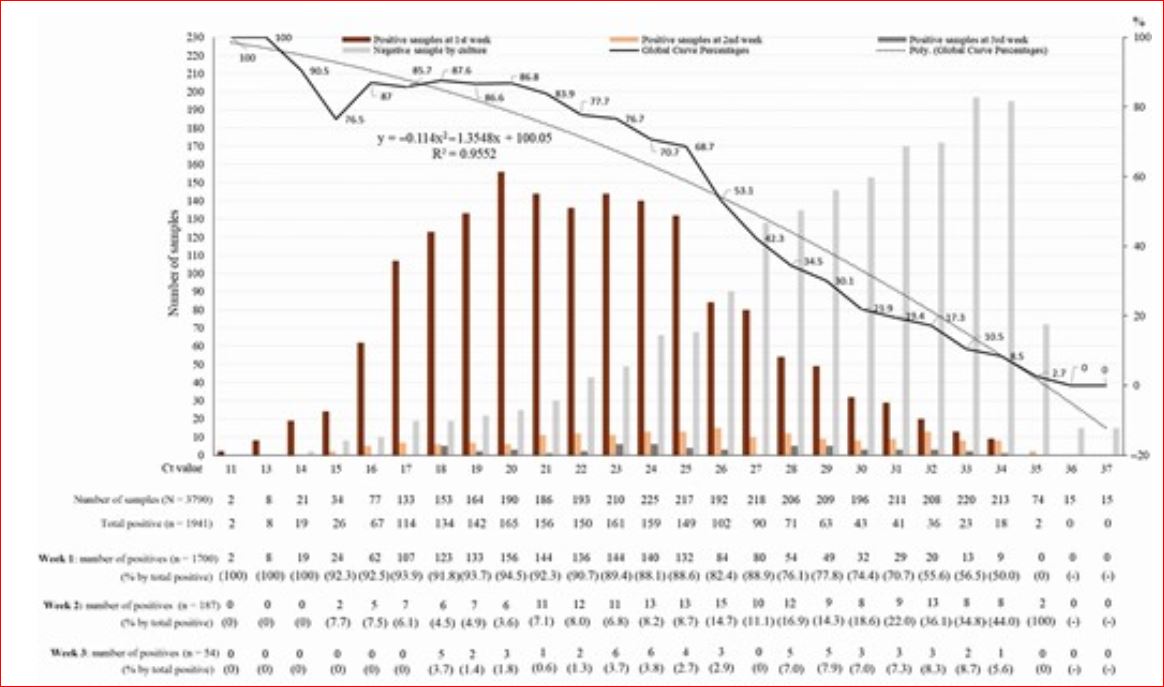
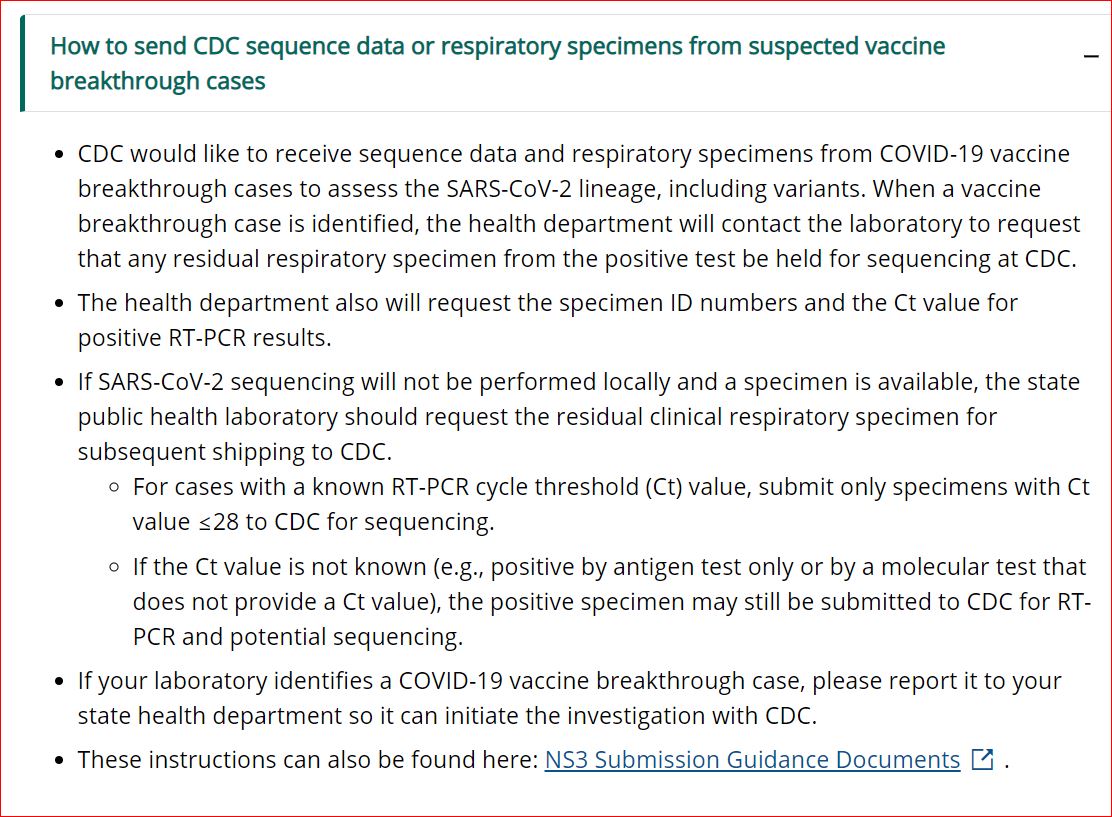
7/21/21, End of an era: Covid PCR tests no longer approved in US: “After December 31, 2021, CDC will withdraw the request to the U.S. Food and Drug Administration (FDA) for Emergency Use Authorization (EUA) of the CDC…RT-PCR Diagnostic Panel.”...07/21/2021: “Lab Alert: Changes to CDC RT-PCR for SARS-CoV-2 Testing,” cdc.gov
……………………….
Vaccines “provide immunity.”…Vaccines “produce immunity.”…”Unlike most medicines, which treat or cure diseases, vaccines prevent them.“…“Will covid-19 vaccines save lives? Current trials aren’t designed to tell us,” Peter Doshi, BMJ…Preventing transmission: “After three doses of OPV [Oral Polio Vaccine], a person becomes immune for life and can no longer transmit the virus to others if exposed again….IPV [Inactivated Polio Vaccine given by injection] prevents infection but does not stop transmission of the virus.”
July 23, 2021, “New Normal Newspeak #2: “Vaccine:”” Off Guardian
“If the Covid19 shots “reduce symptoms,” but don’t prevent infection or transmission…are they truly “vaccines”?”
““New Normal Newspeak” is a series of short articles highlighting how our language has come under assault in the past eighteen months.”
*“Vaccine” is a word a with a simple meaning. I’ll quote it to you, from the Oxford dictionary:
“A substance used to stimulate the production of antibodies and provide immunity
against one or several diseases, prepared from the causative agent of a
disease, its products, or a synthetic substitute, treated to act as an
antigen without inducing the disease.”
And here, from the CDC’s website:
“Vaccine: A product that stimulates a person’s immune system to produce immunity to a specific disease, protecting the person from that disease.””…
[Also CDC, “Vaccines: The Basics...After getting vaccinated, you develop immunity to that disease, without having to get the disease first. This is what makes vaccines such powerful medicine. Unlike most medicines, which treat or cure diseases, vaccines prevent them.“]
Encyclopedia Brittanica says more or less the same. As does dictionary.com. Cambridge University. Merriam Webster. You get the point.
A “vaccine” is substance that, when introduced into a body, “provides immunity” to a specific disease. This person, now immune, is therefore incapable of passing that disease on to others.
This is the entire point of vaccination….
The “vaccine” for Covid19 – whether from Pfizer, Moderna, AstraZeneca or Johnson&Johnson [Janssen]– is being pushed everywhere you look. These companies have made billions in the last year selling hundreds of millions of doses of their “vaccines”. [Per FDA “Emergency” status, no claim is made as to vaccine’s effectiveness: “At this time, data are not available
to make a determination about how long the vaccine will provide
protection, nor is there evidence that the vaccine prevents transmission
of SARS-CoV-2 from person to person.“…[Updates on Pfizer and Moderna: “On June 25, 2021, the FDA revised the patient and provider fact sheets regarding the suggested increased risks of myocarditis (inflammation of the heart muscle) and pericarditis (inflammation of the tissue surrounding the heart) following vaccination.“...Update on Janssen (Johnson and Johnson] vaccine: “On April 23, 2021, the FDA amended the EUA to include information about a very rare and serious type of blood clot in people who receive the vaccine.”]
But given the above definitions, do the Covid19 jabs qualify? Or is “vaccine” another word whose meaning is being changed before our eyes?
As of today, it is readily admitted that Covid “vaccines” do not confer immunity from infection and do not prevent you from passing the disease onto others. Indeed, an article in the British Medical Journal highlighted that the vaccine studies were not designed to even try and assess if the “vaccines” limited transmission.
The media, and government statements, are full of statements to the contrary, but they are heavy with “likely”, “probable” and “could”.
The vaccine manufacturers themselves, upon releasing the untested mRNA gene therapies, were quite clear their product’s “efficacy” was based on “reducing the severity of symptoms”.
Based on that, and the English language, it could be argued that what we’re all being encouraged to take is NOT actually a “vaccine” in the true sense of the word.
So maybe we should stop calling it that.”
…………………………….
Added: Ongoing trials aren’t testing whether vaccine prevents vaccinated person from transmitting virus to anyone else. Via BMJ.com, 10/21/20


Nor do trials assess if vaccines prevent deaths: “Tal Zaks, chief medical officer at Moderna,...said, “Would I like to know that this prevents mortality? Sure, because I believe it does. I just don’t think it’s feasible within the timeframe [of the trial]—too many would die waiting for the results before we ever knew that.””
Oct. 21, 2020, “Will covid-19 vaccines save lives? Current trials aren’t designed to tell us,” British Medical Journal, Peter Doshi, Associate Editor
“BMJ 2020; 371 doi: https://doi.org/10.1136/bmj.m4037 (Published 21 October 2020) Cite this as: BMJ 2020;371:m4037″
“The world has bet the farm on vaccines as the solution to the pandemic, but the trials are not focused on answering the questions many might assume they are. Peter Doshi reports.
As phase III trials of covid-19 vaccines reach their target enrollments,
officials have been trying to project calm. The US coronavirus czar
Anthony Fauci and the Food and Drug Administration leadership have
offered public assurances that established procedures will be followed.1234 Only a “safe and effective” vaccine will be approved, they say, and nine vaccine manufacturers issued a rare joint statement pledging not to prematurely seek regulatory review.5
But what will it mean exactly when a vaccine is declared “effective”? To the public this seems fairly obvious. “The primary goal of a covid-19 vaccine is to keep people from getting very sick and dying,” a National Public Radio broadcast said bluntly.6
Peter Hotez, dean of the National School of Tropical Medicine at Baylor College of Medicine in Houston, said, “Ideally, you want an antiviral vaccine to do two things...first, reduce the likelihood you will get severely ill and go to the hospital, and two, prevent infection and therefore interrupt disease transmission.”7
Yet the current phase III trials are not actually set up to prove either (table 1). None of the trials currently under way are designed to detect a reduction in any serious outcome such as hospital admissions, use of intensive care, or deaths. Nor are the vaccines being studied to determine whether they can interrupt transmission of the virus.
Table 1
Characteristics of ongoing phase III covid-19 vaccine trials
Evaluating mild, not severe, disease
In a September interview Medscape editor in chief Eric Topol pondered what counts as a recorded “event” in the vaccine trials. “We’re not talking about just a PCR [polymerase chain reaction test]-positive mild infection. It has to be moderate to severe illness to qualify as an event, correct?” he asked.8
“That’s right,” concurred his guest, Paul Offit, a vaccinologist who sits on the FDA advisory committee that may ultimately recommend the vaccines for licence or emergency use authorisation.
But that’s not right. In all the ongoing phase III trials for which details have been released, laboratory confirmed infections even with only mild symptoms qualify as meeting the primary endpoint definition. 9101112 In Pfizer and Moderna’s trials, for example, people with only a cough and positive laboratory test would bring those trials one event closer to their completion.
(If AstraZeneca’s ongoing UK trial is designed similarly to its
“paused” US trial for which the company has released details, a cough
and fever with positive PCR test would suffice.)
Part of the reason may be numbers. Severe illness requiring hospital admission, which happens in only a small fraction of symptomatic covid-19 cases, would be unlikely to occur in significant numbers in trials.
Data published by the US Centers for Disease Control and Prevention in
late April reported a symptomatic case hospitalisation ratio of 3.4%
overall, varying from 1.7% in 0-49 year olds and 4.5% in 50-64 year olds
to 7.4% in those 65 and over.13 Because most people with symptomatic covid-19 experience only mild symptoms,14 even trials involving 30 000 or more patients would turn up relatively few cases of severe disease.
In the trials, final efficacy analyses are planned after
just 150 to 160 “events,”—that is, a positive indication of symptomatic
covid-19, regardless of severity of the illness.
Yet until vaccine manufacturers began to release their study protocols in mid-September [2020], trial registries and other publicly released information did little to dispel the notion that it was severe covid-19 that the trials were assessing. Moderna, for example, called hospital admissions a “key secondary endpoint” in statements to the media.15 And a press release from the US National Institutes of Health reinforced this impression, stating that Moderna’s trial “aims to study whether the vaccine can prevent severe covid-19” and “seeks to answer if the vaccine can prevent death caused by covid-19.”16
But Tal Zaks, chief medical officer at Moderna, told The BMJ that the company’s trial lacks adequate statistical power to assess those outcomes. “The trial is precluded from judging [hospital admissions], based on what is a reasonable size and duration to serve the public good here,” he said.
Hospital admissions and deaths from covid-19 are simply too uncommon in the population being studied for an effective vaccine to demonstrate statistically significant differences in a trial of 30,000 people. The same is true of its ability to save lives or prevent transmission:
the trials are not designed to find out.
Zaks said, “Would I like to know that this prevents mortality? Sure, because I believe it does. I just don’t think it’s feasible within the timeframe [of the trial]—too many would die waiting for the results before we ever knew that.”
Stopping transmission
What about Hotez’s second criterion, interrupting virus transmission, which some experts have argued 17 should be the most important test in phase III studies?
“Our trial will not demonstrate prevention of transmission,” Zaks said, “because in order to do that you have to swab people twice a week for very long periods, and that becomes operationally untenable.”
He repeatedly emphasised these “operational realities” of running a vaccine trial. “Every trial design, especially phase III, is always a balancing act between
different needs,” he said. “If you wanted to have an answer on an
endpoint that happens at a frequency of one 10th or one fifth the
frequency of the primary endpoint, you would need a trial that is either
5 or 10 times larger or you’d need a trial that is 5 or 10 times longer
to collect those events. Neither of these, I think, are acceptable in the current public need for knowing expeditiously that a vaccine works.”
Zaks added, “A 30,000 [participant] trial is already a fairly large trial. If you’re asking for a 300,000 trial then you need to talk to the people who are paying for it, because now you’re talking about not a $500m to $1bn trial, you’re talking about something 10 times the size. And I think the public purse and operational capabilities and capacities
we have are rightly spent not betting the farm on one vaccine but, as
Operation Warp Speed [the US government’s covid-19 vaccine plan] is
trying to do, making sure that we’re funding several vaccines in
parallel.””…
[30,000? Polio vaccine was tested on 1.8 million children: “The [polio] vaccine was tested in massive field trials, beginning in 1954, that involved 1.8 million schoolchildren” “sponsored by the National Foundation for Infantile Paralysis (March of Dimes).” “The US government approved the Salk polio vaccine for the public on April 12, 1955.]
Debating endpoints
Still, it’s fair to say that most of the general public assumes that the whole point of the current trials, besides testing safety (box 1), is to see whether the vaccine can prevent bad outcomes. “How do you reconcile that?” The BMJ asked Zaks.
Box 1
Safety and side effects
History shows many examples of serious adverse events from vaccines brought to market in periods of enormous pressure and expectation.
There were contaminated polio vaccines in 1955, cases of Guillain-Barré
syndrome in recipients of flu vaccines in 1976, and narcolepsy linked
to one brand of influenza vaccine in 2009.1819
“Finding severe rare adverse events will require the study of tens of thousands of patients, but this requirement will not be met by early adoption of a product that has not completed its full trial evaluation,” Harvard drug policy researchers Jerry Avorn and Aaron Kesselheim recently wrote in JAMA. 20
Covid-19 vaccine trials are currently designed to tabulate
final efficacy results once 150 to 160 trial participants develop
symptomatic covid-19—and most trials have specified at least one interim
analysis allowing for the trials to end with even fewer data accrued.
Medscape’s Eric Topol has been a vocal critic of the trials’ many interim analyses. “These numbers seem totally out of line with what would be considered stopping rules,” he says. “I mean, you’re talking about giving a vaccine with any of these programmes to tens of millions of people. And you’re going to base that on 100 events?” 8
Great uncertainty remains over how long a randomised trial of a vaccine will be allowed to proceed.
If efficacy is declared, one possibility is that the thousands of
volunteers who received a saline placebo would be offered the active
vaccine, in effect ending the period of randomised follow-up. Such a
move would have far reaching implications for our understanding of
vaccines’ benefits and harms, rendering uncertain our knowledge of
whether the vaccines can reduce the risk of serious covid-19 disease and
precluding any further ability to compare adverse events in the
experimental versus the placebo arm.
“It’ll be a decision we’ll have to take at that time. We have not committed one way or another,” Moderna’s Tal Zaks told The BMJ. “It will be a decision where FDA and NIH will also weigh in. And it will be probably a very difficult decision, because you will be weighing the benefit to the public in continuing to understand the longer term safety by keeping people on placebo and the expectation of the people who have received placebo to be crossed over now that it has been proved effective.”
RETURN TO TEXT
“Very simply,” he replied. “Number one, we have a bad outcome as our endpoint. It’s covid-19 disease.” Moderna, like Pfizer and Janssen, has designed its study to detect a relative risk reduction of at least 30% in participants developing laboratory confirmed covid-19, consistent with FDA and international guidance.2122
Number two, Zaks pointed to influenza vaccines, saying they protect against severe disease better than mild disease. To Moderna, it’s the same
for covid-19: if its vaccine is shown to reduce symptomatic covid-19,
it will be confident it also protects against serious outcomes.
But the truth is that the science remains far from clear cut,
even for influenza vaccines that have been used for decades. Although
randomised trials have shown an effect in reducing the risk of
symptomatic influenza, such trials have never been conducted in elderly people living in the community to see whether they save lives.
Only two placebo controlled trials in this population have ever been conducted, and neither was designed to detect any difference in hospital admissions or deaths.23 Moreover, dramatic increases in use of influenza vaccines has not been associated with a decline in mortality (box 2).26
Box 2
Not enrolling enough elderly people or minorities
A vaccine that has been proved to reduce the risk of symptomatic disease by a certain proportion should, you might think, reduce serious outcomes such as hospital admissions and deaths in equal proportion.
Peter Marks, an FDA official with responsibility over vaccine approvals, recently stated as much about influenza vaccination, which “only prevents flu in about half the people who get it. And yet that’s very important because that means that it leads to half as many deaths related to influenza each year.”24
But when vaccines are not equally effective in all populations the theory breaks down.
If frail elderly people, who are understood to die in disproportionate numbers from both influenza 25 and covid-19, are not enrolled into vaccine trials in sufficient numbers to determine whether case numbers are reduced in this group, there can be little basis for assuming any benefit in terms of hospital admissions or mortality.
Whatever reduction in cases is seen in the overall study population
(most of which may be among healthy adults), this benefit may not apply
to the frail elderly subpopulation, and few lives may be saved.
This is hard to evaluate in the current trials because there are large gaps in the types of people being enrolled in the phase III trials (table 1). Despite recruiting tens of thousands, only two trials are enrolling children less than 18 years old. All exclude immunocompromised people and pregnant or breastfeeding women, and though the trials are enrolling elderly people, few or perhaps none of the studies would seem to be designed to conclusively answer whether there is a benefit in this population, despite their obvious vulnerability to covid-19.
“Adults over 65 will be an important subgroup that we will be looking at,” Moderna’s Zaks told The BMJ. “That said…any given study is powered for its primary endpoint—in our case covid-19 disease irrespective of age.”
Al Sommer, dean emeritus of the Johns Hopkins School of Public Health, told The BMJ, “If they have not powered for evidence of benefit in the elderly, I would find that a significant, unfortunate shortcoming.” He emphasised the need for “innovative follow-up studies
that will enable us to better determine the direct level of protection
immunisation has on the young and, separately, the elderly, in addition
to those at the highest risk of severe disease and hospitalisation.”
One view is that trial data should be there for all target populations. “If we don’t have adequate data in the greater than 65 year old group, then the greater than 65 year old person shouldn’t get this vaccine, which would be a shame because they’re the ones who are most likely to die from this infection,” said vaccinologist Paul Offit. 8
“We have to generate those data,” he said. “I can’t see how anybody—the
Data and Safety Monitoring Board or the FDA Vaccine Advisory Committee,
or FDA decision-makers—would ever allow a vaccine to be recommended for
that group without having adequate data.”
“I feel the same way about minorities,” Offit
added. “You can’t convince minority populations to get this vaccine
unless they are represented in these trials. Otherwise, they’re going to feel like they’re guinea pigs, and understandably so.””
RETURN TO TEXT
Acknowledgments
Sarah Tanveer helped research the design of studies and
identify quotations, and Ulrich Keil provided comments on an early draft
of this article.
Footnotes
This article is made freely available for use in accordance
with BMJ’s website terms and conditions for the duration of the covid-19
pandemic or until otherwise determined by BMJ. You may use, download
and print the article for any lawful, non-commercial purpose (including
text and data mining) provided that all copyright notices and trade
marks are retained.
https://bmj.com/coronavirus/usage
………………………………
……
…..
BMJ 2020; 371 doi: https://doi.org/10.1136/bmj.m4058 (Published 21 October 2020) Cite this as: BMJ 2020;371:m4058
…..
“The ongoing phase III trials for covid-19 vaccines are some of the most consequential randomised trials ever done. In September [2020], following months of campaigning for greater openness,12 four manufacturers made their full study protocols publicly available.3456
The publications create a rare opportunity for “real time transparency”
in which the conduct of clinical trials is opened to public scrutiny
while the studies are still under way.
Whatever the results ultimately show, public release of these protocols—each over 110 pages containing far greater detail than was previously available—enables a more scientific, deliberative, and inclusive trial process. While protocol transparency is not new—and is already common for high impact trials7—transparency in real time is an important development and a great win for public trust.
We may not like what we read, but with real time sharing of
full protocols comes an unprecedented space for translating critique
into action to improve trial design mid-stream. And there is much to critique.
The first question is whether the right endpoints are being studied. Contrary to prevailing assumptions (including those of a former Food and Drug Administration commissioner8),
none of the vaccine trials are designed to detect a significant reduction in hospital admissions, admission to intensive care, or death.9
Rather than studying severe disease, these mega-trials all set a primary endpoint of symptomatic covid-19 of essentially any severity: a laboratory positive result plus mild symptoms such as cough and fever count as outcome events (table 1). These studies seem designed to answer the easiest question in the least amount of time, not the most clinically relevant questions.
Table 1
Details from the trial protocols for covid-19 vaccines3-6
We shouldn’t be surprised. Regulators not only agree with these endpoints but have prespecified the “success” criterion as 50% efficacy against the primary endpoint (with a confidence interval that includes efficacy as low as 30%).10
Considering that these are relative risk reductions, absolute risk
reduction will be important to assess once results are in, especially to
assess benefit-risk profiles in healthy populations.
Built for speed
The second question is whether the trials are recruiting people at high risk. The study protocols suggest this intention, but sample size calculations were apparently based on the expectation of very low event rates in the control arm—around 1% a year for some trials. If these predictions are accurate, 99% of participants receiving a placebo will not develop symptomatic covid-19 over the next year, leading to large “number needed to treat to benefit” estimates.
The covid-19 vaccine protocols should be scrutinised by the widest possible readership, to open a critical discussion of many questions about their design and conduct. These include why children, immunocompromised people, and pregnant women have been excluded from most trials; whether the right primary endpoint has been chosen; whether safety is being adequately evaluated; and whether gaps in our understanding of the clinical implications of pre-existing T cell responses to SARS-CoV-2 are being addressed.11
We still have time to advocate for changes to ensure these
trials investigate the questions that most need answers. While the
notion of “moving the goalposts” during ongoing trials may raise
concerns, meaningful, scientifically valid, transparently reported
amendments to protocols that are made to improve the value of trial
results should always be welcomed.
Critical appraisal of clinical evidence traditionally
occurs after the publication of studies, and generally finds much to
criticise. Early release of full trial protocols offers a historic opportunity for the democratisation of science. The covid-19 vaccine trials may not have been designed with our input, but it is not too late to have our say and adjust their course. With stakes this high, we need all eyes on deck.
Footnotes
Competing interests: I have read and understood BMJ policy on
declaration of interests and declare I have been campaigning for greater
clinical trial data transparency of covid-19 products.
Provenance and peer review: Commissioned; not externally reviewed.
This article is made freely available for use in accordance
with BMJ’s website terms and conditions for the duration of the covid-19
pandemic or until otherwise determined by BMJ. You may use, download
and print the article for any lawful, non-commercial purpose (including
text and data mining) provided that all copyright notices and trade
marks are retained.
https://bmj.com/coronavirus/usage
...............