George Soros gave Ivanka's husband's business a $250 million credit line in 2015 per WSJ. Soros is also an investor in Jared's business.

Sunday, June 13, 2021

Pretending to know things about CO2 that are unknown or unknowable is just a side conversation to the main issue which is the US political class consigning unwanted Americans to the world's most repulsive parasite, Prince Charles

Speaking at World Economic Forum “The Great Resetevent in June 2020, Prince Charles said, We have a golden opportunity to seize something good from this [Covid] crisis–its unprecedented shockwaves may well make people more receptive to big visions of change,” he said. “It is an opportunity we have never had before and may never have again.””[Who is “we?”] 

June 12, 2021, “Is Climate Change ‘Science’?” American Thinker, Jonathon Moseley 

“Trust science, not the scientists.” That is the essence of science. That should be widely shared. Unfortunately, climate change advocates have completed the twisting of science (although this was well underway).

Science was created to eliminate opinions and the role of prestigious experts.

We are watching the rapid collapse of COVID-19 experts, like a house on a Malibu cliff after a heavy rain. Will the unsustainable hoax of climate change be far behind? The establishment system exalts experts if they advance statist goals. But the public rejects royalty. 

First, science has decayed into “Imagineering.” Thought experiments are not science.  (Imagining things can lead to proposed hypotheses. But a hypothesis must still be tested by hard-core experimentation.

Many argue desperately for speculation as being science when science was designed to avoid speculation.

What matters most is what we do not know.  The surprise factor between what we expected and what actually happens in real-world experiments is where discovery lives.  We don’t know what influences are happening that we did not know about.  That is why Imagineering is not science.

Second, so we have to run actual empirical experiments. To determine whether carbon dioxide (CO2) causes the Earth to be warmer would require experiments “with all other things being equal.” 

To qualify as science, we would need to contrast Earth A with no human industrial activity against Earth B with human industrial activity. All other things would have to remain the same, identically.  Then we would have to repeat that experiment.  So we would need Earth C, D, E, F, G, etc.

This cannot be done.  The correct response is for grown-ups to say “We don’t know.” But there is too much to gain in publicity and fame.  So we corrupt science to reach conclusions that cannot be scientifically confirmed.

There has never been an empirical experiment to test whether CO2 causes a planet to be warmer.  Have we tested Venus or Mars by removing some of the CO2 from those planets?   No.  Then we don’t know what role CO2 plays.  You can strongly believe it.  But that’s faith, not science.

Third, because it is impossible to test Earth A versus Earth B, climate change proponents are trying to use another “proxy” by comparing current time periods against the past. This is an attempt to fake up an experiment, substituting for Earth A versus Earth B.  Today is Earth A.  The past is Earth B.

But we cannot “hold all other factors constant across different time periods on Earth.  There are too many influences known and unknown changing over time.  We know that the Earth’s orbit changes shape under the influence of other planets in long-period oscillations called Milankovitch Cycles. So “Today’s Earth” vs. “Yesterday’s Earth” cannot replace an empirical experiment because we cannot control for other influences.

Fourth, the behavior of CO2 in a container in a laboratory cannot be projected to the open atmosphere. Climate change activists say that scientists prove in the laboratory that CO2 “traps” heat.

But the question is how does the planetary atmosphere of a gigantic planet behave?  We don’t care what CO2 does in a box in a lab. We care how the massively complex global climate responds.

Fifth, the reason why is because the atmosphere is in constant motion. All climate change theory is intrinsically grounded on the assumption that air cannot move. CO2, they argue, is like a “blanket.” But it is not.  Air is not nailed to the Earth’s surface. Therefore, we cannot take observations from an enclosed container and conclude anything about the open atmosphere, which is freely and constantly in motion.

The assertions of climate change are impossible to test. The Earth is too big. The atmosphere is too complex. There are too many forces at work, known and unknown.

Science presumes that what cannot be confirmed is treated as false (for now). We cannot pretend we know things we don’t know.
Sixth, what do we know?  We know that hot air rises. We know that the atmosphere circulates vertically through “convection.”  We know that convection is central to weather.  We know that heat at the Earth’s surface is transported up to high altitudes by convection. We know that the very purpose of weather and convection is to transport heat from the surface to the edge of space. We know that the heat is radiated into outer space.

Seventh, CO2 does not trap heat.  A CO2 molecule absorbs energy at frequencies determined by its electrons.  In one of the weirdest mysteries in physics, the absorption of electromagnetic radiation is converted into kinetic energy.  Increased vibration is experienced as heat (and pressure).

Then the CO2 molecule re-emits the energy.  A photon of infrared frequency energy is absorbed and re-emitted.  Then it is absorbed by another molecule.  Then re-radiated.  Absorbed, emitted, absorbed, emitted – maybe thousands of times per second. This is the opposite of trapping. 

But they say CO2 is “opaque” to infrared energy.  When CO2 re-emits heat energy it gets absorbed by another CO2 molecule. Again, that’s irrelevant, because the atmosphere moves vertically, transporting the heat up to space. It’s also wrong because everything absorbs heat. Put a penny out in the sunshine.  It will get hot, without being CO2.

Eighth, CO2 probably cools the earth. By absorbing heat and carrying it to the edge of space, CO2 would facilitate the release of heat out into space.

The air is thinner above, and thicker below. And the Earth is curved So at high altitudes, the probability of an IR photon escaping out into space is significantly greater than being re-absorbed by another air molecule.  The air is very thin at 5 to 10 miles up at the top of convection, and thinning even more rapidly above that.  There is a built-in bias causing heat emitted by CO2 molecules to leave the planet, not to stay.

Ninth, the quantity of plants can freely expand, especially algae and seaweed in the 70% of the Earth’s surface that is lakes and oceans.  If the Earth were warmer, rainfall would increase, droughts would decrease, and plants would proliferate with warmth, moisture, and more CO2.  We should expect proliferating plants to consume any CO2 surplus.

Tenth, we do not have scientifically valid temperature measurements earlier than World War II.  The machine to measure CO2 in the open atmosphere (meant to measure a patient’s breath) existed but did not work well before 1930. The earliest spotty records of temperature in only a few locations date back only to around 1850. An early advocate for global warming lamented that CO2 measurements were unreliable.

Because of the complex nature of the Earth, including many influences we probably don’t know about, we cannot use short periods of time to draw conclusions.  If we knew the Earth warmed over the last 200 years that would not tell us why, in the climate of a 4.5 billion-year-old planet.

It’s like saying I got my brakes changed, and then my house was struck by lightning.  Therefore, brake changes cause lightning.  Repeated experiments would be required on the hypothesis.  Just A happened, then B happened is not science.  Over such short periods of time, the noise of other phenomena drowns out any signal. 

The key to successful science is to isolate just one single cause and carefully measure its effect.  Climate change opinions do not meet these standards.”…image above of Prince Charles via Strategic Culture

…………………..

“To comment, you can find the MeWe post for this article here. If you would like to comment on this or any other American Thinker article or post, we invite you to visit the American Thinker Forum at MeWe. There, you can converse with other American Thinker readers and comment freely (subject to MeWe’s terms of use). The Forum will be fully populated and ready for comments by midday (Eastern time) each day.”


..............

Friday, June 11, 2021

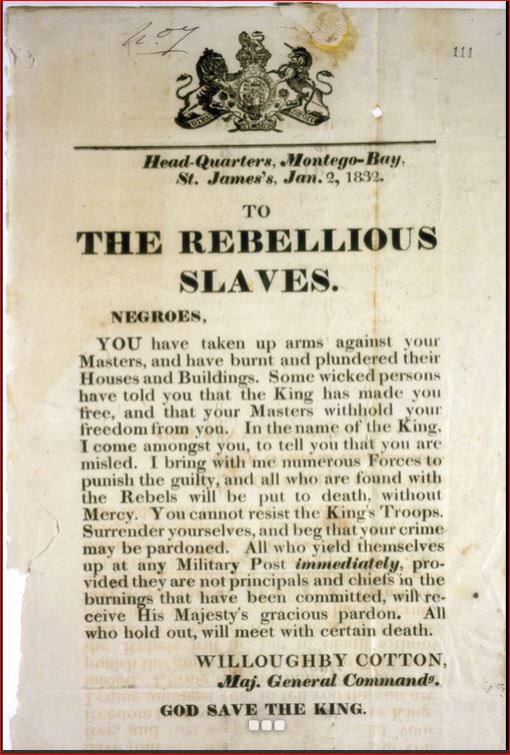
UK warned “rebellious slaves, Negroes” enslaved by UK on Jamaica's lucrative sugar plantations in 1832 to surrender or meet "certain death." "God save the King”

Slave Rebellion, Jamaica, 1832,” slaveryimages.org, “Dated Montego Bay, 2 January 1832, this poster or hand bill is an open letter to slave insurrectionists from the British military commander....This item was most probably printed in Jamaica, though it contains no imprint data.” The reigning UK monarch King William IV, born 1765, crowned King in 1830, died 1837, was a “British sea King, a maritime monarch.

Head-Quarters, Montego-Bay, St. James’s, Jan. 2, 1832″

You have taken up arms against your Masters, and have burnt and plundered their Houses and Buildings. Some wicked persons have told you that the King has made you free, and that your Masters withhold your freedom from you. In the name of the King, I come amongst you, to tell you that you are misled. I bring with me numerous Forces to punish the guilty, and all who are found with the Rebels will be put to death, without Mercy. You cannot resist the King’s Troops. Surrender yourselves, and beg that your crime may be pardoned. All who yield themselves up at any military post immediately, provided they are not principals and chiefs in the burnings that have been committed, will receive His Majesty’s gracious pardon. All who hold out, will meet with certain death.”

WILLOUGHBY COTTON,

Maj. General Command

GOD SAVE THE KING.”

…………………………………………

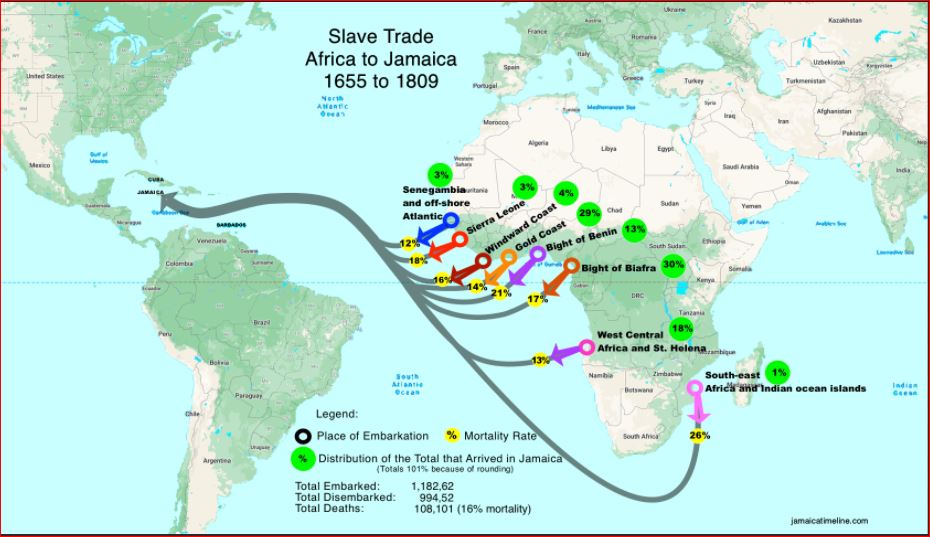
Added: 1655-1809- Slave voyages from Africa to Jamaica. UK profiteers needed 10,000 new African slaves every year for their Jamaica sugar death camps:

Above map, British slave trading, points of departure from Africa to Jamaica. Source: Slave Voyages Database-Trans-Atlantic Slave Trade-Estimates, via JamaicaGreatHouses.com

………………………………………..

“Source: The National Archives, London (formerly, Public Record Office), CO 137/181″

……………………………………..

Additional credit:

“The proclamation is briefly discussed in Mary Turner, Slaves and Missionaries (University of Illinois Press, 1982), p. 16 (thanks to Gad Heuman).”

………………………………………

Added: UK said it couldn’t survive, couldn’t wage war, without profits from Caribbean slave labor: George III in 1779 said, “if we lose our Sugar Islands it will be impossible to raise Money to continue the War.”The Caribbean slave colonies, particularly Jamaica, powered the Atlantic trading system and served as the economic hub of the British Atlantic empire.Defending Britain’s sugar-producing Caribbean colonies, which generated revenue vital to national security, took precedence over reclaiming the [US] rebel territories."King William IV in early 1800s was keen to integrate new technology of steam propulsion throughout the Royal Navy. (Oops-they say the steam engine kick-started the industrial revolution which allegedly caused so-called global warming, UK’s “historic climate debt,” and its “selfish appropriation of more than its fair share of the atmosphere.”)

1/21/2019, Uncovering Royal Perspectives on Slavery, Empire, and the Rights of Colonial Subjects," georgianpapers.com, by Brooke Newman

“In 2017 I spent a month in the Royal Archives tracing how the Georgian monarchs responded to contemporary debates over the rights and duties of British colonial subjects and the slave trade during the age of Atlantic revolutions….

[During] George III’s reign, [1760 to 1820] Britain acquired new imperial territories,...lost the North American colonies follo­wing the American War of Independence in 1783, oversaw the establishment of the Sierra Leone colony in West Africa in 1787, and abolished the British slave trade in 1807….

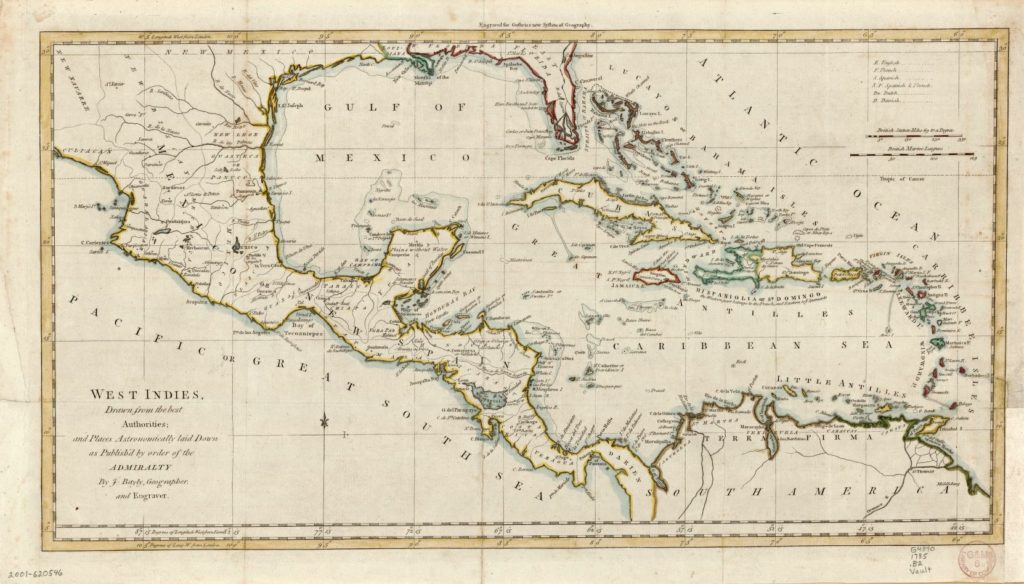
Map of the West Indies, 1785

As George III saw it, attempting to compromise with the [US] rebels would signal British weakness and further encourage colonists throughout Britain’s overseas territories to challenge the authority of the Mother Country.

Although Britain fought to retain control of the American colonies, the Calendar of George III underscores the economic and strategic importance of the British Caribbean islands throughout the American War of Independence. Defending Britain’s sugar-producing Caribbean colonies, which generated revenue vital to national security,

took precedence over reclaiming the [US] rebel territories.

Our Islands must be defended even at the risk of an Invasion of this Island,” George III stressed in a letter…dated September 13, 1779; “if we lose our Sugar Islands it will be impossible to raise Money to continue the War and then no Peace can be obtained but such as one as He that gave one to Europe in 1763 can never subscribe to” [2].

The Caribbean slave colonies, particularly Jamaica,

powered the Atlantic trading system and served as

the economic hub of the British Atlantic empire….

The British leadership concentrated on defending territories in the Caribbean and strategizing to act decisively if the opportunity arose to capture the most valuable sugar-producing island in the region: French Saint-Domingue. Troops must be sent sufficient to secure Jamaica and Barbados, the Capital Islands belonging to this Island,” George III wrote to Lord Sandwich. Indeed, “we must run any risks rather than not Secure them if in addition to this it can be found practicable to undertake any attack on St. Domingue it would be highly desirable [3].” After the American colonies declared independence from Britain in 1783,

the Caribbean remained a region of vital significance to the Crown….

The surviving papers of George III’s third son, Prince William, Duke of Clarence (later William IV), who was the only member of the royal family to step foot in North America and the Caribbean while serving in the Royal Navy, help to shed light on the Crown’s perspectives on African slave trading and slavery in an era of revolutionary upheaval. In 1787, on a visit to Dominica, recaptured from France in 1783, Prince William saw colonial slavery firsthand and noted the island’s importance as a slave trading base. “The trade in slaves at this island is very great owing to our supplying the French with that valuable commodity,he observed in a private letter to George III [4]….

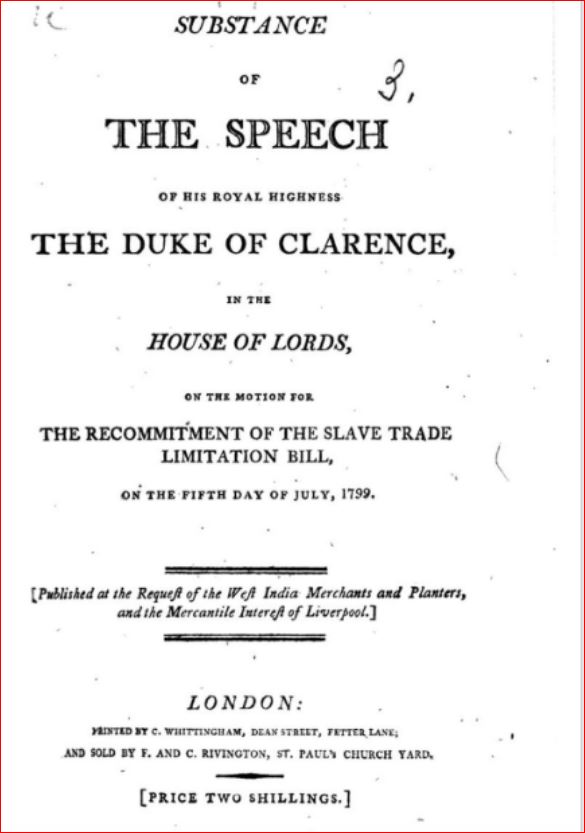
[Future King] Prince William, now the Duke of Clarence, emerged as a vocal defender of colonial slavery and a leading ally of the West India Committee in London. In 1799, in a reprinted and widely circulated pro-slavery speech delivered in the House of Lords, he referenced the long history of European involvement in the African slave trade and drew on his eyewitness knowledge of conditions in the Caribbean islands….The abolitionist campaign to end the slave trade, he argued, was not only radical and misguided,…but also deeply damaging to Britain’s national interests.”…

Notes

[1] GEO/MAIN/2564, His Majesty King George III to Lord North, 31 May 1777.

[2] GEO/MAIN/3518, His Majesty King George III to Lord Sandwich, 13 September 1779.

[3] GEO/MAIN/3520, His Majesty King George III to Lord Sandwich, 13 September 1779.

[4] GEO/MAIN/44732-44735, Prince William to His Majesty King George III, written aboard HMS Pegasus in the English Harbour, 7 January 1787.

Image Credits

Letter from Prince William to George III, written aboard HMS Pegasus in the English Harbour. Image provided courtesy of the Royal Archives, ref. GEO/MAIN 44732.

“Map of the West Indies,” by J. Bayly. London, 1785. Image provided courtesy of the Library of Congress.

“An Allegorical Representation of his Majesty King George the Third.” Mezzotint. Published by Laurie and Whittle, London, 1794. Image provided courtesy of the British Museum.

“Wouski,” by James Gillray. Hand-coloured etching. Published by Hannah Humphrey, New Bond St., January 23, 1788. Image provided courtesy of the British Museum.

Substance of the Speech of His Royal Highness the Duke of Clarence, in the House of Lords, on the Motion for the Recommitment of the Slave Trade Limitation Bill, on the Fifth Day of July, 1799. London, 1799.”

“”Dr. Newman is Associate Professor of History and Associate Director of the Humanities Research Center at Virginia Commonwealth University. She was awarded an Omohundro Institute Georgian Papers Programme Fellowship in 2017.”

………………………………………..

Extra: The UK “annexed Magnetic North to the British Crown on 1 June 1831.”

[King] William [IV] also ran a distinctly naval court. Key household offices were deliberately allotted to sailors, while the naval heroes of the Napoleonic wars were prominent there….He also rewarded successful explorers, including naval Captain James Clark Ross, who annexed Magnetic North to the British Crown on 1 June 1831.”…


..................

Thursday, June 10, 2021

In 1565 after he made huge profits selling African slaves in the West Indies, Queen Elizabeth I awarded John Hawkins a Coat of Arms featuring a dark-skinned slave “bound and captive” and gave Hawkins ships and guns for more slave trading

John Hawkins, 1532-1595, “was the first Englishman to regularly trade in slaves. He “pioneered the Atlantic triangular slave trade by being the first merchant to follow the route and turn a profit at each stop.”

Sir John Hawkins:

“After marrying the daughter of the Treasurer of the Navy, John formed a syndicate of wealthy London merchants to back a new venture trading against Spanish law with the Spanish Colonies in the Americas. These colonies were very short of labour and John Hawkins aimed to take slaves by force in Africa and trade them for the produce of Spanish America. This would produce a double turnover in one voyage. A huge profit would be made.

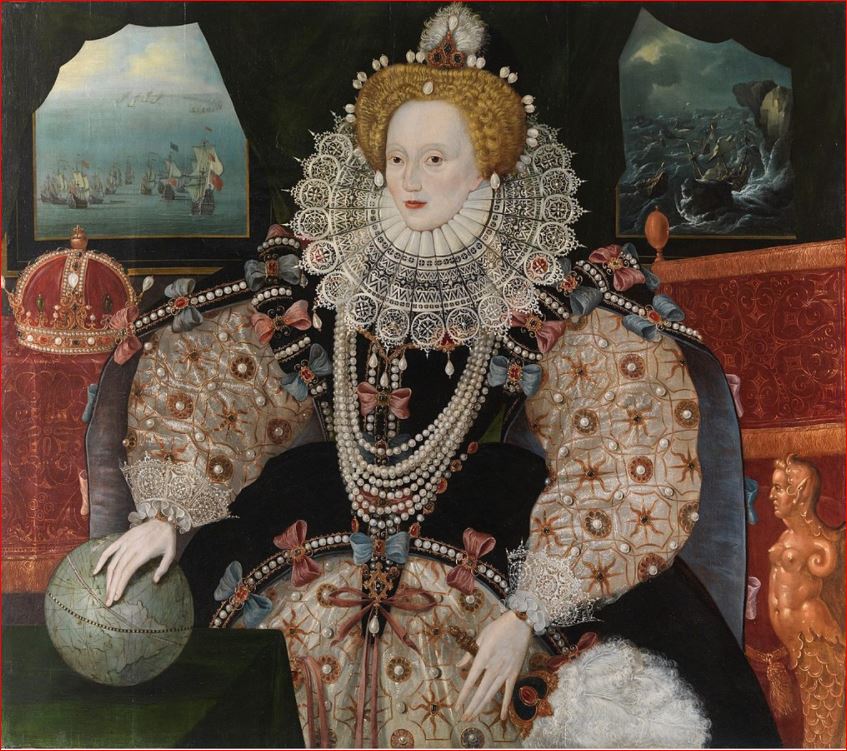
[Image, Queen Elizabeth I, 1588, “Armada Portrait Elizabeth I Queens House. “The portrait was made to commemorate the defeat of the Spanish Armada (depicted in the background)” Born 1533, ascended to throne in 1558, died 1603]

He sailed from Plymouth in 1562 with three ships. He violently kidnapped about four hundred Africans in Guinea and traded them in the West Indies for Elizabethan luxuries:- pearls, ginger, sugar and hides. He had become England’s first slave trader. He sailed again in 1564 from the Cattewater (part of the estuary of the river Plym) with four ships. The syndicate this time included Queen Elizabeth I, Navy Board Officers and members of the Privy Council. He violently enslaved around five hundred people in Guinea and traded them in the West Indies [Caribbean]. His personal profit was huge and the Queen gave him a coat of arms. It had a bound slave as the crest.”…

[Image, A “bound and captive” dark skinned man “in his proper colour” tops the Coat of Arms awarded by Queen Elizabeth I to slave trader John Hawkins, 1/4/1565, “Arms granted to slave trader John Hawkins in 1565, for the massive profits he made in the slave trade. Sable on a point wavy, a lion passant or, in chief three bezants, crest, a demi Moor in his proper colour, bound and captive, with annulets in his arms and ears. Note the lion in the grant of arms is described as passant, but in the accompanying illustration is statant.” College of Arms, United Kingdom]

His missions were so lucrative that Queen Elizabeth I sponsored his subsequent journeys and provided ships, supplies and guns.”…

(continuing): “John Hawkins was responsible for seven ships in two squadrons sailing to Guinea in 1566. Another member of this expedition was Hawkins’ cousin Francis Drake. In 1567, after a service in St Andrews Church attended by the 400 men of his crews, he sailed to the West Indies via Guinea again. After much bloodshed on the Guinea coast 500 slaves were transported to the Caribbean. According to slavers accounts of the time this would probably have involved killing at least three times that number of people. Hawkins made three voyages to what is now Sierra Leone between 1562 and 1569 enslaving around 1,200 Africans.”…

Added:

Hawkins published a book in 1568, An Alliance to Raid for Slaves. An excerpt is provided in David Northrup book, “The Atlantic Slave Trade,” first published in 1994. Hawkins is in Sierra Leone seeking to obtain “Negroes, is approached by a local Negro on behalf of a local king who offers Hawkins a deal. If Hawkins and his men will help the local king defeat some nearby adversaries, Hawkins will be given a group of Negro slaves in return. Hawkins agrees but there were complications.


…………………………………..

Tuesday, June 8, 2021

Of the millions of slaves taken from Africa and sold in the new world, only about 5% of them went to America-BBC, “How Britain is facing up to its hidden slavery history”

About 30 million slaves were uprooted from Africa and sold in the new world,...but what a lot of people don’t know is that only something like 5% of those slaves went to America.“...The amount of taxpayer money used to pay off British slave owners for loss of their slaves “was so large that it wasn’t paid off until 2015. You have to ask, how come your tax money was paying off this compensation [to British slave owners], and you didn’t know about it, never learned about it in school.”Britain dispatched about 10,000 voyages to Africa for slaves” over a period 245 years beginning in 1562.

July 3, 2020, “How Britain is facing up to its hidden slavery history,” BBC.com, Holly Williams

“An estimated 2.3 million African slaves were sent to the British Caribbean, but compared to narratives about the US, these stories have been rarely told….

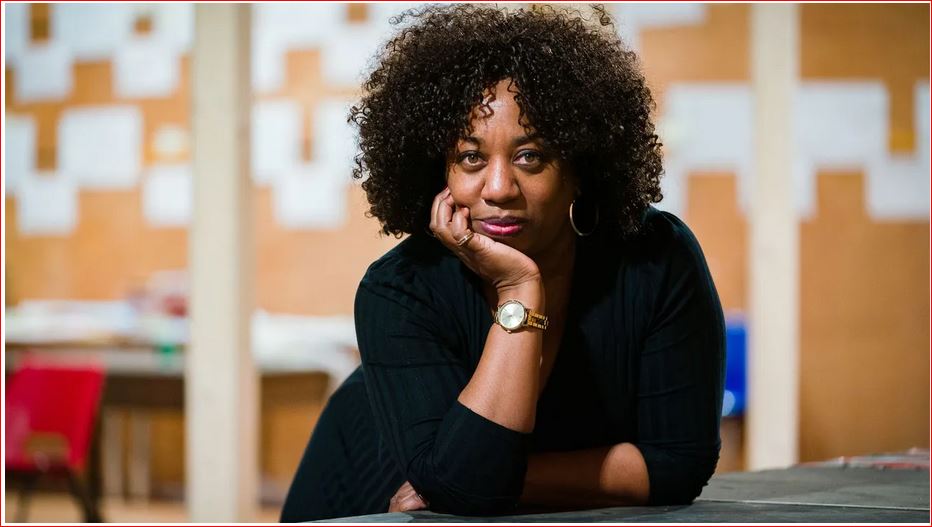
(Journalist turned playwright Juliet Gilkes Romero has written new play The Whip”..)

[Journalist-turned-playwright Juliet Gilkes] Romero believes it’s…who gets to tell what stories on the global stage. “We hear about black Americans, but we don’t hear the British stories. About 30 million slaves were uprooted from Africa and sold in the new world,…but what a lot of people don’t know is that only something like 5% of those slaves went to America, she points out; 55% were sold to Brazil and Spanish South America and 35% were sold in the West Indies [for British sugar plantations]. And yet the American narrative is first and foremost. That’s because of Hollywood–unless we’re telling these stories, people don’t know.”…

But Britain’s involvement is now starting to be subject to greater attention:...The Whip is, in fact, one of several British slavery narratives to get a high-profile airing….

Romero was commissioned to write the work in 2015but the subject gained traction when, in 2018, HM Treasury tweeted: “Here’s today’s surprising #FridayFact. Millions of you have helped end the slave trade through your taxesThe amount of money borrowed for the Slavery Abolition Act was so large that it wasn’t paid off until 2015. Which means that living British citizens helped pay to end the slave trade.”…

The British government spent £20 million, a staggering 40% of its budget in 1833, to buy freedom for slaves. That’s equivalent to approximately £20bn today, making it one of the biggest ever government bailouts. The cost was so high, the vast loans the government took out to fund it were only just paid off in 2015….

The money didn’t go to the slaves, but to their owners. That’s right: the British taxpayer, until five years ago, was paying off debts that the government racked up in order to compensate British slave owners for their loss of ‘property’….

And what’s even more shocking is that supposedly freed slaves were in fact committed to six to 12 years of further service as unpaid ‘apprentices’, meaning slave owners were compensated to the tunes of millions – and continued to get free labour. It wasn’t until 1838 that these…apprenticeships were abolished too, and slaves in the British Empire were truly emancipated….

Records show that ancestors of former Prime Minister David Cameron and authors George Orwell and Graham Greene all profited at the time from these massive pay-outs, as did Prime Minister William Gladstone, who helped his father claim for £106,769. That’s a payment of around £83 million in today’s money, to just a single family.

What blew me away was here I was, a working woman, a descendent of the transatlantic slave trade, and I helped pay off this massive loan,says Romero, whose parents came to the UK from Trinidad and Barbados in the 1960s. “That added urgency to what I wanted to write-I just thought I’ve got to get this out there.”…

Romero feels frustrated that the British public too often simply don’t know the real stories about our own shameful past – that, historically, we haven’t been told by our politicians, through our education systems, or through our art….

Romero says…“You have to wonder how much it was suppressed. You have to ask, how come your tax money was paying off this compensation, and you didn’t know about it, never learned about it in school.””…

……………………………………..

Added: Britain dispatched about 10,000 voyages to Africa for slaves” over a period 245 years beginning in 1562 during reign of Elizabeth 1.

“Life on the [sugar] plantations was extremely hard with a third of newly imported slaves dying within three years. This created a constant demand for new slaves to replace them.The sugar colonies were Britain’s most valuable colonies.Between 1750 and 1780, about 70% of the [UK] government’s total income came from taxes on goods from its colonies.The Caribbean islands became the hub of the British Empire....Britain dispatched about 10,000 voyages to Africa for slavesover a period 245 years beginning in 1562 during the reign of Elizabeth 1….Slave Trade was the richest part of Britain’s trade in the 18th century.”

“London, Sugar and Slavery permanent exhibition “documents how British involvement in slavery came about because of the growing consumption of tea and coffee. …This meant an increased need for sugar, and for cheap labor on colonial sugar cane plantations. On display is a tall collar with long spikes that slaves were forced to wear so that they would snag among the trees if they tried to escape.”.…”By the mid-1700s there were approximately 15,000 black servants-many of them slaves-in London.”

“"The formation of the City of London was shaped significantly by sugar, said Nick Draper, one of the lead researchers on University College London’s groundbreaking Legacies of British Slave Ownership project. “Merchants in London would advance credit to planters and guarantee remittances to slave traders so that London merchant houses became the center of this economic system built on Caribbean slavery.”” Bloomberg


..............

Sunday, June 6, 2021

City of London financed highly lucrative British slave trade, government's navy protected UK's 10,000+ trips to Africa to pick up slaves mainly for transport to Caribbean sugar plantation/death camps but some to remain in London-NY Times, Akhil Sharma, 6/13/14

“Life on the [sugar] plantations was extremely hard with a third of newly imported slaves dying within three years."...The “London, Sugar and Slavery” permanent exhibition “documents how British involvement in slavery came about because of the growing consumption of tea and coffee. …This meant an increased need for sugar, and for cheap labor on colonial sugar cane plantations. On display is a tall collar with long spikes that slaves were forced to wear so that they would snag among the trees if they tried to escape.”...Britain dispatched about 10,000 voyages to Africa for slaves” over a period 245 years beginning in 1562 during the reign of Elizabeth 1...."By the mid-1700s there were approximately 15,000 black servants-many of them slaves-in London." 

[Image, British sugar slaves:Enslaved people cutting sugarcane on the Caribbean island of Antigua, aquatint from Ten Views of the Island of Antigua by William Clark, 1832. The British Library”]

June 13, 2014, London’s Legacy in the Slave Trade,” NY Times, Akhil Sharma

“It was a bright Saturday morning, and the City of London, the financial district of the British capital, was empty. I was wandering its narrow side lanes seeking a sculpture….Finally, in a courtyard between office buildings I came upon it: “The Gilt of Cain,” by Michael Visocchi and Lemn Sissay.

A stone pulpit inscribed with a poem is flanked by a dozen tall abstracted figures a slave auction in progress. It is one of the few memorials to slavery in the city, a shocking fact considering how deeply involved London was in the international slave trade and how many slaves it had been home to over the years, until national abolition in 1833. [It wasn’t until 1838 that slavery was abolished in British Caribbean colonies].

Though it’s much less widely discussed than its American counterpart, London’s relationship to slavery is profound: The city financed and regulated the trade, and the government seated there sent out its navy to protect its shipping routes. In the 1710s and ’20s alone, British ships carried 200,000 slaves across the Atlantic. And, over the centuries, the trade led to a substantial African population in the capital. Even in 1596 their presence was so noticeable that Queen Elizabeth I ordered them to be expelled. Yet their presence only grew as the trade increased. Historians estimate that by the mid-1700s there were approximately 15,000 black servants — many of them slaves — in London, out of a population of around 700,000. Slavery there was as brutal as it was in Mississippi or Alabama; slaves were often beaten so badly that they died or became crippled.

[The formation of the City of London was shaped significantly by sugar, said Nick Draper, one of the lead researchers on University College London’s groundbreaking Legacies of British Slave Ownership project. “Merchants in London would advance credit to planters and guarantee remittances to slave traders so that London merchant houses became the center of this economic system built on Caribbean slavery." Bloomberg]

Slaves also became part of the city’s visual iconography. Crowds of civilians would watch army bands with slave members playing music influenced by their African background. Bakeries selling sweet treats often had Africans on their signage, as slavery was inextricably linked to sugar cane plantations. Many lanes and streets had names like Black Boy Lane and Blackmoor Alley.

I was in London to explore this complicated, layered legacy. The best place to begin such an overview is probably the old sugar warehouses on the West India Docks. These massive brick buildings along the Thames near Canary Wharf still have windows with thick ominous bars, used to prevent theft when sugar was precious. Today the warehouses contain shops, bars and restaurants, as well as a festive atmosphere; out front, buskers and children with painted faces share the sidewalk. During my visit, a man offered to show me how to ride a unicycle.

But inside one of the warehouses is a site with a darker mood: the Museum of London Docklands and its permanent exhibition on the slave trade, called “London, Sugar and Slavery,” It documents how British involvement in slavery came about because of the growing consumption of tea and coffee. This meant an increased need for sugar, and for cheap labor on colonial sugar cane plantations. The exhibition shows how sugar was produced and then sold in tall cones. On display is a tall collar with long spikes that slaves were forced to wear so that they would snag among the trees if they tried to escape.

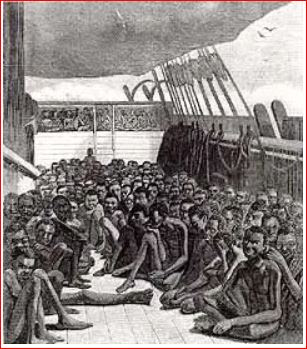
[“Life on the [sugar] plantations was extremely hard with a third of newly imported slaves dying within three years. This created a constant demand for new slaves to replace them.The sugar colonies were Britain’s most valuable colonies….Between 1750 and 1780, about 70% of the [UK] government’s total income came from taxes on goods from its colonies.The Caribbean islands became the hub of the British Empire....Britain dispatched about 10,000 voyages to Africa for slaves” over a period 245 years beginning in 1562 during the reign of Elizabeth 1….Slave Trade was the richest part of Britain’s trade in the 18th century.”British Involvement in the Transatlantic Slave Trade,” The Abolition Project…[Image: African slaves on British ship,

  schoolhistory.org.uk…]

The most chilling feature, though, is an understated wall with a chart that lists the ships that sailed from London. The column headings include the name of ships, their captains, the date the ships left London, their destination in Africa and the number of enslaved Africans they carried from there. I looked at each row of information and thought of how many lives and families had been shattered by the voyage described….

In 1783, Guildhall was the site of the infamous Zong Massacre trial. The Zong was a ship manned by slave traders; they decided to tie the hands and feet of 133 slaves and throw them overboard, and then tried to collect insurance on their dead cargo. When this horror began to be widely known, it pushed many who had been ambivalent about slavery to oppose it. The case was heard by William Murray, Lord Chief Justice and First Earl of Mansfield. A decade earlier, Murray had also been the judge who tried the Somerset case, an ambiguous decision that involved an escaped slave and colonial law and has been interpreted by some as a statement that slavery was unlawful in Britain….

It is easy to stand in the hushed and dignified National Portrait Gallery and think that slavery was brought to a close by elites writing letters to newspapers and giving speeches. Visiting the Parliamentary Archives creates a completely different, and more realistic, understanding: Abolition occurred only when the people in power became afraid of losing their seats in Parliament. Having made an appointment online, I visited the archive, slipping past tourists waiting in long lines and entering Parliament where workers do….

Melanie Unwin, the deputy curator of the Palace of Westminster Collection and one of the organizers of an exhibition on the ending of the slave trade that was held throughout London in 2007,..told me how few Londoners know about the history of slavery in their own city. “Most would be surprised that there were blacks in the U.K. before the 1950s.I had noted this surprising fact myself in conversations with white Britons — although everyone I spoke to did want to learn more.”…

……………………………………………………..

“Editors’ Note: After this article was published, editors learned that the writer had accepted free accommodations from the hotel that is mentioned. Times policy does not allow travel writers to accept such benefits; if editors had known in advance about the arrangement, the article would not have been published.”

…………………………………..

Added: Slave voyage estimates

Trans-Atlantic Slave trade estimates, 1501-1866

Flag

Spain / Uruguay
Portugal / Brazil
Great Britain
Netherlands
U.S.A.
France
Denmark / Baltic"


............

Followers

Blog Archive

About Me

My photo
I'm the daughter of an Eagle Scout and World War II Air Force pilot born in Brooklyn, finally settling in New Jersey.