The former Warsaw Pact states, anxious not to lower their guard over Russia, tried to calm the game.
Unlike the 1966 debates, when France refused to have its army
commanded by a senior US officer and withdrew from Integrated Command, the conflict is not about the independence of Alliance members from in the USA, but on the continuation of the Alliance itself.
Tracking the lot number of these Serbian weapons I was able toidentify and tracemortar shells in the hands of Islamic State terroristsin Yemenback to their buyer-the US Government.
What is at stake in Yemen? The war in Yemen is a proxy warfor control over one of the poorest countries in the world.
It has led, according to UN, to the world’s worst humanitarian crisis,
with an estimated 24 million people (close to 80 % of the population)
being in urgent need of protection and assistance. That includes two
million children under-five who are starving to death. It is a war between Iran, on the one hand, and the US, Saudi Arabia and UAE, on the other hand. The Islamic State, however, also plays a significant role in this armed conflict.The terrorist group in Yemen fights mainly against the Iran-backedHouthi rebels who control Northern Yemen.
End user-the Islamic State
On 27 July 2019 the Islamic State group released a propaganda video featuring its branch in Yemen. The video shows barbaric scenes of atrocities including shocking scenes of beheadings of people kept in captivity by the Islamic State in Yemen.One 5-second frame shows weapons purchased by the US government in the hands of the terrorists.Here
is how I discovered that. The mark on the mortar shells is clearly
visible – 82 mm M74 HE KV lot 04/18. The two letters KV mean that those
mortar shells were manufactured by the Serbian arms factory Krusik (K stands for Krusik and V – for Valjevo, the town where the factory is located). The following digits 04/18 mean that the mortar shells are lot 04, produced in 2018.
As I had already had documents about arms exports from Krusik I was able to trace back this particular lot 04/18. According to the documents, such 82 mm M74HE mortar shells KV lot 04/18 which appear in the Islamic State videoin Yemenwere purchased by the American company Alliant Techsystems LLC (a wholly owned subsidiary of ATK Orbital, USA)on behalf of the US Government. The exporter was the Serbian state-owned company Jugoimport SDPR. The packing list of the weapons for their export was signed on 12 February 2018.They were purchased under the contract MP00135498 between Jugoimports SDPR and Alliant Techsystems LLC, USA. The quantity of the weapons was 10,500 pcs.
According to the contract MP00135498, signed on 20 January 2017, the American company Alliant Techsystems LLCpurchased a total of 105,150 pcs. of 82 mm mortar shells “for the needs of the US Government”(za
potrebe VLADA SAD in Serbian in the original documents). The exporter
was Jugoimport SDPR, Serbia and the manufacturer – Krusik, Serbia. Both Serbian companies are state-owned and under the control of the Serbian government. The price of the deal indicated in the contract is $8,043,975.
Under the cover of NATO Operation Resolute Support
After I identified who had purchased this particular lot 04/18 in the Islamic State video in Yemen, I tracked how and when it was exported.
On 3 April 2018Jugoimport SDPR (the exporter) sent an e-mail to Krusik (the arms manufacturer) toconfirm a shipment on a Silk Way West Airlinesflight 7L9632 on 15 April 2018 to the destination Belgrade-Kabul-Baku.Jugoimport SDPR sent three packing lists so that Krusik prepare the shipment. The three packing lists were for the lots 04/18., 06/18, and 07/18 (10,500 pcs., 2,406 pcs., and 2,920 pcs. of mortar shells 82 mm M74 HE respectively). Alliant Techsystems LLC is indicated as the consignee of the weapons.
The next day (4 April 2018) Jugoimport SDPR sent a second e-mail informing Krusik that the plan had been changed. The shipment that was planned for export on the flight on 15 May 2018 must be prepared for export on a flight on 8 May 2018 (lots 04/18., 06/18, and 07/18). The other shipment that was planned for export on the flight on 8 May 2018 must be prepared for export on the flight on 15 May 2018 (8,500 pcs. of mortar shells 82 mm HE lot 05/18). Why the cargo was exchanged, Jugoimport SDPR did not clarify.
A total of 40,236 pcs. of 82 mm mortar shells HE were transported on four Silk Way flights in May 2018 with the end user being the Afghan National Police.All of them were purchased by Alliant Techsystems LLC (ATK) on behalf of the US Department of the Armyunder a $81.5 million US federal contract W52P1J16D0058-0006.
In the delivery plan which Alliant Techsystems LLC provided to Jugoimport and Krusik some of the Serbian mortar shells were re-exported via Burgas Airport in Bulgaria on three Silk Way flights on 25 April, 18 May and 29 May 2018.
Coincidentally, Bulgarian AR-SF rifles also appear in the hands of Islamic State terrorists in Yemen in the same video as the Serbian mortar shells from Krusik. This particular type of rifle is manufactured by the Bulgarian arms factory Arsenal.
A leaked e-mail between Jugoimport and Krusik dated 15 March 2018 reveal that the weapons exported on papers to the Afghan National Police (lots 06/18, 07/18 and 08/18) under the Pentagon contractW52P1J16D0058-0006 were shipped to storage depot 22 Bunkers, Pol-e Charki, Kabul. The weapons (lot 04/18) in the video of the Islamic State in Yemen were also shipped to that address but with an end user the Afghan National Army.
A number of companies are involved including Sierra Four Industries, Orbital ATK, Global Ordnance, and UDC in the United States, as well as the Azeri, Serbian, and Saudi governments.
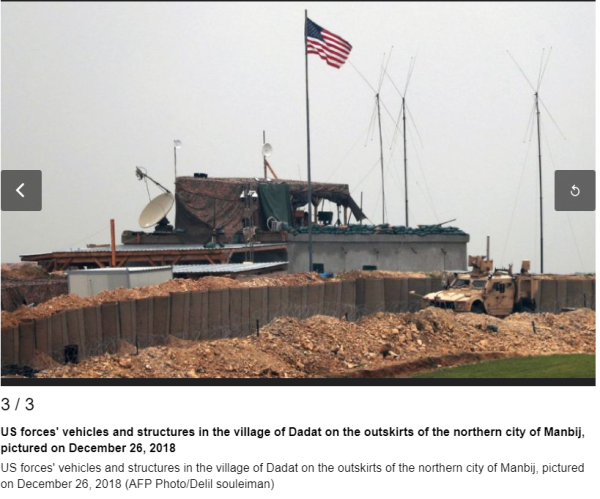
.“While Trump has ordered a partial withdrawal of the approximately 1,000 American troops on Syrian territory–who have been enforcing an illegal [US] military occupation under international law–U.S. officials and the president himself have admitted that some will be staying. And they will remain on Syrian soilnot to ensure to safety of any group of people, but rather to maintain control over oil and gas fields.
The U.S. military has already killed hundreds of Syrians, and possibly even some Russians,precisely in order to hold on to these Syrian fossil fuel reserves.
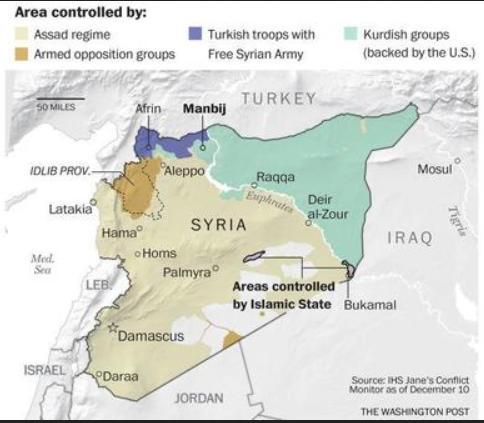
The Washington Post noted in 2018 that the U.S. and its Kurdish allies were militarily occupying a massive “30 percent slice of Syria, which is probably where 90 percent of the pre-war oil production took place.”
Now, for the first time, Trump has openly confirmed the imperialist ulterior motives behind maintaining a US military presence in Syria.
Three days earlier, the president tweeted, “The U.S. has secured the Oil.”
“Donald J. Trump ✔@realDonaldTrump
Just spoke to President @RTErdoganof Turkey.
He told me there was minor sniper and mortar fire that was quickly
eliminated. He very much wants the ceasefire, or pause, to work.
Likewise, the Kurds want it, and the ultimate solution, to happen. Too
bad there wasn’t…..this thinking years ago. Instead, it was always held
together with very weak bandaids, & in an artificial manner. There
is good will on both sides & a reallygood chance for success. The U.S. has secured the Oil,& the ISIS Fighters are double secured by Kurds & Turkey.”…
TheNew York Times confirmed the strategy on Oct. 20. Citing a “senior administration official,” the newspaper reported:
“President Trump is leaning in favor of a new Pentagon plan to keep a small contingent of American troops in eastern Syria, perhaps numbering about 200, to combat the Islamic State and block the advance of Syrian government and Russian forces into the region’s coveted oil fields.
…A side benefit would be helping the Kurds keep control of oil fieldsin the east, the official said.”
Trump then explicitly reiterated this policy in a White House press briefing on the Syria withdrawal on Oct. 23.
“We’ve secured the oil (in Syria), and therefore a small number of U.S. troops will remain in the areawhere they have the oil,” Trump said. “And we’re going to be protecting it. And we’ll be decidingwhat we’re going to do with it in the future.” .....
Using ISIS as Excuse
....
U.S. Secretary of Defense Mark Esper – the
former vice president of government relations at top weapons
manufacturer Raytheon, before being promoted by Trump to the head of the
Pentagon – revealed the actual U.S. policy on Syria in a press conference on the 21st:
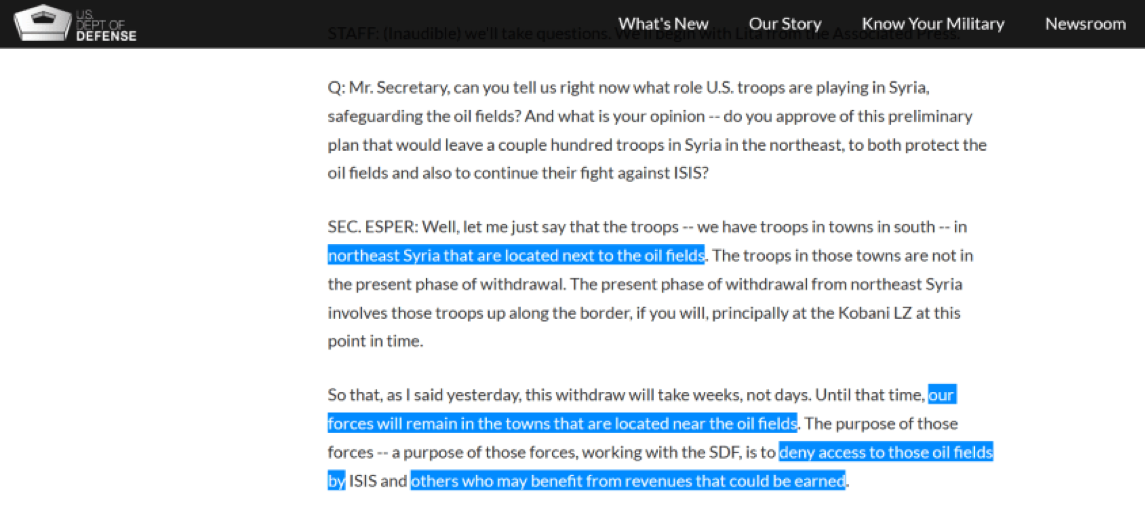
“We have troops in towns in northeast Syria that are located next to the oil fields. The troops in those towns are not in the present phase of withdrawal.
…Our forces will remain in the towns that are located near the oil fields.”
Esper added that the U.S. military is “maintaining a combat air patrolabove all of our forces on the ground in Syria.”
Unlike Trump, Esper offered an excuse to justify the continued U.S. military occupation of Syria’s oil fields. He insisted that American soldiers remain to help the Kurdish-led Syrian Democratic Forces (SDF) hold on to the resourcesand prevent ISIS jihadists from taking them over.
This led mainstream corporate media outlets like CNN to report, “Defense secretary says some U.S. troops will temporarily stay in Syria to protect oil fields from ISIS.”
But any observer who carefully parsed Esper’s comments during his press conference would have been able to detect the real goalbehind the prolonged U.S. presence in northeastern Syria. As Esper said, “A purpose of those [US] forces, working with the SDF, is to deny access to those oil fields by ISIS and others who may benefit from revenues that could be earned.”
......
“And otherswho may benefit from their revenues earned” is a crucial qualifier. In fact, Esper used this language-“ISIS and others”-two more times in his presser.
Who exactly Esper meant by “others” is clear: The U.S. strategy is to prevent Syria’s UN-recognized government and the Syrian majority that lives under its control from retaking their own oil fieldsand reaping the benefits of their revenue.
Hundreds Massacred
This is not just speculation. CNN made it plain when it reported the following [on 10/21] in an undeniably blunt passage, citing anonymous U.S. senior military officials:
“The US military has long had military advisers embedded with the Syrian Democratic Forces near the Syrian oil fields
at Deir Ezzoir ever since the area was captured from ISIS. The loss of
those oil fields denied ISIS a major source of revenue, a one-time
source of funds that has differentiated the organization from other
terror groups.
In a bid to seize the oil fields, Russian mercenaries attacked the areas, leading to a clash that saw dozens if not hundreds of Russian mercenaries killed inU.S. airstrikes,an episode that Trump has touted as proof he is tough on Russia.That action helped deter Russian or regime forces from making similar bids for the oil fields.
The U.S.forces near the oil fields remain in place and senior military officials had previously told CNN that they would likely be among the last to leave Syria.”
CNN thus acknowledged that the U.S. military had killed up to “hundreds” of Syrian and Russia-backed fighters seeking to gain access to Syria’s oil fields.It [US regime] massacred these fighters not for humanitarian reasons,but to prevent the Syrian government from using “oil revenues to help rebuild western Syria.”
This shockingly direct admission flew in the face of the popular myth that the U.S. was keeping troops in Syria to protect Kurdsfrom an assault by NATO member Turkey. The CNN report was an apparent reference tothe Battle of Khasham, a little known but important episode in the eight-year international proxy war on Syria.
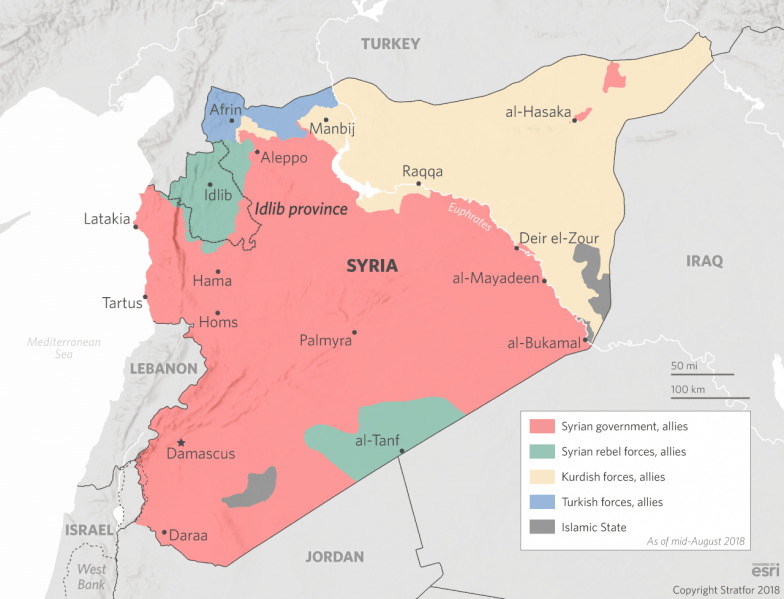
The battle unfolded on Feb. 7, 2018, when the Syrian military and its allies launched an attack to try to retake major oil and gas reserves in Syria’s Deir ez-Zour governorate, which were being occupied by American troopsand their Kurdish proxies.
The Times noted that U.S. special operations forces from JSOC were working with Kurdish forces at an outpost next to Syria’s important Conoco gas plant.The Kurdish-led SDF had seized this facility from ISIS in 2017 with the help of the U.S.military.
The Wall Street Journal noted at the time that the “plant is capable of producing nearly 450 tons of gas a day,” and was one of ISIS’ most important sources of funding.
The commodities monitoring websites MarketWatch and OilPrice.com were closely following the story and analyzing which forces would take over one of Syria’s most important gas plants.
Starving Syriaof Oil & Wheat
For the Syrian government, regaining control over its oil and gas reserves in the eastern part of its territory is crucial to paying for reconstruction efforts and social programs — especially at a time when suffocating U.S. and EU sanctions have crippled the economy, caused fuel shortages, and severely hurt Syria’s civilian population.
The U.S. subsequently forced the Kurdish-led YPG torebrand as the SDF, and then treated them as proxies to try to weaken the Syrian government and its allies Iran and Russia. In June, Reuters confirmed that Kurdish-led authorities had agreed to stop selling wheat to Damascus, after the U.S. pressured them to do so.
The Grayzonehas reported how the Center for a New American Security, a leading Democratic Party foreign policy think tankbankrolled by the U.S. and NATO, proposed using the“wheat weapon” to starve Syria’s civilian population.
Trump appeared to echo this strategy in his Oct. 21 cabinet meeting.
“We want to keep the oil, and we’ll work something out with the Kurds so that they have some [US taxpayer] money, have some cashflow,” he said. “Maybe we’ll have one of our big oil companies to go in and do it properly.”
While Trump has pledged to bring U.S. soldiers home and end
their military occupation of Syrian territory-which is illegal under
international law-it is evident that the broader regime change war continues.
“Ben Norton is a journalist and writer. He is a reporter for The Grayzone, and the producer of the “Moderate Rebels podcast,” which he co-hosts with Max Blumenthal. His website is BenNorton.com, and he tweets at @BenjaminNorton.
Subsequently this week it is being reported that the Pentagon is to deployAbrams tanks and other heavy equipment to the oil fields near Deir Ez-Zor. The troops involved for such a new deployment would far outnumber the 1,000 or so soldiers that President Trump had said were “coming home”.
The oil fields of Syria are located mainly in the eastern provinces bordering with Iraq. Those areas (about a third of the country) are the last-remaining territory still outside of the control of the government in Damascus. TheSyrian state will need to recover its oil fields in order to fund the reconstruction of the nation after nearly eight years of war.
The president was referring to the dubious deal he hatched with Turkey last week
which resulted in the US abandoning its Kurdish allies and unleashing a
deadly offensive by Turk forces against northeast Syria. [NATO approved this “deal” and had high praise for Turkey.]
After incurring much criticism from both Republicans and Democrats, as
well as military experts and media pundits for his withdrawal of US
troops, Trump is understandably trying to put a positive spin on his move.
A NY Times’ reporton Mondaysheds more light on that aspect. Admittedly,
the Times is hardly a reliable source, given its embedded links to US
intelligence agencies and its trenchant anti-Trump agenda warping almost
everything it publishes. Nevertheless, given that Trump and the NY Times appear to be consistent here on the issue suggests that there is indeed substance to the admission.
Trump has agreed tokeep 150 troops at the US base at Al Tanf in southern Syria,where the camp is a training ground for thousands of jihadist militants known as Maghawir al-Thawra. The Maghawir al-Thawra are not fighting ISIS, as the Pentagon claims. They are more accurately just another proxy for US interests, involved in a nefarious division of labor along with ISIS and the Kurds.