George Soros gave Ivanka's husband's business a $250 million credit line in 2015 per WSJ. Soros is also an investor in Jared's business.

Wednesday, May 23, 2012

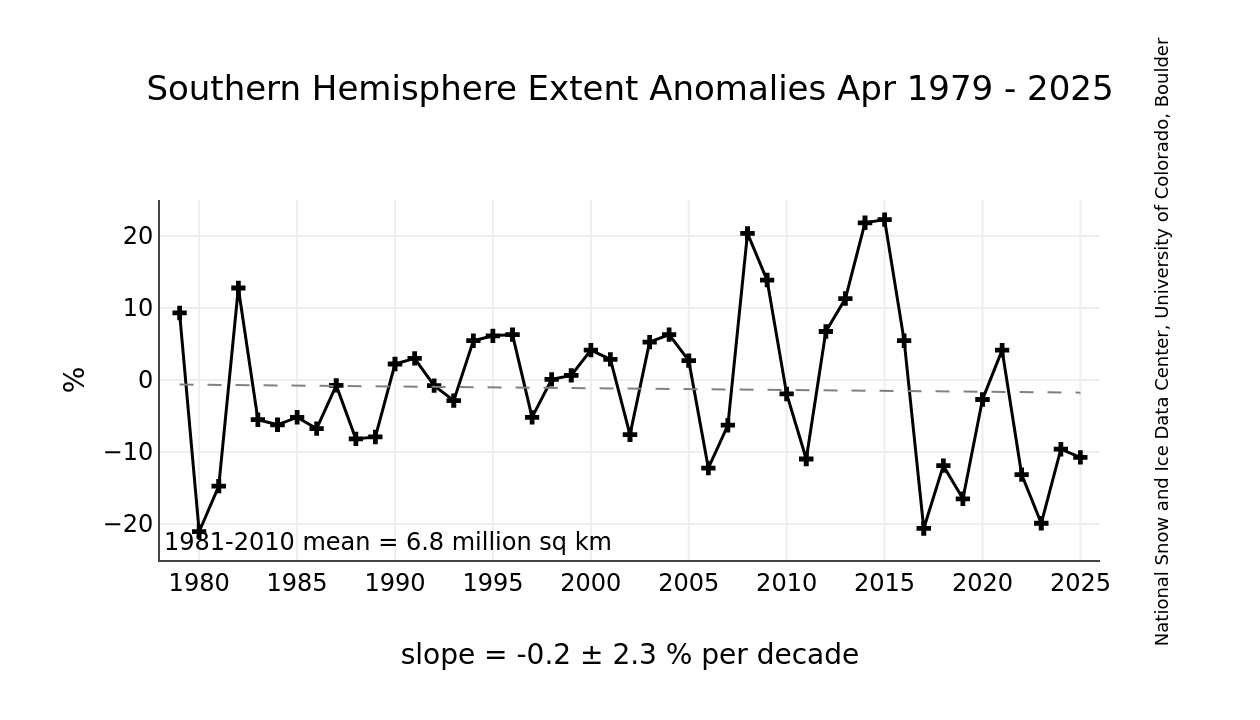
Antarctic Sea Ice continues years long upward trend, May 2012

5/23/12, "Sea Ice Index," NSIDC.org

Following graph upper right of NSIDC web page after Arctic Ice.


NSIDC southern hemisphere sea ice extent, 1979-2012

From web page, they say Arctic ice changes are an index of "climate change." (Below). Do they mean natural climate change or catastrophic man caused climate change? But they don't say that about Antarctic ice. They don't explain why Antarctic Ice does NOT follow "climate change" (whether natural or catastrophic man-caused):

"About the Sea Ice Index"

"These satellite-derived images depict current sea ice conditions and trends. Long-term changes in Arctic sea ice are an index of climate change. Southern Hemisphere sea ice images are also available. For more information about current conditions and their significance, see Arctic Sea Ice News and Analysis.

Sea Ice Index Documentation"

==================================

As of 5/1/12, From NSIDC website:

"Antarctic sea ice spread by strong winds"

"The sea ice cover that surrounds the continent of Antarctica has been higher than average through most of the Southern Hemisphere summer (December to March). Ice extent declined much more slowly than usual in late November and remained above average through December and January, although it did not reach record highs for those months. At its minimum extent in March, Antarctic sea ice remained above average. Ice extent was the highest in the Weddell Sea and the northwestern Ross Sea.

The high ice extent likely stemmed from unusually strong winds that circled the continent of Antarctica during most the southern summer. These circumpolar winds tend to push the ice out from the continent, increasing the extent of the ice, although not necessarily the volume. Air temperatures in December and January were close to average over most of the sea ice-covered water. Researchers approximate the circumpolar wind intensity by an index called the Southern Annular Mode (SAM). A positive value for SAM indicates strong circumpolar winds around the continent; negative values indicate weaker winds. This index was at a record high for the two months of December 2011 and January 2012, at the same period of the higher-than-normal seasonal extents. For more information on Antarctic sea ice, see the NSIDC Icelights article: Sea ice down under: Antarctic sea ice and climate."...

The site adds the following about ice thickness but only mentions Arctic:

"Cryosat provides new ice thickness data"

"The NASA ICESat satellite recorded Arctic sea ice thickness between 2003 and 2008, but the mission ended in 2009, and the follow-on mission is not expected to begin until 2016. In the meantime, NASA is filling some of the data gap with airplane-borne instruments as part of Operation IceBridge.

The European Space Agency (ESA) has released initial data from the radar altimeter on their CryoSat-2 satellite. Last week, ESA released the first calibrated maps of Arctic sea ice thickness capturing thickness changes through the winter from October 2010 through March 2011. In the coming years, CryoSat-2 will provide monthly fields of thickness that will allow scientists to track the evolution of the ice cover. For more information on CryoSat-2 and an animation of the thickness maps, see: http://www.esa.int/SPECIALS/Cryosat/SEMU55NW91H_0.html."


.

Arctic Sea Ice April 2012 highest April in over 10 yrs., near 1979-2012 avg. per NSIDC, good amount of 2 meter+ ice per US Navy Nowcast

NSIDC: April 2012 Arctic Sea Ice close to 1979-2012 avg. Good amount of 2 meter+ thickness per US Navy, see comment #5.

5/15/12, "Global temperature and Arctic ice update," BBC, Paul Hudson

"Significantly, April Arctic sea ice was close to the 1979-2012 average, and the highest in April for over 10 years, shown below.


Experts though reported that much of the ice cover was thin, indeed since the end of April ice extent has fallen sharply."

Source web page, NSIDC.org, Arctic Sea Ice News

--------------------------------------

Note: Mr. Hudson says some say ice cover is thin, but commenter adds actual scientific data:

5. "At 20:28 15th May 2012, Mick wrote:

"There is a good amount of 2 metre plus ice this year according to this US navy site.
http://www7320.nrlssc.navy.mil/hycomARC/navo/arcticictn_nowcast_anim30d.gif

And according to Nansen ice area and extent still pretty much on the longer term average so the claim of ice extent falling sharply seems premature.
http://arctic-roos.org/observations/satellite-data/sea-ice/ice-area-and-extent-in-arctic

Also the sea ice anomaly via the Cryosphere not looking that large either.
http://arctic.atmos.uiuc.edu/cryosphere/IMAGES/seaice.anomaly.arctic.png

Could be an interesting season, although current levels are normally considered a poor predictive guide to the peak summer melt, however, a staff member at NSIDC did predict an ice free or nearly ice free summer this year a few years back. Interesting times. :)"

ARCTIC ICE THICKNESS 'NOWCAST' from US Navy:


==========================

"25. At 10:54 16th May 2012, ukpahonta wrote:

This week, after reviewing his own new data, NASA climate scientist Jay Zwally said: "At this rate, the Arctic Ocean could be nearly ice-free at the end of summer by 2012, much faster than previous predictions."

http://news.nationalgeographic.com/news/2007/12/071212-AP-arctic-melt.html

One wonders why such an organisation would report it unless it was an effort, much like the sensationalism expected within red top tabloids, to increase sales."

.

Mark Morano and Lord Monckton politely greet climate protester in Chicago


Climate skeptics Mark Morano and Lord Monckton (seen in suits and ties) politely greet small group of protesters in Chicago including person with large black hat holding bullhorn with word "vermin" displayed, 5/22/12. (Apparently "Vermin Supreme" is a person). Photo at Tom Nelson of protesters with signs, plus link to a bunch more photos from those gathered to protest Heartland's yearly conference which unlike
  • scold that

1/3/12, "U.S. Taxpayers Cover Nearly Half the Cost of U.N.’s Global Warming Panel," CNS News, E. Harrington


UN IPCC chief Pachauri, getty photo


via Tom Nelson

Tuesday, May 22, 2012

NASA Astronauts note NASA Chief Scientist told US Senate sea levels will rise up to 2 meters but offered no scientific basis for his alarming claim

5/22/12, "NASA Astronauts Announce Second Letter to NASA at Heartland Conference," WUWT, rep49

"At the Heartland Conference in Chicago this morning, four of the forty-nine signers of the March letter to NASA Administrator Charles Bolden (discussed at WUWT here, here, and here) appeared to discuss their reasons for signing that letter and to announce a second letter responding to NASA’s response. The text of that letter is reproduced below:

May 11, 2012

The Honorable Charles Bolden, Jr. NASA Administrator

NASA Headquarters

Washington, D.C. 20546-0001

Dear Charlie:

In our letter of March 28, 2012, we, the undersigned, respectfully requested that NASA and the Goddard Institute for Space Studies (GISS) refrain from including unproven remarks in public releases and websites.

On April 11th, Dr. Waleed Abdalati responded, holding that: “As an agency, NASA does not draw conclusions and issue ‘claims’ about research findings.”

Eight days later, at a (U.S.) senate hearing, Dr. Abdalati, did just that, concluding that Sea-Level rise within the next 87 years projects within a range of 0.2 meters to 2 meters, with lower ranges less likely while “the highest values are based on warmest of the temperature scenarios commonly considered for the remainder of the 21st century.” Abdalati added: “The consequences of a 1 meter rise in sea level by the end of this century would be very significant in terms of human well-being and economics, and potentially global socio-political stability.”

The range and imprecision of this conclusion is astounding!

“Commonly considered?” Is this science by poll? If hard data points to a provable rise, it should be stated with its probability. Can you imagine one of your predecessors, Dr. Thomas Paine, declaring, “Our Apollo 11 Lunar Lander’s target is the Sea of Tranquility, but we may make final descent within a range that includes Crater Clavius”?

We are not trying to stifle discourse, but undisciplined commentary, lacking in precision, is wholly inappropriate when NASA’s name and reputation is attached.

This letter should end the discussion, as a protracted discourse on this topic is not in NASA’s interest, but a commitment from you to equal or exceed the agency’s reputation for careful reliance upon rigorous science and accurate data most certainly is!

Join us, please, in encouraging your colleagues to achieve the level of excellence the world has come to expect from America’s National Aeronautics and Space Administration!

Waiting to do so is not an option!

[signed 41]

PS Waiting to send was not an option either –we have fewer signatures than the first, as not everyone was reachable and only one opted out.

/s/ Jack Barneburg, Jack – JSC, Space Shuttle Structures, Engineering Directorate, 34 years

/s/ Larry Bell – JSC, Mgr. Shuttle Cargo Engineering, Crew Syst. Div. 32 years

/s/ Jerry C. Bostick – JSC, Director of Mission Support, 23 years

/s/ Dr. Phillip K. Chapman – JSC, Scientist – astronaut, 5 years

/s/ Michael F. Collins, JSC, Chief, Flight Design and Dynamics Div., MOD, 41 years

/s/ Dr. Kenneth Cox – JSC, Chief Flight Dynamics Div., Engr. Directorate, 40 years

/s/ Walter Cunningham – JSC, Astronaut, Apollo 7, 8 years

/s/ Dr. Donald M. Curry – JSC, Mgr. Shuttle Leading Edge, Thermal Protection Sys., Engr. Dir., 44 years

/s/ Leroy Day – Hdq. Deputy Director, Space Shuttle Program, 19 years

/s/Charles F. Deiterich – JSC, Mgr., Flight Operations Integration, MOD, 30 years

/s/ Dr. Harold Doiron – JSC, Chairman, Shuttle Pogo Prevention Panel, 16 years

/s/ Grace Germany – JSC, Program Analyst, 35 years

/s/ Richard Gordon – JSC, Astronaut, Gemini Xi, Apollo 12, 9 years

/s/ Gerald D. Griffin – JSC, Apollo Flight Director, and Director of Johnson Space Center, 22 years

/s/ Thomas M. Grubbs – JSC, Chief, Aircraft Maintenance and Engineering Branch, 31 years

/s/ David W. Heath – JSC, Reentry Specialist, MOD, 30 years

/s/ Miguel A. Hernandez, Jr. PE – JSC, Flight crew training and operations, 14 years

/s/ Enoch Jones – JSC, Mgr. SE&I, Shuttle Program Office, 26 years

/s/ Dr. Joseph Kerwin – JSC, Astronaut, Skylab 2, Director of Space and Life Sciences, 22 years

/s/ Jack Knight – JSC, Chief, Advanced Operations and Development Div., MOD, 40 years

/s/ Dr. Christopher C. Kraft – JSC, Apollo Flight Director and Director of Johnson Space Center, 24 years

/s/ Paul C. Kramer – JSC, Ass’t. for Planning Aeroscience and Flight Mechanics Div., Egr. Dir., 34 years

/s/ Dr. Lubert Leger – JSC, Ass’t. Chief Materials Div., Engr. Directorate, 30 years

/s/ Dr. Humbolt C. Mandell – JSC, Mgr. Shuttle Program Control and Advance Programs, 40 years

/s/ Donald K. McCutchen – JSC, Project Engineer – Space Shuttle and ISS Program Offices, 33 years

/s/ Richard McFarland – ARC, Mgr. Tech development VMS & Motion Simulators, 28 years

/s/ Thomas L. (Tom) Moser – Hdq. Dep. Assoc. Admin. & Director, Space Station Program, 28 years

/s/ Dr. George Mueller – Hdq., Assoc. Adm., Office of Space Flight, 6 years

/s/ James Peacock – JSC, Apollo and Shuttle Program Office, 21 years

/s/ Alex Pope – JSC, Aerospace Engineer, Engr. Directorate, 44 years

/s/ Joseph E. Rogers – JSC, Chief, Structures and Dynamics Branch, Engr. Directorate, 40 years

/s/ Bernard J. Rosenbaum – JSC, Chief Engineer, Propulsion and Power Div., Engr. Dir., 48 years

/s/ James R. Roundtree – JSC, Sim. Dev. Branch Chief, Systems Dev. Div., Mission Support Dir., 26 years

/s/ Dr. Harrison (Jack) Schmitt – JSC, Astronaut Apollo 17, 10 years

/s/ Kenneth Suit – JSC, Ass’t Mgr., Systems Integration, Space Shuttle, 37 years

/s/ Robert F. Thompson – JSC, Program Manager, Space Shuttle, 44 years

/s/ Frank Van Renesselaer – Hdq.– Dir. Expendable Equipment (Ext. Tank, Solid Boosters, & Shuttle Upper Stages), 20 years

/s/ James Visentine – JSC Materials Branch, Engr. Directorate, 30 years

/s/ Manfred (Dutch) von Ehrenfried – JSC, Flight Controller; Mercury, Gemini & Apollo, MOD, 10 years

/s/ Al Worden – JSC, Astronaut, Apollo 15, 9 years

/s/ Thomas (Tom) Wysmuller – ARC, GSFC, Hdq. - Meteorologist, 5 years"

==================================

Following is Obama NASA Chief Scientist's letter to which NASA alumni above were responding. In it he claimed NASA does not draw conclusions or issue 'claims' about research findings.

4/11/12, "Response from NASA Chief Scientist Waleed Abdalati to Letter on NASA Climate Studies," SpaceRef.com

""NASA sponsors research into many areas of cutting-edge scientific inquiry, including the relationship between carbon dioxide and climate. As an agency, NASA does not draw conclusions and issue 'claims' about research findings. We support open scientific inquiry and discussion.

"Our Earth science programs provide many unique space-based observations and research capabilities to the scientific community to inform investigations into climate change, and many NASA scientists are actively involved in these investigations, bringing their expertise to bear on the interpretation of this information. We encourage our scientists to subject these results and interpretations to scrutiny by the scientific community through the peer-review process. After these studies have met the appropriate standards of scientific peer-review, we strongly encourage scientists to communicate these results to the public.
"If the authors of this letter disagree with specific scientific conclusions made public by NASA scientists, we encourage them to join the debate in the scientific literature or public forums rather than restrict any discourse.""


via Heartland conference

G8 new front in climate has nothing to do with CO2, focus now on black carbon, long ignored by scientists and green groups-G. Lean

5/21/12, "G8: Leaders open up vital new front in the battle to control global warming," UK Telegraph, Geoffrey Lean

"It seems to have gone virtually unnoticed, but the world leaders at the weekend's G8 summit look as if they have taken the biggest step in years in tackling climate change. And it's quite apart from anything to do with carbon dioxide.

The summit's final communiqué, the Camp David Declaration, supports “comprehensive actions” to reduce “short-lived climate pollutants”. These substances – including black carbon (soot), methane, ground-level ozone, and hydrofluorocarbons – are responsible for about half of global warming. Straightforward measures to address them, a report by the United Nations Environment Programme concluded last year, would delay dangerous climate change by more than three decades, buying crucial time for the much more difficult process of slashing carbon dioxide emissions.

More important still, the measures would save some 2.4 million lives a year, mainly by cutting the inhalation of soot, chiefly emitted by vehicle diesel engines and by the inefficient wood and dung burning cookstoves used by most of the world's poorest people – and increase grain harvests, at present hit by pollution, by 52 million tons a year.

While the international climate negotiations drag on, these pollutants can be reduced through existing national laws and regulations, using technologies that are already available. And many climate sceptics agree on the importance of doing so: Senator James Inhofe, who pioneered Republican rejection of action to curb carbon dioxide, supports it on black carbon, while Canada – which caused controversy this winter by quitting the Kyoto Protocol – has been in the forefront of countries urging an assault on such the short-lived agents of climate change.

The G8's endorsement of action at the weekend is a triumph for the small Institute for Governance and Sustainable Development (IGSD), which has been campaigning for action on the pollutants while most climate scientists and green pressure groups have ignored them. In just a few short years it has brought the issue from invisibility to the agendas of the world's most powerful leaders. In February six governments – including the US, Canada and Mexico – launched a five year programme to tackle them, and the rest of the G8 has now signed up to it. And it commissioned the World Bank to produce a report on how it can integrate ways of reducing them into its activities.

The leaders also reaffirmed their commitments to limiting the increase in the world's temperature to less than two degrees centigrade over pre-industrial levels and phasing out subsidies for fossil fuels – and welcomed December's Durban climate summit as “a significant breakthrough” towards reaching international agreements on cutting carbon dioxide by 2015.

It will remain important to continue this international effort. But as Durwood Zaelke, the IGSD president puts it “the solution-orientated approach” of the programme to address the short-lived pollutants can “show the world it is possible to start meeting the climate challenge.”" via Tom Nelson

===========================

Much damaging soot comes from activity in Communist China and Southeast Asia:

Between 1980 and 1995, "BC (black carbon) emissions from developed countries have declined and aircraft are apparently not to blame. However, during this time BC emissions from China and India have nearly doubled."

2/25/2005, "Distant origins of Arctic black carbon: A Goddard Institute for Space Studies ModelE experiment," Dorothy Koch and James Hansen, NASA Goddard Institute for Space Studies, Journal of Geophysical Research

p.1 "Black carbon (BC) particles, derived from incomplete combustion of fossil fuels and biomass, may have a severe impact on the sensitive Arctic climate, possibly altering the temperature profile, cloud temperature and amount, the seasonal cycle, and the tropopause level and accelerating polar ice melting. We use the Goddard Institute for Space Studies general circulation model to investigate the origins of Arctic BC by isolating various source regions and types. The model suggests that the predominant sources of Arctic soot today are from south Asia (industrial and biofuel emissions) and from biomass burning.

These are the primary global sources of BC
(approximately 20% and 55%, respectively, of the global emissions), and BC aerosols in these regions are readily lofted to high altitudes where they may be transported poleward. According to the model the Arctic BC optical thickness is mostly from south Asia (30%) and from biomass (28%) (with slightly more than half of biomass coming from north of 40 N)."...

========================

Southeast Asia reference:

5/18/12, "CO2 Not to Blame for Southwest Droughts?" World Climate Report

"According to Allen et al.:

“Our analysis strongly suggests that recent Northern Hemisphere tropical expansion is driven mainly by black carbon and tropospheric ozone, with greenhouse gases playing a smaller part.”...

The authors argue that there is a good likelihood that black carbon emissions have been underestimated—especially those arising from Southeast Asia....

The bottom line is that the primary influences on a major component of the earth’s atmospheric circulation and thus general weather patterns turns out to be, on further examination, not atmospheric greenhouse gas concentration changes, but rather black carbon (soot) and tropospheric ozone. And one impact from the forced atmospheric circulation changes is a tendency for more aridity across the Southwestern U.S.

So, the EPA can try all they want to reduce U.S. greenhouse gas emissions
, but no matter how successful they are, they will have little impact, if any, on the future of drought in the Southwestern U.S., as drought there is a complex interaction between natural variability and human climate alterations—of which, as shown by Allen et al., greenhouse gases play only a minor role.

So much for the “robust” signal that human greenhouse gases will lead to more drought in the Southwest."...


.

Sunday, May 20, 2012

Graphs show how James Hansen of NASA GISS altered scientific climate records to make the world today look warmer than the 1930's

May 13, 2012, "Hansen – The Climate Chiropractor," Steven Goddard

"Need your climate adjusted? – call Dr. James Hansen at GISS. Below is a chronology of the destruction and politicization of the US and global temperature record.

The Northern Hemisphere used to have a broken hockey stick problem. According to the National Academy Of Sciences in 1975, the hemisphere had cooled 0.7C since the 1930s, and was colder than it was at the turn of century.

www.sciencenews.org/view/download/id/37739/name/CHILLING_POSSIBILITIES

[Scientists in 1975 feared cooling]

Dr. Hansen realized he had a problem when he took over – that data didn’t look anything like a hockey stick. So he fixed it! You can do such cool stuff when you are pushing an agenda, and you control the historical record."...(Graphs at link show that Hansen erased warming of 1930's to make more recent temperatures look 'alarmingly' warm. Newspaper clippings from the 1930's describe heat waves at the time).

(continuing): "Phil Jones and NOAA had clearly stated that there was no warming in the US.

"February 04, 1989

Last week, scientists from the United States Commerce Department’s National Oceanic and Atmospheric Administration said that a study of temperature readings for the contiguous 48 states over the last century showed there had been no significant change in average temperature over that period.

Dr. (Phil) Jones said in a telephone interview today that his own results for the 48 states agreed with those findings."

"Global Warmth In ’88 Is Found To Set a Record – New York Times"

In 1999, Hansen himself said that he didn’t see much happening in the US.

"Empirical evidence does not lend much support to the notion that climate is headed precipitately toward more extreme heat and drought. The drought of 1999 covered a smaller area than the 1988 drought, when the Mississippi almost dried up. And 1988 was a temporary inconvenience as compared with repeated droughts during the 1930s “Dust Bowl” that caused an exodus from the prairies, as chronicled in Steinbeck’s Grapes of Wrath…..

in the U.S. there has been little temperature change in the past 50 years, the time of rapidly increasing greenhouse gases in fact, there was a slight cooling throughout much of the country."

NASA GISS: Science Briefs: Whither U.S. Climate?

Undaunted by reality, all the evidence, and millions of temperature records – in the year 2000 Dr. Hansen and Tom Karl at NOAA adjusted the US temperature record to make it look like Hansen’s already adjusted global temperature record....

Below [link 8th graph on page] is an animation of their handiwork. 1934 was no longer the hottest year, and the 1930s was no longer the hottest decade. Hansen essentially erased the Dust Bowl.

Conclusion. US and global surface temperature records are so corrupted as to be meaningless.

Below [link] are clippings of news stories from the 1930s. July of 1936 was the hottest month in US history. The summer of 1934 was the worst drought in US history. Half of the lower 48 states set their all-time temperature record during the 1930s. The most powerful hurricane to ever hit the US happened in 1935."...

==============================

Commenter to Steven Goddard post:

"geologyjim says:

The real crime here is the silence from so many others in the “climate science community

The absence of integrity is epidemic."


via Climate Depot, via John O'Sullivan

Followers

Blog Archive

About Me

My photo
I'm the daughter of an Eagle Scout and World War II Air Force pilot born in Brooklyn, finally settling in New Jersey.